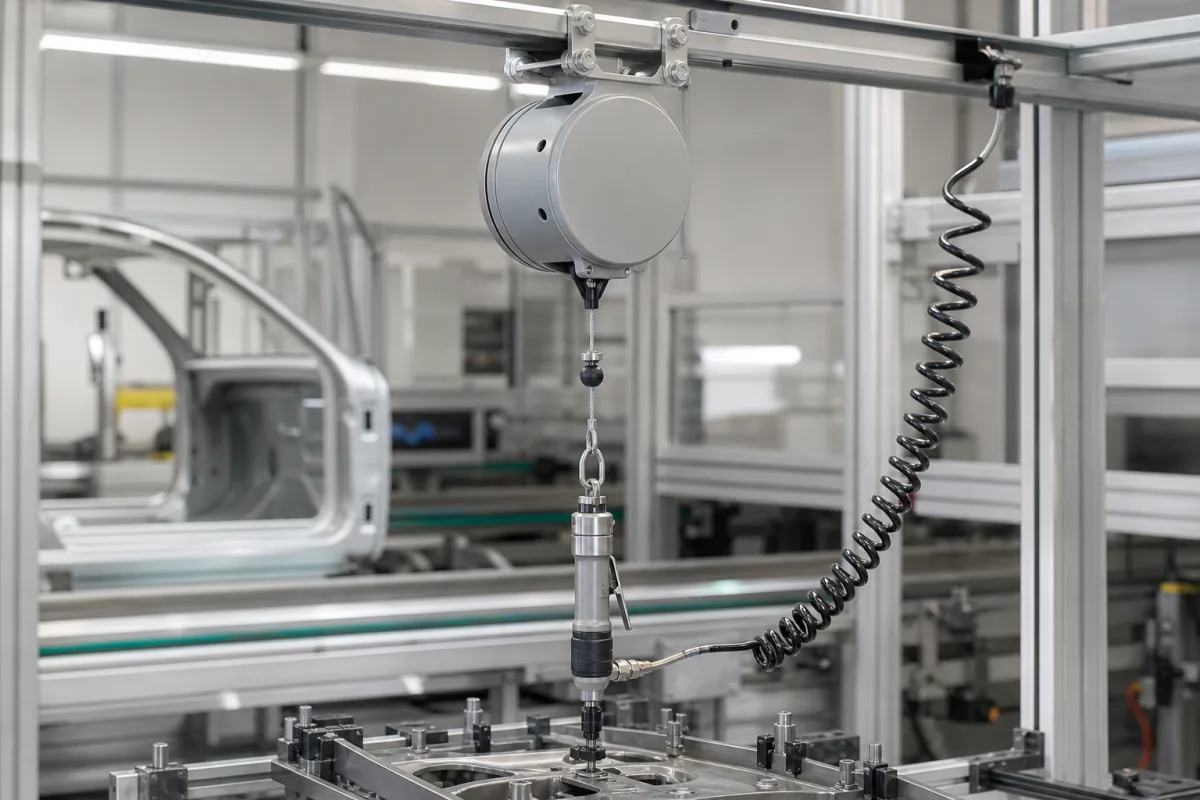
A spring tool balancer hangs above a workstation and carries the weight of a hand tool on a cable wound on a spring-loaded drum, so the operator moves the tool without holding its weight, as with the air tool pictured hanging from a balancer on a trolley rail. Ask three things first: the total load the balancer must carry, the capacity range and stroke of the model offered, and how it is suspended and secured if the main hook fails.
Spring-drum tool balancers that suspend hand tools at assembly stations, including models whose hose carries compressed air to the tool. Air (pneumatic) balancers, hoists, and cable or hose reels used only to store supply lines are outside this page.
CNFX editorial research · Sources checked October 12, 2026 · 4 sources
Ingersoll Rand's BHR manual says to assess the total load to be balanced, meaning the tool, its accessories and the sections of hose or cable lifted by the balancer, and that this load must fall within the balancer's minimum and maximum capacity. Its intended use is to eliminate the constant weight of a tool during vertical movement, used manually by one operator at a time. [1] ENDO's manuals ask users to confirm that the suspended load is within the capacity range, including when the rope is pulled sideways. [2]
Published ranges show how narrow each model is: Ingersoll Rand lists BHR8 at 0.4–0.8 kg, BHR15 at 0.75–1.5 kg and BHR25 at 1.2–2.5 kg, each with a 1350 mm stroke. [1] ENDO lists BS3W at 1.5–3.0 kg, BS5W at 3.0–5.0 kg and BS7W at 5.0–7.0 kg with a 1.3 m stroke. [2] Finer's SW series runs from 1.0–3.0 kg to 180–200 kg, with strokes from 1.9 m on the smallest sizes down to 1.5 m on the larger ones. [4]
ENDO's support site explains why staying inside the range matters, using its gauge-equipped EWF-22 as the example: setting the tension below the minimum set load activates the safety device so the wire rope cannot be pulled out, and raising it beyond the maximum winds the spring tight with the same result. [3]
Give the supplier the tool model and weight, the weight of attachments and of the hose or cable section the balancer lifts, the stroke needed from the working height, the mounting point (fixed or trolley) and the ambient temperature.
02
Install it on a strong support with a separate safety suspension
The Ingersoll Rand manual requires the support structure's mechanical resistance to exceed 5 × (balancer weight + maximum load), and the safety suspension to be attached to a support other than the main one, so that the maximum fall if the main suspension breaks is no more than 100 mm. The load must be applied vertically and the balancer must be free to move in its suspension; it may be hung from a roller guide to cover a wider work area. [1] ENDO likewise says an auxiliary chain or wire on the balancer's auxiliary hanger should stop it falling if the upper hook fails, with some leeway so the balancer can move. [3]
Editorial calculation: for a BHR25, the manual's figures of 1.35 kg balancer mass and 2.5 kg maximum load give 5 × 3.85 kg = 19.25 kg, so the support must resist more than about 19.3 kg (about 189 N). [1]
To adjust, ENDO says turning the adjuster clockwise increases spring tension on all its balancers, and the final setting is made while checking the balance point of the actual load; letting go of the hook before the load is attached makes it retract quickly. [3] Ingersoll Rand asks users to check after adjustment that the full stroke runs freely, to end the working travel at least 100 mm before the lower limit, and not to readjust a balancer that has started to lose holding force, because that may mean the drum spring is about to break. [1]
03
Inspect it and respect the spring
Ingersoll Rand calls for a visual check on a regular basis (for example once each work shift) of the suspensions, fixings, hooks and cable, refers to ISO 4309:2011 for cable rejection criteria, and requires inspection at least once a year by skilled, authorized personnel. Its sample tests per production lot hold 1.25 times the maximum capacity at full stroke for 10 minutes (static) and run 1.1 times the maximum load for 1 hour (dynamic). [1]
ENDO asks for inspection at least once a month and says to shorten that interval for high-rate operation or hostile environments, checking the rope for broken wires, kinks and wear. Its manual warns that the spring can expand explosively if handled roughly or pulled from the centre, and that it stays dangerous even when broken. [2] Temperature limits differ by maker: ENDO states −10 °C to +50 °C indoors; Ingersoll Rand states 5 °C to 60 °C indoors. [2][1]
04
Finer's SW range, and the questions to put to any balancer seller
Finer's SW series spans 1.0–3.0 kg up to 180–200 kg and is listed beside air casters and machine skates. [4]
Ask any supplier for the capacity range and stroke of each model, the safety devices fitted (fall arrest, rope lock), the suspension and safety-chain points, rope type, body material and mass, and the inspection and spare-parts arrangements.
05
Drum spring, rope, adjuster and the two suspension points
The safety suspension point is the row both manuals insist on: it catches the body if the main hook or fixing fails. [1][3]
Explore company information and manufacturing capabilities, then discuss the scope of your project with a relevant supplier.
Share this page
Compiled and source-reviewed by the CNFX editorial team.
Each manufacturer above links to the page on that company's own website where the product is listed, with the date we checked it. How we source and review
· Page last updated 13 October 2026
Buyer questions
What weight should I use to choose a tool balancer?
Ingersoll Rand says to use the total load: the tool, its accessories and the hose or cable sections the balancer lifts, which must fall within the balancer's minimum and maximum capacity. [1]
Does a tool balancer need a safety chain?
Ingersoll Rand requires a safety suspension on a separate support limiting any fall to 100 mm; ENDO says an auxiliary chain or wire should be attached to stop the balancer falling if the upper hook fails. [1][3]
How often should a spring balancer be inspected?
ENDO says at least once a month; Ingersoll Rand calls for a regular visual check, for example each shift, plus at least a yearly inspection by skilled personnel. [2][1]
Sources and what still needs a direct check
Sources checked 2026-10-12. ENDO and Ingersoll Rand make tool balancers and publish instruction manuals; Finer is the supplier linked to this page.