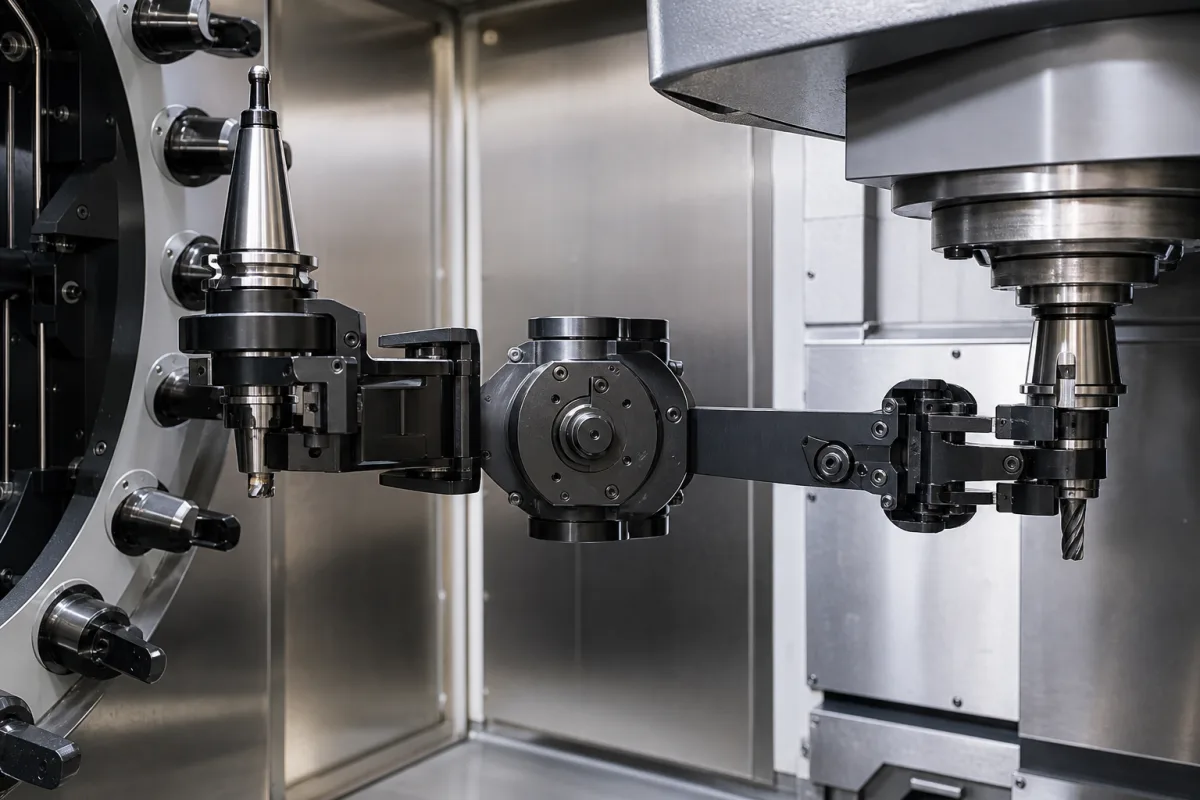
Tool change arm (double-gripper ATC arm and its cam box): arm travel, arm radius, tool mass per gripper and the locks that hold tools through the 180° swap
The double-ended exchange arm between magazine and spindle · cam-box stroke and radius, tool mass per gripper, how the grippers keep a tool through a 180° swap, and the change times machines quote
On a machining centre with a double-arm changer, the magazine only brings the next tool to a change position; the arm does the exchange. One gripper takes the tool in the spindle, the other takes the new tool from the magazine pot, the arm pulls both out, turns 180° and pushes them home. That makes the arm a separate purchase with its own figures: how far it strokes, how long it is, how heavy a tool each end may carry, how fast its cam box completes the cycle, and how the grippers stop a tool leaving the arm halfway through the swing.
Double-ended tool change arms for automatic tool changers on machining centres, with the cam box (ATC drive unit) that strokes and swings them, their grippers, clamping members and locking pins, and their tool mass and cycle-time ratings. Tool magazines as a whole (drum, disc and chain) are covered on the CNC tool magazine page; the rotating drum and its pockets on the Magazine carousel/drum page; cam indexers that step the magazine on the Indexing mechanism page; the reliability, failure shares and test methods of complete tool changers on the Automatic tool changer (ATC) reliability and testing page. Robot tool changers and lathe turrets are outside this page.
CNFX editorial research · Sources checked October 13, 2026 · 4 sources
Cam-box ratings: 115 mm stroke, 250 mm radius and 8 kg per gripper for #40 taper against 165 mm, 300 mm and 15 kg for #50
Gizin, a Taiwanese maker of ATC cam boxes, publishes the arm figures for each unit. The arm travel is the axial stroke that pulls the tools out of the spindle and pot; the arm length is the radius from the swing axis to each gripper; the swivel angle is the turn that brings the grippers onto the two tools before the 180° exchange. [1]
All units listed are oil-bath lubricated with PNP sensors (three on the 250 mm and 300 mm units, one on the AK01). [1] Each cycle time is given for the cam box's own motion, at 50 Hz or 60 Hz supply.
Editorial calculation: treating two maximum tools as point masses at the gripper radius and ignoring the arm itself, the swinging inertia of a #40 arm is 2 × 8 kg × (0.25 m)² = 1.0 kg·m², and of a #50 arm 2 × 15 kg × (0.30 m)² = 2.7 kg·m², about 2.7 times as much, which the #50 box turns with a 1.1 kW motor against 0.6 kW and in 2.1–2.5 s against 1.14–2.5 s. [1] A short-radius arm such as the 140–180 mm AK01 reaches a 0.56 s cycle with the same 8 kg × 2 rating.
Gizin cam box
Arm travel
Arm length (radius)
Max tool weight
Cycle time
Swivel angle
Motor, net weight
AA01, #40 taper, vertical
115 mm
250 mm
8 kg × 2
1.3–2.5 s (50 Hz), 1.14–2 s (60 Hz)
30°–120°
0.6 kW, 95 kg
AB01 / AD01, #40 taper, vertical
115 mm
250 mm
8 kg × 2
1.3–2.5 s (50 Hz), 1.14–2 s (60 Hz)
60°–90°
0.6 kW, 95 kg
AC01, #40 taper, horizontal
115 mm
250 mm
8 kg × 2
1.3–2.5 s (50 Hz), 1.14–2 s (60 Hz)
60°–90°
0.6 kW, 95 kg
AK01, #40 taper, vertical
95 mm
140–180 mm
8 kg × 2
0.56 s
60°–90°
0.75 kW, 60 kg
BA01, #50 taper, vertical
165 mm
300 mm
15 kg × 2
2.5 s (50 Hz), 2.1 s (60 Hz)
60°–90°
1.1 kW, 145 kg
Give the taper (#40 or #50, BT, CAT, DIN or HSK), the spindle-to-pot distance the arm must span, the heaviest and longest tools, the stroke needed to clear the taper, the supply frequency and the cycle time required.
02
Keeping both tools in the grippers through the swap: a spring clamping member, a tool-locking pin and an arm-locking pin
A Brother Industries patent (US 6,007,464) describes the full arm sequence driven from one ATC shaft: the arm grips the used tool in the spindle and the new tool in the magazine, moves down, swings 180° to exchange their positions and moves up to insert them; one rotation of the ATC driving shaft turns the arm 180°. In the magazine described, only the holding pot at the change position tips 90° down so its tool hangs vertically for the arm. [2]
Each gripping portion has a clamping member pushed out by a spring. When the arm swings onto a tool the clamping member is pressed back, and once the tool has passed its tip it springs out and presses the tool into the gripper. [2]
Two pins in the arm add the locking. When the arm moves down, springs push a tool-locking pin and an arm-locking pin upward: the tapered face of the tool-locking pin blocks the clamping roller shaft so the clamp cannot slide back, and the tapered face of the arm-locking pin seats in a groove on the arm's central shaft so the arm body turns only together with the swinging shaft. [2] Both locks release before the tool's taper is fully seated in the spindle, so the arm body can follow the tool as it is drawn along the spindle taper rather than forcing it. [2]
Editorial note: these are the parts that wear on a used arm (clamp springs, rollers, pins and their tapered faces), and the reason the patent gives for the locks is that the tool must stay held while the arm swings and moves. [2]
Ask how each gripper retains the tool (spring clamp, plunger, key engagement), how the arm is locked to its drive shaft during the swing, and which parts are supplied as a gripper repair kit.
03
What the arm delivers on the machine: 1.5 s and 1.9 s tool-to-tool, and tool limits from 4.0 kg to 15 lb
Machine builders quote the arm's work as tool-to-tool time and as the largest tool the changer accepts. Two published BT40 / 40-taper examples:
Fadal describes its arm as using synchronous swing motion to pick up the new and old tools simultaneously, with an enclosed tool carriage to keep chips and coolant from causing runout. [4] Editorial calculation: 15 lb is 6.8 kg and 3 in × 15 in is 76 × 381 mm, inside Gizin's 8 kg per gripper rating for #40 cam boxes; the Mectron's 4.0 kg is half of that rating. [4][3][1]
The image above shows the arrangement: a horizontal double-ended arm with its hub between a tool magazine on the left and the spindle on the right, a taper tool holder in each gripper.
Quote tool-to-tool and chip-to-chip times separately, and give the maximum tool weight, diameter (with and without empty neighbouring pockets) and length the arm must carry.
04
Arm and cam-box data to send
Paste it into your enquiry below or into an email to a maker, then replace every bracket.
Taper: [#40 or #50; BT, CAT, DIN, HSK]
Geometry: [spindle-to-pot distance; arm radius; stroke]
Tools: [max weight; max diameter; max length]
Cycle: [tool-to-tool time; supply 50 or 60 Hz]
Mounting: [vertical or horizontal machine; cam box orientation]
Grippers: [clamp type; locking; spare kit]
Signals: [sensor count and type]
Explore company information and manufacturing capabilities, then discuss the scope of your project with a relevant supplier.
Share this page
Compiled and source-reviewed by the CNFX editorial team.
Each manufacturer above links to the page on that company's own website where the product is listed, with the date we checked it. How we source and review
· Page last updated 13 October 2026
Buyer questions
How heavy a tool can a #40 tool change arm carry?
Gizin rates its #40 taper cam boxes at 8 kg per gripper (8 kg × 2) with a 250 mm or 140–180 mm arm radius, and its #50 box at 15 kg × 2 with a 300 mm radius. [1]
How does a tool change arm stop tools falling out during the swing?
In Brother's US 6,007,464 design a spring-loaded clamping member holds each tool, and a tool-locking pin and an arm-locking pin engage when the arm moves down so neither the clamp nor the arm body can shift during the 180° swing. [2]
How fast is a double-arm tool change?
Published examples include 1.5 s tool-to-tool (3.0 s chip-to-chip) on a BT40 Mectron MTV-T471 and 1.9 s on Fadal's 40-taper Dual Arm ATC. [3][4]
Sources and what still needs a direct check
Sources checked 2026-10-13. Four sources from four publishers: Gizin's cam-box catalogue for arm travel, radius, tool mass and cycle time; Brother Industries' US patent 6,007,464 for the gripping and locking mechanism; Yuasa International's Mectron MTV-T471 specification and Machine Design's 2001 note on Fadal's Dual Arm ATC for machine-level change times and tool limits.