Automatic Tool Changer (ATC)
View system integration details
This page explains how Tool Exchange Arm is classified within Machinery and Equipment Manufacturing. Technical values and manufacturer relationships are research references; confirm the current specification and supplier evidence for each order.
Mechanical arm component of an Automatic Tool Changer (ATC) responsible for physically transferring tools between the machine spindle and tool magazine.
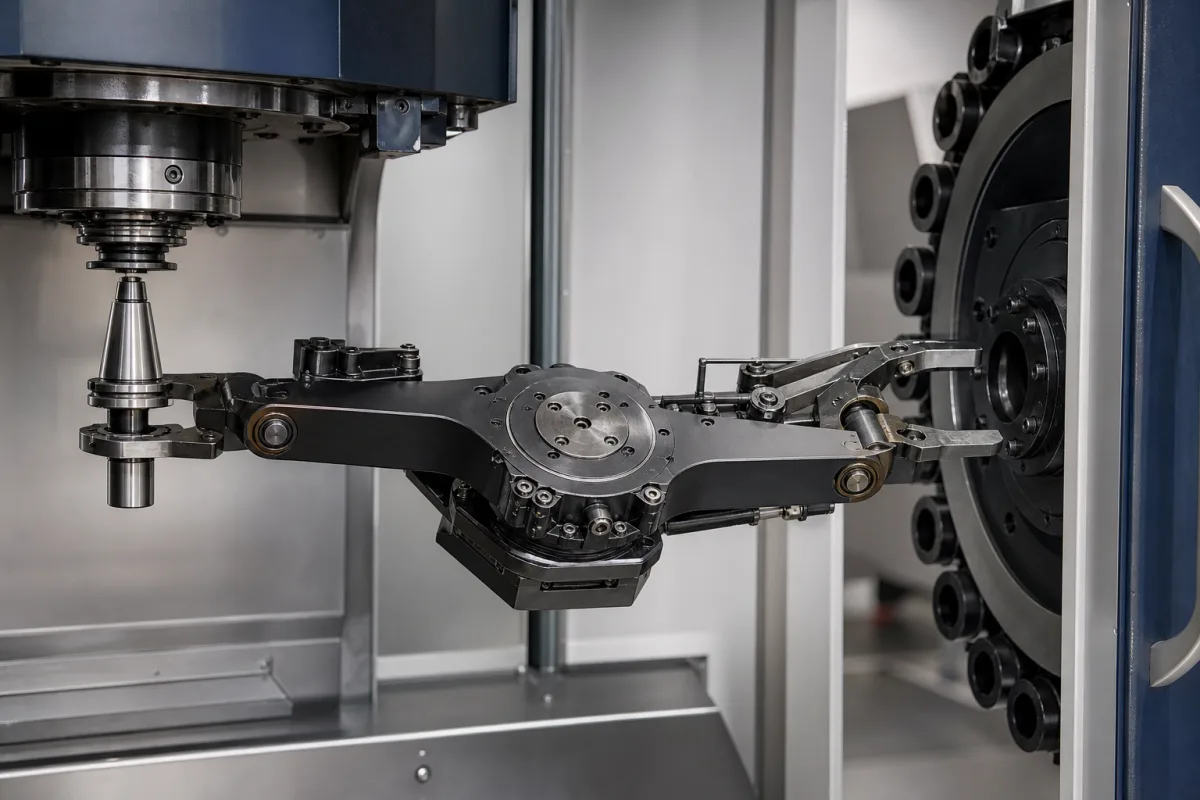
Technical details and manufacturing context for Tool Exchange Arm
| Parameter | Typical range | Notes & selection driver |
|---|---|---|
| Rated Load Capacity | 8–20 kg | Maximum tool weight the arm can handle reliably |
| Tool Taper Size | BT40–BT50 | Compatible with standard machine tapersISO 7388 |
| Swing Radius | 150–300 mm | Determines clearance needed in the work envelope |
| Rotation Speed | 30–60 rpm | Higher speeds reduce tool change time |
| Positioning Repeatability | ±0.02 mm | Ensures consistent tool alignmentISO 230-2 |
| Operating Pressure | 0.5–0.8 MPa | Below 0.5 MPa the arm may not grip securely |
| Supply Voltage | 24 ±10% V DC | For solenoid valves and sensors |
| Operating Temperature | 0–60 °C | Outside this range, seals may fail |
| Ingress Protection | IP54–IP65 | Protects against dust and water jetsIEC 60529 |
| Material Grade | 40Cr–42CrMo | High-strength alloy steel for durabilityGB/T 3077 |
| Weight | 25–60 kg | Affects inertia and mounting requirements |
Ranges are indicative industry figures for RFQ preparation, not a supplier commitment. Confirm every value and standard with the legal manufacturer before ordering.
| pressure: | 0 to 10 bar |
| other spec: | Tool weight capacity: 0.5 to 25 kg, Positioning accuracy: ±0.01 mm, Cycle time: 2 to 10 seconds |
| temperature: | -10°C to 80°C |
Indicative industry ranges for design and RFQ preparation. Confirm the exact figures and applicable standard with the manufacturer before specifying.
Quoted from the published standard.
A practical evidence checklist for RFQ preparation and supplier evaluation.
Compare the published product scope and source details, then include your specifications and quantity in an enquiry.
Manufacturer profiles associated with Tool Exchange Arm.
Explore company information and manufacturing capabilities, then discuss the scope of your project with a relevant supplier.
Ask for use case, specification boundaries, supplier type, and RFQ preparation information for this product.
The rated load capacity is listed as 8–20 kg, indicating the maximum tool weight the arm can handle reliably. This is a reference range; confirm the exact capacity for your specific model with the manufacturer.
The arm is compatible with standard machine tapers such as BT40–BT50, per ISO 7388. Ensure your spindle and tool holders match the taper size of the arm.
The operating pressure should be 0.5–0.8 MPa. Below 0.5 MPa, the arm may not grip securely. Verify the pressure range for your specific model.
The positioning repeatability is ±0.02 mm per ISO 230-2, ensuring consistent tool alignment. This is a reference value; confirm with the manufacturer for your application.
This component is essential for the following industrial systems and equipment:
Editorial classification, named public sources where available, and source-reviewed manufacturer records.
Compare manufacturer profiles with relevant product and process capability.