Industry-Verified Manufacturing Data (2026)

Tool Post

Based on aggregated insights from multiple verified factory profiles within the CNFX directory, the standard Tool Post used in the Machinery and Equipment Manufacturing sector typically supports operational capacities ranging from standard industrial configurations to heavy-duty production requirements.

Technical Definition & Core Assembly

A canonical Tool Post is characterized by the integration of Clamping Mechanism and Base Plate. In industrial production environments, manufacturers listed on CNFX commonly emphasize Cast Iron construction to support stable, high-cycle operation across diverse manufacturing scenarios.

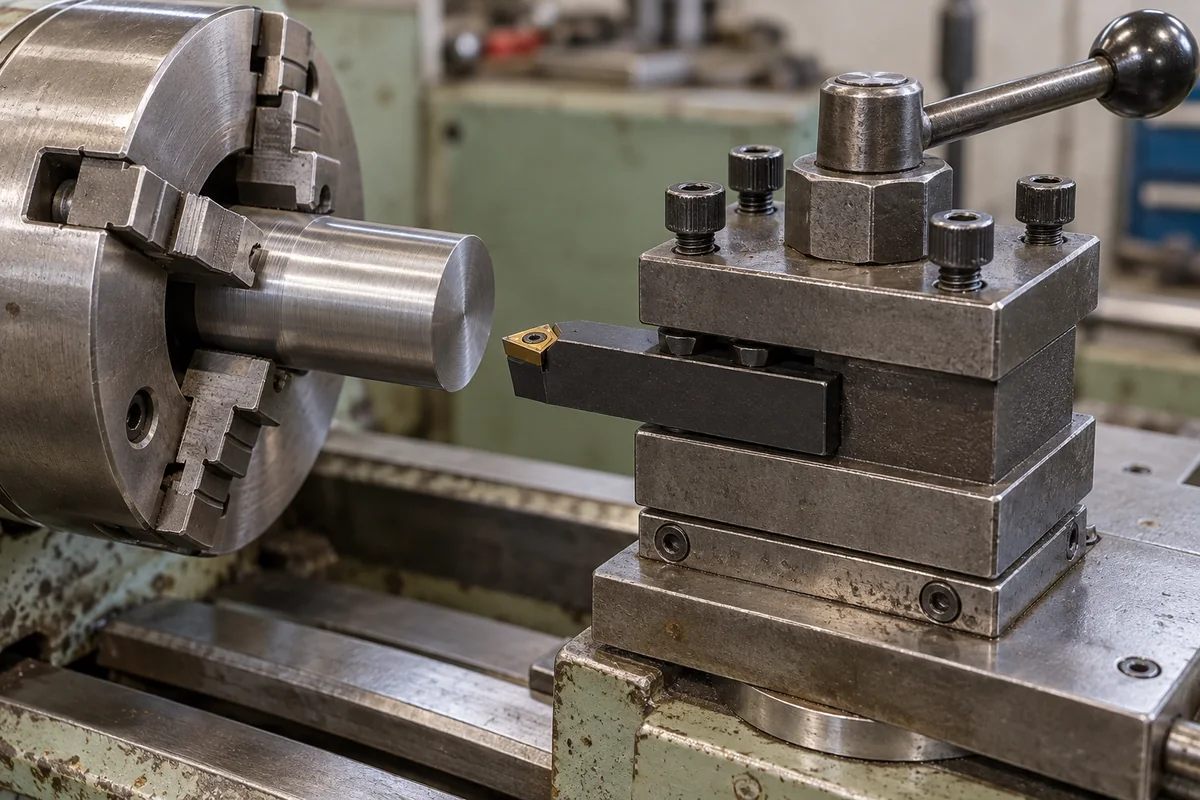
A component of a lathe carriage that holds and positions cutting tools for machining operations.
Product Specifications

Technical details and manufacturing context for Tool Post

Definition
The tool post is a critical component mounted on the carriage of a lathe or similar machine tool. It securely clamps cutting tools in precise positions and orientations, allowing for accurate machining operations such as turning, facing, and threading. It enables quick tool changes and adjustments to accommodate different machining requirements.
Working Principle
The tool post is mechanically fastened to the carriage. Cutting tools are inserted into tool holders or directly into the post's clamping mechanism. Through manual or powered adjustment mechanisms (like compound slides or turrets), the tool post positions the cutting edge at the correct height, angle, and distance relative to the workpiece to perform the intended cutting operation as the carriage moves along the bed.
Common Materials
Cast Iron, Steel
Technical Parameters
  • Tool post height and base dimensions for compatibility with specific lathe carriage models. (mm) Customizable
Components / BOM
  • Clamping Mechanism
    Secures the cutting tool in place using bolts, wedges, or quick-release levers.
    Material: Steel
  • Base Plate
    Provides the mounting interface to the lathe carriage, often with T-slots or bolt holes.
    Material: Cast Iron
Engineering Reasoning
0.5-3.0 kN clamping force, 0.01-0.05 mm positioning accuracy, -20°C to 150°C operating temperature
Clamping force < 0.3 kN causes tool slippage, positioning error > 0.1 mm exceeds machining tolerance, temperature > 200°C degrades material properties
Design Rationale: Hertzian contact stress exceeding 800 MPa causes permanent deformation at tool-toolpost interface, thermal expansion coefficient mismatch (steel: 11.0×10⁻⁶/°C vs carbide: 4.5×10⁻⁶/°C) creates residual stresses
Risk Mitigation (FMEA)
Trigger Cyclic torsional loading exceeding 450 N·m during interrupted cutting
Mode: Thread stripping in toolpost locking mechanism
Strategy: Acme thread design with 30° flank angle and 0.8 thread engagement factor
Trigger Coolant ingress with chloride concentration > 500 ppm
Mode: Galvanic corrosion at dissimilar metal interfaces (steel-aluminum)
Strategy: Cathodic protection with zinc sacrificial anodes and 25 μm epoxy coating

Industry Taxonomies & Aliases

Commonly used trade names and technical identifiers for Tool Post.

Applied To / Applications

This component is essential for the following industrial systems and equipment:

Industrial Ecosystem & Supply Chain DNA

Complementary Systems
Downstream Applications
Specialized Tooling

Application Fit & Sizing Matrix

Operational Limits
pressure: Not applicable (mechanical clamping component)
other spec: Maximum tool shank size: 25mm, Maximum cutting force: 5000N, Positioning accuracy: ±0.01mm
temperature: -20°C to 150°C (operational range for standard materials)
Media Compatibility
✓ High-speed steel cutting tools ✓ Carbide insert tooling ✓ Ceramic tool inserts
Unsuitable: High-corrosion chemical processing environments without protective coatings
Sizing Data Required
  • Lathe swing diameter (workpiece size)
  • Tool shank dimensions (height x width)
  • Required tool positioning repeatability

Reliability & Engineering Risk Analysis

Failure Mode & Root Cause
Thread wear and stripping
Cause: Repeated tightening cycles, improper torque application, or thread contamination leading to loss of clamping force and tool instability
Corrosion and material degradation
Cause: Exposure to cutting fluids, coolants, or environmental moisture causing pitting, rust, or galvanic corrosion that weakens structural integrity
Maintenance Indicators
  • Visible tool movement or chatter during operation indicating insufficient clamping force
  • Difficulty in achieving proper tool alignment or excessive force required during tool changes
Engineering Tips
  • Implement proper torque procedures using calibrated tools and follow manufacturer specifications for tightening sequences
  • Establish regular cleaning protocols to remove metal chips, coolant residue, and contaminants from threads and clamping surfaces

Compliance & Manufacturing Standards

Reference Standards
ISO 9001:2015 Quality Management Systems ANSI B5.9-1985 Machine Tool Spindles - Tool Shanks DIN 69880-1 Tool Holders for Automatic Tool Changers
Manufacturing Precision
  • Taper Bore: +/-0.005mm
  • Mounting Face Flatness: 0.02mm
Quality Inspection
  • Hardness Test (Rockwell C Scale)
  • Dimensional Verification with CMM

Factories Producing Tool Post

Verified manufacturers with capability to produce this product in China

✓ 96% Supplier Capability Match Found

P Project Engineer from Australia Jan 21, 2026
★★★★★
"The Tool Post we sourced perfectly fits our Machinery and Equipment Manufacturing production line requirements."
Technical Specifications Verified
S Sourcing Manager from Singapore Jan 18, 2026
★★★★★
"Found 59+ suppliers for Tool Post on CNFX, but this spec remains the most cost-effective."
Technical Specifications Verified
P Procurement Specialist from Germany Jan 15, 2026
★★★★★
"The technical documentation for this Tool Post is very thorough, especially regarding technical reliability."
Technical Specifications Verified
Verification Protocol

“Feedback is collected from verified sourcing managers during RFQ (Request for Quote) and factory evaluation processes on CNFX. These reports represent historical performance data and technical audit summaries from our B2B manufacturing network.”

17 sourcing managers are analyzing this specification now. Last inquiry for Tool Post from Thailand (18m ago).

Supply Chain Compatible Machinery & Devices

Hydraulic Press

Industrial machine using hydraulic pressure to compress, form, or assemble materials

Explore Specs →
Heavy-Duty CNC Plasma Cutting Machine

Industrial machine for precision metal cutting using plasma arc technology

Explore Specs →
Automated Assembly Line System

Integrated production system for sequential component assembly operations

Explore Specs →
Automated Powder Coating System

Integrated industrial system for applying dry powder coatings to metal substrates.

Explore Specs →

Frequently Asked Questions

What materials are tool posts typically made from?

Tool posts are commonly manufactured from cast iron for stability and vibration damping, or steel for enhanced strength and durability in industrial applications.

How does a tool post secure cutting tools on a lathe?

The tool post uses a clamping mechanism to firmly hold cutting tools in position on the base plate, allowing for precise adjustment and secure operation during machining.

What are the main components of a tool post assembly?

A standard tool post consists of a base plate that mounts to the lathe carriage and a clamping mechanism that holds the cutting tool, often with additional positioning elements for accuracy.

Can I contact factories directly on CNFX?

CNFX is an open directory, not a transaction platform. Each factory profile provides direct contact information and production details to help you initiate direct inquiries with Chinese suppliers.

Get Quote for Tool Post

Request technical pricing, lead times, or customized specifications for Tool Post directly from verified manufacturing units.

Your business information is encrypted and only shared with verified Tool Post suppliers.

Thank you! Your message has been sent. We'll respond within 1–3 business days.

Need to Manufacture Tool Post?

Connect with verified factories specializing in this product category

Add Your Factory Contact Us
Previous Product
Tool Magazine
Next Product
Tool Rack