Industry-Verified Manufacturing Data (2026)

Torque Limiting Clutch

Based on aggregated insights from multiple verified factory profiles within the CNFX directory, the standard Torque Limiting Clutch used in the Machinery and Equipment Manufacturing sector typically supports operational capacities ranging from standard industrial configurations to heavy-duty production requirements.

Technical Definition & Core Assembly

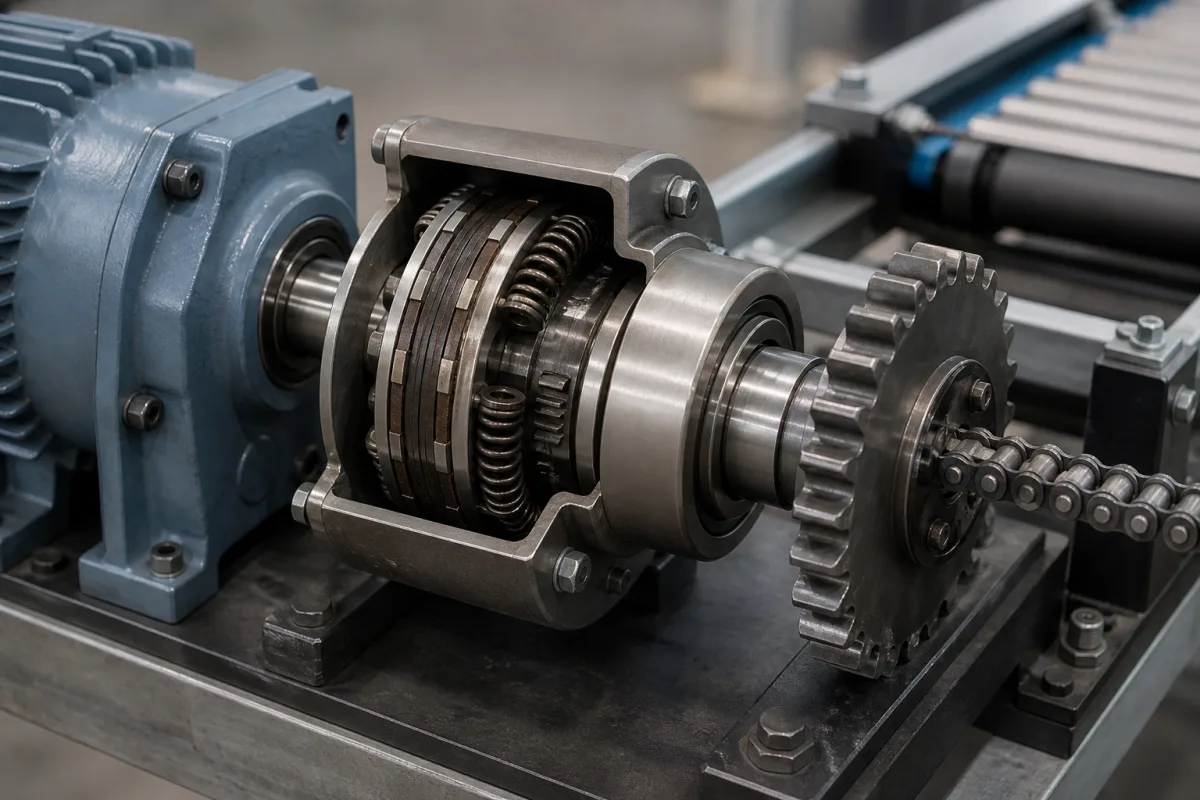
A canonical Torque Limiting Clutch is characterized by the integration of Drive Hub and Friction Plates/Discs. In industrial production environments, manufacturers listed on CNFX commonly emphasize Alloy Steel construction to support stable, high-cycle operation across diverse manufacturing scenarios.

A mechanical safety device that automatically disengages or slips when torque exceeds a preset limit to protect machinery from overload damage.
Product Specifications

Technical details and manufacturing context for Torque Limiting Clutch

Definition
A torque limiting clutch is a critical safety component within torque adjustment mechanisms that prevents mechanical overload by disconnecting or slipping the drive when torque surpasses a predetermined threshold. It serves as a mechanical fuse to protect downstream equipment, shafts, gears, and motors from damage due to jams, sudden stops, or excessive loads.
Working Principle
Operates through mechanical means such as spring-loaded friction plates, ball-detent mechanisms, or shear pins. When input torque exceeds the preset limit (adjusted via spring tension or pin strength), the clutch slips (in friction types) or shears (in shear-pin types), interrupting torque transmission until the overload condition is resolved and the clutch is reset.
Common Materials
Alloy Steel, Spring Steel, Bronze/Brass (friction surfaces), Hardened Steel Balls
Technical Parameters
  • Rated torque limit - the maximum torque at which the clutch engages/disengages (Nm) Per Request
Components / BOM
  • Drive Hub
    Connects to input shaft and transmits torque to friction elements
    Material: Alloy Steel
  • Friction Plates/Discs
    Provide controlled slippage when torque limit is exceeded
    Material: Sintered Bronze/Steel Composite
  • Spring Assembly
    Applies preset pressure to maintain engagement below torque limit
    Material: Spring Steel
  • Housing/Casing
    Encloses and protects internal components, provides mounting points
    Material: Cast Iron or Aluminum Alloy
Engineering Reasoning
5-500 N·m
Torque exceeding 550 N·m causes permanent deformation of spring elements
Design Rationale: Plastic deformation of hardened steel spring elements due to Hertzian contact stress exceeding 1500 MPa yield strength
Risk Mitigation (FMEA)
Trigger Lubricant degradation to viscosity below 68 cSt at 40°C
Mode: Increased friction coefficient from 0.12 to 0.35 causing thermal runaway
Strategy: Integrated viscosity sensors with automatic shutdown at 55°C
Trigger Spring fatigue from 10⁷ cycles at 80% rated torque
Mode: Spring constant reduction from 1500 N·m/rad to 900 N·m/rad
Strategy: Shot-peened spring surfaces with compressive residual stress of 400 MPa

Industry Taxonomies & Aliases

Commonly used trade names and technical identifiers for Torque Limiting Clutch.

Applied To / Applications

This component is essential for the following industrial systems and equipment:

Industrial Ecosystem & Supply Chain DNA

Complementary Systems
Downstream Applications
Specialized Tooling

Application Fit & Sizing Matrix

Operational Limits
pressure: Atmospheric to 10 bar (typical), higher with sealed designs
speed range: 0-5000 RPM (typical), depends on bearing and lubrication
temperature: -40°C to 150°C (typical), up to 200°C with special materials
torque range: 0.1 Nm to 5000 Nm (standard), custom designs available
Media Compatibility
✓ Industrial gearboxes ✓ Conveyor drive systems ✓ Pump and compressor drives
Unsuitable: High-frequency cyclic loading applications (causes premature wear)
Sizing Data Required
  • Maximum operating torque (Nm)
  • Required disengagement/slip torque (Nm)
  • Shaft speed and duty cycle (RPM, hours/day)

Reliability & Engineering Risk Analysis

Failure Mode & Root Cause
Slippage under load
Cause: Wear of friction surfaces due to excessive torque cycling, contamination, or improper lubrication leading to reduced clamping force
Spring fatigue or fracture
Cause: Cyclic loading beyond design limits, material defects, or corrosion from environmental exposure compromising the torque-setting mechanism
Maintenance Indicators
  • Audible clicking or grinding noises during normal operation indicating internal slippage or component wear
  • Visible wear debris or discoloration around the clutch housing suggesting internal degradation or overheating
Engineering Tips
  • Implement regular torque calibration checks using certified equipment to ensure the clutch engages at the specified torque, preventing premature slippage or overload damage
  • Establish a contamination control protocol including proper sealing, clean lubrication, and environmental shielding to prevent abrasive particles or moisture from degrading friction surfaces and springs

Compliance & Manufacturing Standards

Reference Standards
ISO 1940-1:2003 (Balance quality requirements for rotors) ANSI/ASME B107.300-2018 (Torque Tools) DIN 743-1:2012 (Calculation of load capacity of shafts and axles)
Manufacturing Precision
  • Bore diameter: +/-0.025 mm
  • Parallelism of mounting surfaces: 0.05 mm
Quality Inspection
  • Torque calibration test (verification of slip torque setting)
  • Hardness testing (Rockwell C scale for critical components)

Factories Producing Torque Limiting Clutch

Verified manufacturers with capability to produce this product in China

✓ 96% Supplier Capability Match Found

P Project Engineer from Australia Jan 13, 2026
★★★★★
"Testing the Torque Limiting Clutch now; the technical reliability results are within 1% of the laboratory datasheet."
Technical Specifications Verified
S Sourcing Manager from Singapore Jan 10, 2026
★★★★★
"Impressive build quality. Especially the technical reliability is very stable during long-term operation."
Technical Specifications Verified
P Procurement Specialist from Germany Jan 07, 2026
★★★★★
"As a professional in the Machinery and Equipment Manufacturing sector, I confirm this Torque Limiting Clutch meets all ISO standards."
Technical Specifications Verified
Verification Protocol

“Feedback is collected from verified sourcing managers during RFQ (Request for Quote) and factory evaluation processes on CNFX. These reports represent historical performance data and technical audit summaries from our B2B manufacturing network.”

10 sourcing managers are analyzing this specification now. Last inquiry for Torque Limiting Clutch from Turkey (39m ago).

Supply Chain Compatible Machinery & Devices

Automated Assembly Line System

Integrated production system for sequential component assembly operations

Explore Specs →
Automated Powder Coating System

Integrated industrial system for applying dry powder coatings to metal substrates.

Explore Specs →
Centrifugal Pump Impeller

Rotating component that transfers energy to fluid in centrifugal pumps.

Explore Specs →
High-Precision CNC Laser Cutting Machine

Computer-controlled industrial machine using focused laser beams to cut sheet metal with micron-level accuracy.

Explore Specs →

Frequently Asked Questions

How does a torque limiting clutch protect machinery from damage?

A torque limiting clutch automatically disengages or slips when torque exceeds a preset limit, preventing overload damage to connected machinery components by interrupting power transmission during excessive load conditions.

What materials are used in torque limiting clutch construction?

Torque limiting clutches are typically constructed from alloy steel for structural components, spring steel for the spring assembly, bronze or brass for friction surfaces, and hardened steel balls for smooth operation and durability.

Can the torque limit be adjusted on these clutches?

Yes, most torque limiting clutches feature adjustable torque settings through the spring assembly, allowing operators to set specific torque limits based on machinery requirements and operational conditions.

Can I contact factories directly on CNFX?

CNFX is an open directory, not a transaction platform. Each factory profile provides direct contact information and production details to help you initiate direct inquiries with Chinese suppliers.

Get Quote for Torque Limiting Clutch

Request technical pricing, lead times, or customized specifications for Torque Limiting Clutch directly from verified manufacturing units.

Your business information is encrypted and only shared with verified Torque Limiting Clutch suppliers.

Thank you! Your message has been sent. We'll respond within 1–3 business days.

Need to Manufacture Torque Limiting Clutch?

Connect with verified factories specializing in this product category

Add Your Factory Contact Us
Previous Product
Torque Limiter
Next Product
Torque Motor