Direct drive · Continuous and peak torque, cooling, motor constant and heat, speed limits and feedback
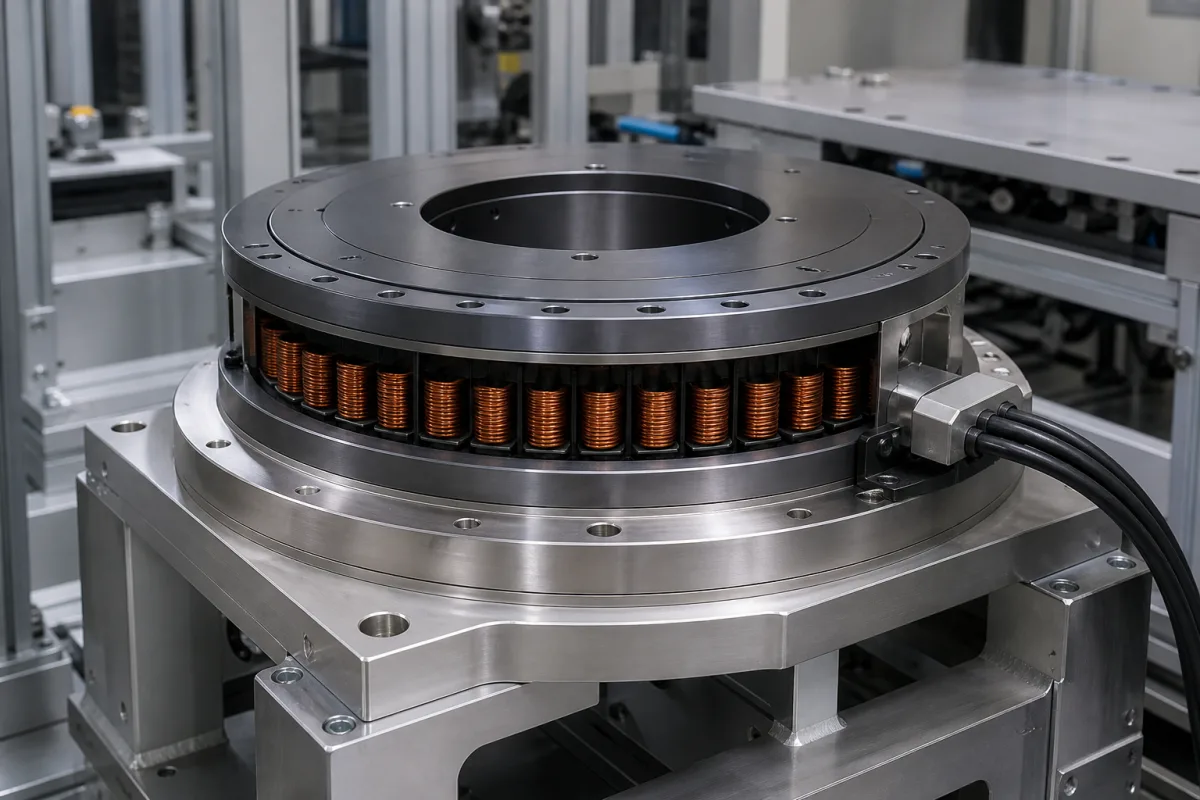
A torque motor is a high-pole-count direct-drive motor with a large hollow bore in the examples cited, that drives a load without a gearbox. Ask three things first: the continuous and peak torque at your duty cycle and cooling, the speed you need at that torque, and the feedback, sensors and drive it works with.
Direct-drive torque motors for positioning and rotary axes, frameless kits and housed direct-drive rotary motors, as used in machine tools, robots and rotary tables. AC torque motors for winding tension, motor spindles, geared servo motors and linear motors are outside this page.
CNFX editorial research · Sources checked October 11, 2026 · 4 sources
HIWIN's torque motor catalogue describes its TM-2 motors as wear-free direct drives without a reduction mechanism, with a large hollow shaft, low cogging torque from a high pole count, and built-in temperature sensors. For the TM-2-1A-LA0, it lists continuous torque of 90 N·m and stall torque of 74 N·m water-cooled, peak torque of 150 N·m for 1 s, a torque constant of 9.53 N·m/A, 22 poles, rotor inertia of 0.0033 kg·m² and a maximum DC bus of 750 V. Specifications carry a ±10% tolerance. [1]
Editorial calculation: peak torque is 150 ÷ 90 ≈ 1.67 times continuous, and only for 1 s, so size the motor on the RMS torque of the duty cycle and use peak torque for short acceleration. Continuous torque here assumes water cooling; ask what the rating is with your cooling. [1]
Give the supplier the load inertia and friction, motion profile (angles, times, dwell), required continuous and peak torque, speed, accuracy, cooling available, hollow-bore and mounting size, feedback (encoder type and resolution), drive and DC bus, and environment.
02
Check heat, speed and temperature protection
The same datasheet gives a motor constant of 2.57 N·m/√W at 25 °C, water-cooled thermal resistance of 0.072 K/W, resistance of 9.2 Ω line to line at 25 °C, maximum speed of 437 rpm at continuous torque and 268 rpm at peak torque, and temperature sensors PTC100, PTC130 and Pt1000. [1]
Editorial calculation: copper loss at continuous torque is about (90 ÷ 2.57)² ≈ 1,230 W, and with 0.072 K/W the winding runs about 1,230 × 0.072 ≈ 88 K above the coolant. [1] Because Km is quoted at 25 °C and winding resistance rises with temperature, the real loss at operating temperature is higher; ask suppliers for torque and loss at operating temperature.
Connect the temperature sensors to the drive so it can protect the winding, and confirm that the required speed is available at the torque you need: in the example, speed falls from 437 rpm at continuous torque to 268 rpm at peak. [1]
03
Check bearing loads, runout and encoder on a housed direct-drive motor
IAI's catalogue describes its DD motor as a housed rotary actuator driving a rotary table without belt or reduction gears. Its DD-H18 high-torque type lists 600 W, a rated torque of 25 N·m and a maximum instantaneous torque of 75 N·m, an allowable load inertia of 1.8 kg·m² against a rotor inertia of 0.0106 kg·m², speeds of 1 to 1,440 deg/s, a ø20.5 mm hollow bore and 0 to 40 °C operation. The rated torque applies only when the motor sits on a mounting surface that dissipates heat like a 400 × 400 × 10 mm aluminium plate. [4]
IAI bases these load ratings on a life of five years at 8 hours a day at rated speed with smooth operation without shock, and asks to be consulted where a 20-bit unit would exceed the allowable dynamic moment or thrust load. [4]
Editorial calculation: peak torque is 75 ÷ 25 = 3 times rated, against 150 ÷ 90 ≈ 1.67 for 1 s in the water-cooled frameless example above; the load inertia allowance is 1.8 ÷ 0.0106 ≈ 170 times the rotor inertia; 1,440 deg/s is 240 rpm; and five years at 8 hours a day is about 14,600 operating hours. [4][1]
For a housed direct-drive motor, give the supplier the load inertia, axial load, overturning moment and runout you need, the mounting orientation and the heat path of the mounting surface.
04
Read frameless datasheets: test conditions, cooling and sizes
ETEL's torque motor brochure describes a torque motor as a frameless motor with no housing, bearings or feedback device, which the machine builder selects or buys as an assembly, and says sizing is based on torque rather than power: peak torque is the maximum the motor produces, continuous torque what it can supply continuously, and the duty cycle decides which one governs. It associates light duty cycles with high short peaks with air-cooled series and rising continuous torque with liquid cooling, and states a standard range of 140 to 1,290 mm outside diameter and 38 to 42,900 N·m peak torque. [2]
Tecnotion states all values ±10%, a PTC 1 kΩ / KTY83-122 temperature sensor, a maximum allowable speed of 16,500 rpm for the series, and that the continuous values apply only with the mounting surface at 20 °C and the motor at maximum continuous current. [3]
Editorial calculation: with Km² = 0.127 N²·m²/W, copper loss at 5.4 N·m is 5.4² / 0.127 ≈ 230 W at 25 °C coils; the stated 300 W at 100 °C coils reflects the higher resistance when hot. 300 W × 0.25 °C/W = 75 °C rise, which from a 20 °C mounting surface gives about 95 °C, close to the 100 °C coil condition. Peak torque is 6.7 / 5.4 ≈ 1.24 times continuous here, against 150 / 90 ≈ 1.67 in the water-cooled example above, so compare ratios only at the same stated conditions. [3][1]
Tecnotion QTR-A-105-34, winding N
Value
Stated condition
Ultimate torque Tu
10.6 N·m
20 °C/s temperature rise, magnet 25 °C
Peak torque Tp
6.7 N·m
6 °C/s temperature rise, magnet 25 °C
Continuous torque Tc
5.4 N·m
Coil at 100 °C
Torque constant Kt
1.07 N·m/Arms
Up to Ic
Motor constant Km²
0.127 N²·m²/W
Coils at 25 °C
Continuous current Ic / peak Ip
5.1 / 7.3 Arms
Coils 100 °C / magnet 25 °C
Continuous power loss Pc
300 W
Coils at 100 °C
Thermal resistance Rth
0.25 °C/W
Coils to mounting surface, radial mounting
Stator OD / rotor ID / height
105 / 56 / 34 mm
Total mass 964 g
Ask for each torque figure with its test condition (coil temperature, temperature rise rate, cooling and mounting surface temperature), the thermal resistance basis, and the sensor type.
05
Rotary tables, frameless kits and reducers alongside the motors
HIWIN lists torque motors and rotary tables with drives; CSK lists DDR torque motor series with linear motors; Mosrac lists frameless and housed direct-drive rotary motors with encoders and joint modules; Honpine lists frameless torque and DD motors with harmonic and RV reducers.
06
Stator, magnet rotor, sensors, bearing and encoder
The bearing and housing row separates the two forms on this page: a frameless motor comes without them, while a housed motor such as IAI's DD-H18 carries its own runout and load ratings. [2][4]
Part
Role
Fix in the order
Stator with coils
Produces torque; continuous ratings given with water cooling. [1]
Not included in a frameless motor; chosen by the machine builder. [2]
Frameless or housed.
Encoder
Direct connection to the load makes feedback more accurate. [1]
Type and resolution.
07
Torque, speed, bus voltage and bore: quoting a direct-drive axis
Ask for every torque value together with its condition; the rated torque row here sets a water-cooled figure beside one stated at 100 °C coil temperature. [1][3]
Field
What it means and published values
Ask the supplier for
Rated torque (N·m)
E.g. 90 N·m continuous water-cooled, 150 N·m peak for 1 s [1]; 5.4 N·m at 100 °C coil. [3]
Explore company information and manufacturing capabilities, then discuss the scope of your project with a relevant supplier.
Share this page
Compiled and source-reviewed by the CNFX editorial team.
Each manufacturer above links to the page on that company's own website where the product is listed, with the date we checked it. How we source and review
· Page last updated 13 October 2026
Buyer questions
Should I size a torque motor on peak or continuous torque?
On the RMS torque of the duty cycle against continuous torque with your cooling; peak torque in the example is only for 1 s. [1]
How hot does a torque motor run?
In the example, about 1,230 W of copper loss at continuous torque and 0.072 K/W give roughly 88 K above the coolant (editorial calculation). [1]
Why do torque motors have temperature sensors?
So the drive can protect the winding; the example motor has PTC100, PTC130 and Pt1000 sensors. [1]
What does frameless mean for a torque motor?
The motor has no housing, bearings or feedback device; the machine builder selects them or buys an assembly. [2]
Why do torque ratings differ between catalogues?
They are stated at different conditions, such as coil at 100 °C, a 6 °C/s temperature rise for peak torque, or water cooling; compare at the same conditions. [3][1]
What should I check on a housed direct-drive motor besides torque?
IAI's DD-H18 catalogue entry lists 30 µm axial and radial runout, an 80 N·m allowable dynamic moment and a 3,400 N thrust load, with rated torque valid only on a mounting surface equivalent to a 400 × 400 × 10 mm aluminium plate. [4]
Sources and what still needs a direct check
Sources checked 2026-10-11. HIWIN is a torque motor maker listed on this page; its catalogue is used as a worked example, not a recommendation.