In-plant handling · Power supply by run length and duty, load and table, speed, track and safety devices
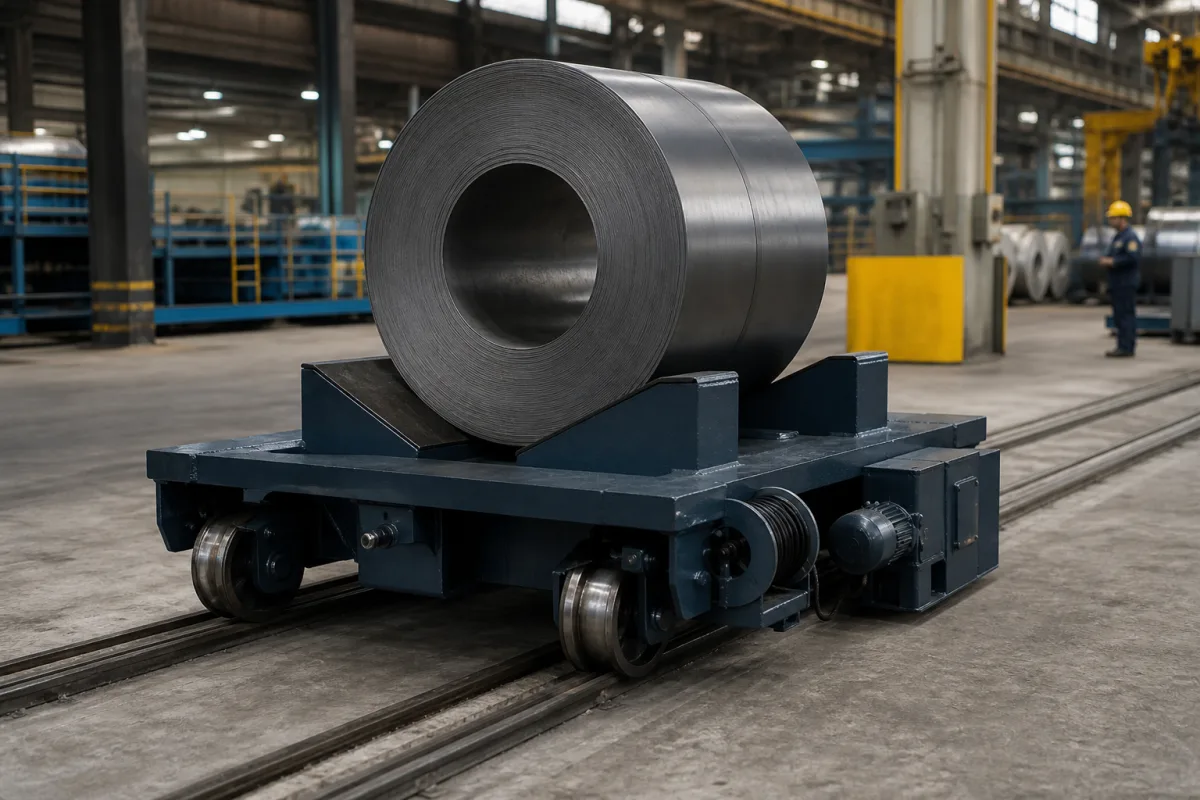
A transfer car moves heavy loads such as coils, dies, ladles or fabrications along rails across or between bays. Ask three things first: the load and its shape, the power supply suited to your run length and number of trips, and the track, speed and safety devices along the route.
Electric rail-guided transfer cars and carts for coils, dies, ladles and general loads, including turntable and inter-bay cars. Trackless and AGV carts, crane end carriages and hand trolleys are outside this page.
CNFX editorial research · Sources checked October 11, 2026 · 5 sources
Choose the power supply for the run length and duty
KSCRANE's low-voltage rail cart is supplied from 380 V AC transformed to 36 V AC on the two rails, picked up through the wheels and converted to DC to control the cart; it suits frequent use and longer runs, with no distance limit, but beyond about 70 m extra transformers are needed to make up the voltage drop. Its cable-reel cart has no load limit and suits frequent use and harsh conditions such as high temperature or explosion-proof areas, needs a cable arranger beyond 50 m and can run up to 200 m. Its battery cart has unlimited distance and no strict rail requirements and suits long runs at low frequency, but the run time per charge is limited, batteries need regular maintenance and their life is about 2.5 years. [1][2][3]
DGCrane lists rail power, battery, cable and busbar supply as the options to choose, together with load, table size and height, rail gauge and length, and the working environment. [5]
Give the supplier the load (weight, shape, coil or die dimensions), table size and height, rail gauge and run length, route shape (straight, curved, turntable), trips per hour, power supply preference, speed, environment (heat, dust, explosion risk), and safety and control requirements.
02
Check load, speed, track and safety devices
KSCRANE's published series run from 2 t to 63 t on four wheels for the low-voltage cart, with motor power rising from 1 kW at 2 t to 6.3 kW at 63 t, and running speeds of 0–25 or 0–20 per minute; the table labels the speed unit as mm, which reads as an error for metres per minute, so confirm speed in the quotation. Its coil transfer cart can run on C-, S- or L-shaped track, with options for automatic control and safety equipment including horn, lights, emergency stop, bumpers and detectors. [1][4]
Editorial calculation: at 20 m/min a 100 m run takes 5 minutes each way, about 10 minutes for a round trip before loading time, so a single car can make at most about 6 round trips an hour on that route. [1] Use your own route length, speed and loading times when comparing power supplies.
03
Coil, die, ladle and battery cars in the supplier listings
KSCRANE, Dafang, DGCrane and New Leader list rail, coil, die and ladle transfer carts with battery, cable-reel and low-voltage rail options; Symmen lists battery transfer trolleys; Nante lists a transfer car series with crane end carriages; Ancore, CHNZBTECH and Machinesol list ladle transfer cars with electric arc furnace and casting equipment.
04
Table, wheels, power pick-up, controls and safety devices
The power supply row carries the length limits set out above: extra transformers beyond about 70 m on a low-voltage rail, a cable arranger beyond 50 m on a cable reel, and limited run time per charge on a battery. [1][2][3]
Transfer car builders and the cart types on their sites
Coil, die and ladle carts, turntable cars and battery trolleys appear on the reviewed sites; DGCrane also lists busbar power alongside rail, battery and cable supply.
KSCRANE
Manufacturing site to be confirmed for the order
Lists coil, ladle, battery, cable-reel and low-voltage rail transfer carts.
Explore company information and manufacturing capabilities, then discuss the scope of your project with a relevant supplier.
Share this page
Compiled and source-reviewed by the CNFX editorial team.
Each manufacturer above links to the page on that company's own website where the product is listed, with the date we checked it. How we source and review
· Page last updated 13 October 2026
Buyer questions
Which power supply suits a long run?
Published supplier data say low-voltage rail carts have no distance limit but need extra transformers beyond about 70 m, cable-reel carts reach about 200 m, and battery carts have unlimited distance but limited use per charge. [1][2][3]
Which power supply suits hot or explosion-risk areas?
KSCRANE describes its cable-reel cart as suitable for high-temperature and explosion-proof conditions. [2]
What safety devices should a transfer car have?
One supplier lists horn, lights, emergency stop, bumpers and detectors as available safety equipment. [4]
Sources and what still needs a direct check
Sources checked 2026-10-11. KSCRANE and DGCrane are transfer car suppliers listed on this page; their published data are used as examples, not recommendations.