Industry-Verified Manufacturing Data (2026)

Transfer Mechanism

Based on aggregated insights from multiple verified factory profiles within the CNFX directory, the standard Transfer Mechanism used in the Machinery and Equipment Manufacturing sector typically supports operational capacities ranging from standard industrial configurations to heavy-duty production requirements.

Technical Definition & Core Assembly

A canonical Transfer Mechanism is characterized by the integration of Drive Motor/Actuator and Transmission Element (Belt/Chain/Roller). In industrial production environments, manufacturers listed on CNFX commonly emphasize Carbon Steel construction to support stable, high-cycle operation across diverse manufacturing scenarios.

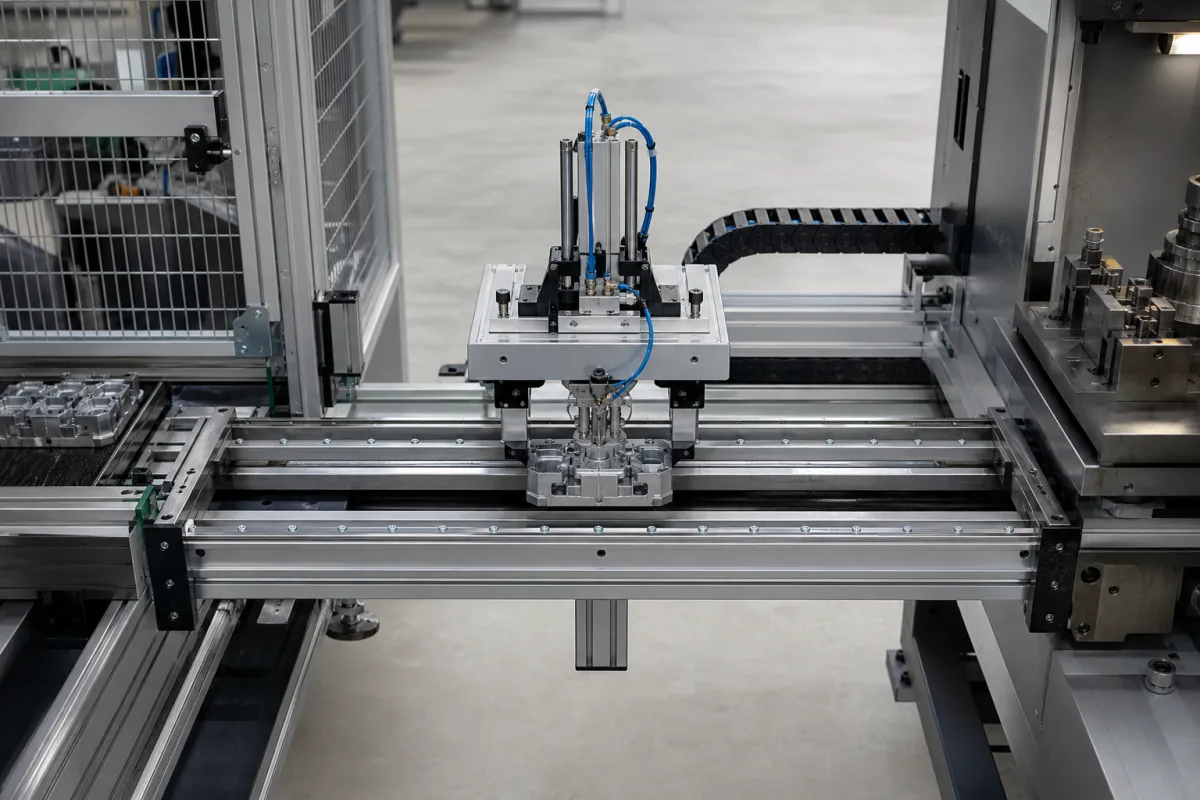
A mechanical component within a handling system responsible for moving materials, parts, or products between different points or stations.
Product Specifications

Technical details and manufacturing context for Transfer Mechanism

Definition
A Transfer Mechanism is a critical sub-assembly within a larger Handling System, such as a conveyor system, assembly line, or automated production cell. Its primary role is to facilitate the controlled, reliable, and often synchronized movement of items from one operational stage, workstation, or storage location to the next. It ensures the continuity of the material flow, integrates with other system components like lifts, sorters, or robots, and is fundamental to achieving automation and process efficiency.
Working Principle
The mechanism operates by converting a primary input energy (typically electrical or pneumatic) into controlled mechanical motion. This is achieved through a combination of a drive unit (motor, actuator), a transmission system (belts, chains, gears, rollers, screws), and a supporting structure or guideway. Control systems (PLCs, sensors) regulate the motion's start, stop, speed, and positioning to synchronize with the overall handling process.
Common Materials
Carbon Steel, Stainless Steel, Aluminum Alloy, Engineering Plastics (e.g., UHMW-PE, Nylon)
Technical Parameters
  • The maximum load capacity dimension (width/length) the mechanism is designed to accommodate. (mm) Standard Spec
Components / BOM
  • Drive Motor/Actuator
    Provides the primary motive power to the mechanism.
    Material: Various (Housing: Aluminum/Steel, Windings: Copper)
  • Transmission Element (Belt/Chain/Roller)
    Directly contacts and moves the load, transferring power from the drive.
    Material: Rubber/PVC (Belt), Steel (Chain, Roller)
  • Support Frame/Guide Rail
    Provides structural support, alignment, and a defined path for the moving components.
    Material: Steel, Aluminum
  • Control Sensor (e.g., Proximity, Photoelectric)
    Detects the presence/position of items to trigger actions (start, stop, divert) within the control system.
    Material: Plastic, Metal, Glass
Engineering Reasoning
0.5-3.0 m/s linear velocity, 10-1000 N force capacity, -20°C to 80°C ambient temperature
Exceeds 3.5 m/s velocity causing bearing fatigue, exceeds 1200 N load causing structural yield, exceeds 90°C causing lubricant breakdown
Design Rationale: Bearing fatigue at >10⁶ cycles under 3.5 m/s due to Hertzian contact stress exceeding 1.2 GPa, structural yield at >1200 N load exceeding material yield strength of 250 MPa, lubricant thermal breakdown at >90°C exceeding ISO VG 32 viscosity-temperature index
Risk Mitigation (FMEA)
Trigger Misalignment exceeding 0.1 mm/m during installation
Mode: Premature bearing wear and increased vibration >4.5 mm/s RMS
Strategy: Laser alignment during installation with 0.05 mm/m tolerance and real-time vibration monitoring with piezoelectric accelerometers
Trigger Contaminant ingress exceeding ISO 4406 18/16/13 cleanliness level
Mode: Abrasive wear of sliding surfaces and seal degradation
Strategy: IP65-rated enclosure with positive pressure filtration and magnetic particle traps in lubrication system

Industry Taxonomies & Aliases

Commonly used trade names and technical identifiers for Transfer Mechanism.

Applied To / Applications

This component is essential for the following industrial systems and equipment:

Industrial Ecosystem & Supply Chain DNA

Complementary Systems
Downstream Applications
Specialized Tooling

Application Fit & Sizing Matrix

Operational Limits
pressure: 0 to 10 bar
flow rate: Up to 1000 kg/h
temperature: -20°C to 120°C
slurry concentration: Up to 40% solids by weight
Media Compatibility
✓ Plastic pellets ✓ Metal parts ✓ Dry granular materials
Unsuitable: Highly corrosive chemical slurries
Sizing Data Required
  • Material flow rate (kg/h)
  • Transfer distance (m)
  • Material bulk density (kg/m³)

Reliability & Engineering Risk Analysis

Failure Mode & Root Cause
Bearing fatigue and seizure
Cause: Inadequate lubrication, contamination ingress, or excessive misalignment leading to increased friction and heat generation
Coupling misalignment and wear
Cause: Improper installation, foundation settling, or thermal expansion causing shaft misalignment and vibration-induced damage
Maintenance Indicators
  • Unusual grinding or knocking sounds during operation indicating bearing or gear issues
  • Excessive vibration or visible wobble in rotating components suggesting imbalance or misalignment
Engineering Tips
  • Implement precision laser alignment during installation and regular alignment checks to maintain shaft parallelism within 0.002 inches per inch
  • Establish condition-based lubrication program using vibration analysis and thermography to optimize lubrication intervals and detect early bearing degradation

Compliance & Manufacturing Standards

Reference Standards
ISO 9001:2015 Quality Management Systems ANSI/ASME B5.54-2005 Machine Tool Spindles DIN 5480-1:2006 Involute Splines
Manufacturing Precision
  • Shaft alignment: +/-0.05mm
  • Gear backlash: 0.1-0.2mm
Quality Inspection
  • Dimensional Verification with CMM
  • Hardness Testing (Rockwell C scale)

Factories Producing Transfer Mechanism

Verified manufacturers with capability to produce this product in China

✓ 95% Supplier Capability Match Found

T Technical Director from Brazil Jan 14, 2026
★★★★★
"The technical documentation for this Transfer Mechanism is very thorough, especially regarding technical reliability."
Technical Specifications Verified
P Project Engineer from Canada Jan 11, 2026
★★★★☆
"Reliable performance in harsh Machinery and Equipment Manufacturing environments. No issues with the Transfer Mechanism so far. (Delivery took slightly longer than expected, but technical support was excellent.)"
Technical Specifications Verified
S Sourcing Manager from United States Jan 08, 2026
★★★★★
"Testing the Transfer Mechanism now; the technical reliability results are within 1% of the laboratory datasheet."
Technical Specifications Verified
Verification Protocol

“Feedback is collected from verified sourcing managers during RFQ (Request for Quote) and factory evaluation processes on CNFX. These reports represent historical performance data and technical audit summaries from our B2B manufacturing network.”

9 sourcing managers are analyzing this specification now. Last inquiry for Transfer Mechanism from Vietnam (1h ago).

Supply Chain Compatible Machinery & Devices

Heavy-Duty CNC Plasma Cutting Machine

Industrial machine for precision metal cutting using plasma arc technology

Explore Specs →
Automated Assembly Line System

Integrated production system for sequential component assembly operations

Explore Specs →
Automated Powder Coating System

Integrated industrial system for applying dry powder coatings to metal substrates.

Explore Specs →
Centrifugal Pump Impeller

Rotating component that transfers energy to fluid in centrifugal pumps.

Explore Specs →

Frequently Asked Questions

What materials are best for transfer mechanisms in corrosive environments?

Stainless steel or engineering plastics like UHMW-PE are ideal for corrosive environments due to their resistance to rust and chemical degradation, ensuring long-term durability and reduced maintenance.

How do control sensors improve transfer mechanism performance?

Control sensors such as proximity or photoelectric sensors enhance precision by detecting material position, enabling automated start/stop functions, reducing jams, and improving overall system efficiency and safety.

What maintenance is required for belt-driven transfer mechanisms?

Regular maintenance includes inspecting and tensioning belts, lubricating moving parts, checking alignment of transmission elements, and cleaning debris to prevent wear and ensure consistent material transfer.

Can I contact factories directly on CNFX?

CNFX is an open directory, not a transaction platform. Each factory profile provides direct contact information and production details to help you initiate direct inquiries with Chinese suppliers.

Get Quote for Transfer Mechanism

Request technical pricing, lead times, or customized specifications for Transfer Mechanism directly from verified manufacturing units.

Your business information is encrypted and only shared with verified Transfer Mechanism suppliers.

Thank you! Your message has been sent. We'll respond within 1–3 business days.

Need to Manufacture Transfer Mechanism?

Connect with verified factories specializing in this product category

Add Your Factory Contact Us
Previous Product
Transfer Car
Next Product
Transfer Mechanism (e.g., Robotic Arm, Walking Beam)