Industry-Verified Manufacturing Data (2026)

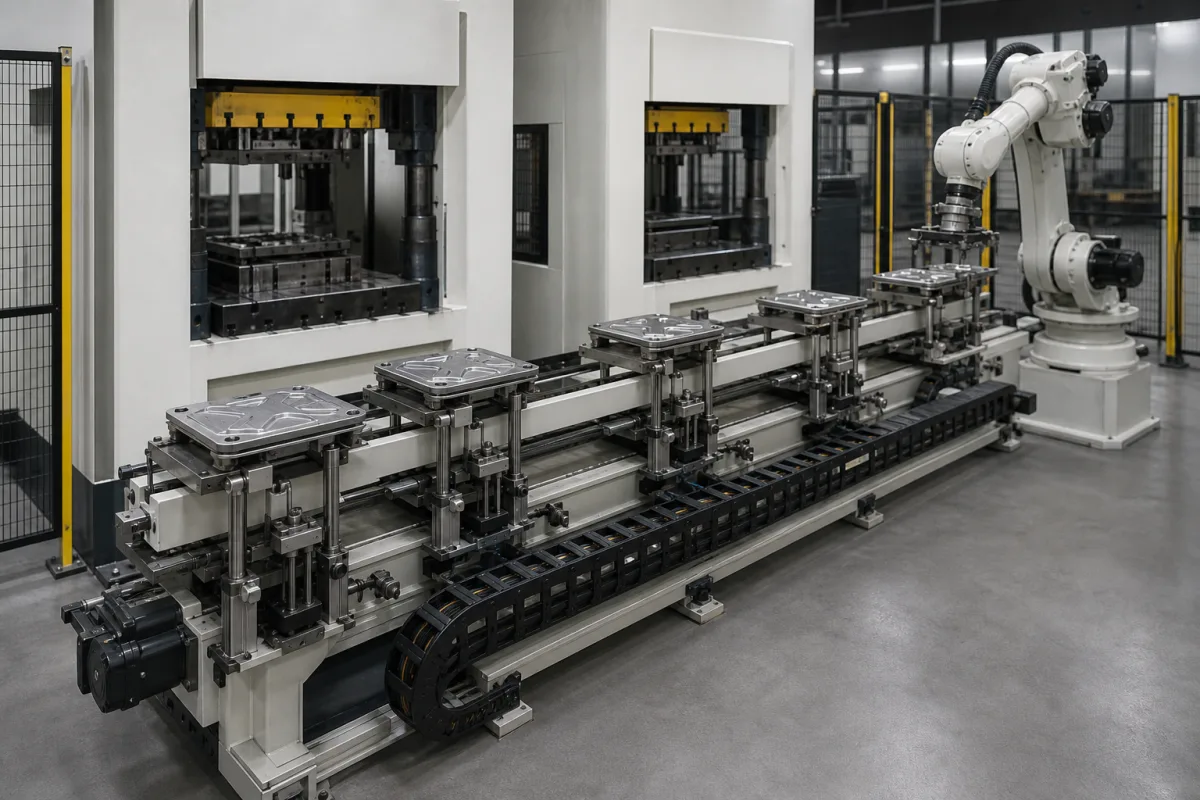
Transfer Mechanism (e.g., Robotic Arm, Walking Beam)

Based on aggregated insights from multiple verified factory profiles within the CNFX directory, the standard Transfer Mechanism (e.g., Robotic Arm, Walking Beam) used in the Machinery and Equipment Manufacturing sector typically supports operational capacities ranging from standard industrial configurations to heavy-duty production requirements.

Technical Definition & Core Assembly

A canonical Transfer Mechanism (e.g., Robotic Arm, Walking Beam) is characterized by the integration of Actuator (Motor/Cylinder) and Structural Frame/Arm. In industrial production environments, manufacturers listed on CNFX commonly emphasize Steel construction to support stable, high-cycle operation across diverse manufacturing scenarios.

A mechanical component within an Automated Transfer System responsible for physically moving materials, parts, or products between stations or processes.
Product Specifications

Technical details and manufacturing context for Transfer Mechanism (e.g., Robotic Arm, Walking Beam)

Definition
The Transfer Mechanism is a core functional part of an Automated Transfer System. It executes the physical movement and precise positioning of items along a production or assembly line. Common implementations include robotic arms for flexible, multi-axis manipulation and walking beams for synchronized, linear transfer of items between fixed stations. Its role is to automate material handling, replacing manual labor, increasing throughput, and ensuring consistent, precise placement critical for downstream operations.
Working Principle
The mechanism operates based on its specific type. A robotic arm typically uses servo motors and programmable logic to move its articulated joints along multiple axes, gripping, lifting, and placing items. A walking beam uses a cam or linkage system to lift, advance, and lower a set of carriers in a cyclic motion, transferring items between stationary supports. Both are integrated with and controlled by the overarching Automated Transfer System's control unit.
Common Materials
Steel, Aluminum alloy, Engineering plastics
Technical Parameters
  • Maximum payload dimensions (Length x Width x Height) the mechanism can accommodate. (mm) Standard Spec
Components / BOM
  • Actuator (Motor/Cylinder)
    Provides the motive force for movement (linear or rotary).
    Material: Steel, Copper
  • Structural Frame/Arm
    Provides rigidity and defines the range of motion.
    Material: Steel, Aluminum alloy
  • End Effector (Gripper/Clamp)
    Interface that physically contacts and secures the item being transferred.
    Material: Steel, Engineering plastics, Rubber
  • Control Interface
    Receives commands from the system controller to coordinate movement.
    Material: Electronic components, Plastic housing
Engineering Reasoning
0.1-2.0 m/s linear velocity, 0.01-0.1 mm positioning accuracy, 5-50 kg payload capacity
Structural yield strength exceeded at 250 MPa stress, bearing fatigue life limit of 10^7 cycles at 100 N load, servo motor thermal limit of 80°C winding temperature
Design Rationale: High-cycle fatigue from cyclic loading exceeding material endurance limit, thermal expansion mismatch causing bearing seizure at ΔT > 50°C, harmonic resonance at 15-25 Hz excitation frequencies
Risk Mitigation (FMEA)
Trigger Lubricant degradation below 40 cSt viscosity at operating temperature
Mode: Linear guide bearing seizure causing 0.5 mm positional deviation
Strategy: Integrated viscosity monitoring with automatic grease replenishment at 45 cSt threshold
Trigger Encoder feedback signal loss for >10 ms duration
Mode: Servo motor overshoot exceeding 0.2 mm tolerance band
Strategy: Dual redundant absolute encoders with majority voting logic and 5 ms failover

Industry Taxonomies & Aliases

Commonly used trade names and technical identifiers for Transfer Mechanism (e.g., Robotic Arm, Walking Beam).

Applied To / Applications

This component is essential for the following industrial systems and equipment:

Industrial Ecosystem & Supply Chain DNA

Complementary Systems
Downstream Applications
Specialized Tooling

Application Fit & Sizing Matrix

Operational Limits
pressure: Atmospheric to 1.5 bar
other spec: Max payload: 50 kg, Max speed: 2 m/s, Positioning accuracy: ±0.5 mm
temperature: -20°C to 80°C
Media Compatibility
✓ Metal parts ✓ Plastic components ✓ Packaged goods
Unsuitable: Corrosive chemical baths
Sizing Data Required
  • Payload mass and dimensions
  • Required cycle time/throughput
  • Travel distance and path complexity

Reliability & Engineering Risk Analysis

Failure Mode & Root Cause
Misalignment-induced wear
Cause: Improper installation, foundation settling, or thermal expansion causing misalignment between transfer mechanism components, leading to accelerated bearing, gear, or coupling failure.
Control system failure
Cause: Electrical noise, voltage spikes, or software bugs disrupting the programmable logic controller (PLC) or servo drives, resulting in erratic movement, loss of position accuracy, or complete stoppage.
Maintenance Indicators
  • Unusual grinding, clicking, or squealing noises during operation, indicating mechanical wear or misalignment.
  • Excessive vibration or jerky, inconsistent movement, suggesting issues with bearings, drives, or control systems.
Engineering Tips
  • Implement a precision laser alignment program during installation and after major maintenance to ensure optimal component alignment and reduce wear.
  • Establish a regular preventive maintenance schedule for lubrication, inspection of mechanical components (bearings, gears, belts), and calibration of sensors and control systems.

Compliance & Manufacturing Standards

Reference Standards
ISO 9283:1998 - Manipulating industrial robots - Performance criteria and related test methods ANSI/RIA R15.06 - Industrial Robots and Robot Systems - Safety Requirements DIN EN ISO 10218-1:2011 - Robots and robotic devices - Safety requirements for industrial robots
Manufacturing Precision
  • Positioning repeatability: +/-0.05mm
  • Load capacity deviation: +/-1% of rated capacity
Quality Inspection
  • Laser interferometer accuracy verification
  • Dynamic load testing with strain gauges

Factories Producing Transfer Mechanism (e.g., Robotic Arm, Walking Beam)

Verified manufacturers with capability to produce this product in China

✓ 96% Supplier Capability Match Found

T Technical Director from Australia Feb 19, 2026
★★★★★
"Great transparency on the Transfer Mechanism (e.g., Robotic Arm, Walking Beam) components. Essential for our Machinery and Equipment Manufacturing supply chain."
Technical Specifications Verified
P Project Engineer from Singapore Feb 16, 2026
★★★★☆
"The Transfer Mechanism (e.g., Robotic Arm, Walking Beam) we sourced perfectly fits our Machinery and Equipment Manufacturing production line requirements. (Delivery took slightly longer than expected, but technical support was excellent.)"
Technical Specifications Verified
S Sourcing Manager from Germany Feb 13, 2026
★★★★★
"Found 10+ suppliers for Transfer Mechanism (e.g., Robotic Arm, Walking Beam) on CNFX, but this spec remains the most cost-effective."
Technical Specifications Verified
Verification Protocol

“Feedback is collected from verified sourcing managers during RFQ (Request for Quote) and factory evaluation processes on CNFX. These reports represent historical performance data and technical audit summaries from our B2B manufacturing network.”

18 sourcing managers are analyzing this specification now. Last inquiry for Transfer Mechanism (e.g., Robotic Arm, Walking Beam) from Poland (47m ago).

Supply Chain Compatible Machinery & Devices

Heavy-Duty CNC Plasma Cutting Machine

Industrial machine for precision metal cutting using plasma arc technology

Explore Specs →
Automated Assembly Line System

Integrated production system for sequential component assembly operations

Explore Specs →
Automated Powder Coating System

Integrated industrial system for applying dry powder coatings to metal substrates.

Explore Specs →
Centrifugal Pump Impeller

Rotating component that transfers energy to fluid in centrifugal pumps.

Explore Specs →

Frequently Asked Questions

What materials are best for transfer mechanism construction in heavy-duty applications?

For heavy-duty applications, steel provides optimal durability and load capacity, while aluminum alloy offers a lighter alternative with good strength-to-weight ratio for faster cycle times.

How do I select the right end effector for my transfer mechanism?

End effector selection depends on your material characteristics - grippers for irregular shapes, clamps for secure holding, vacuum cups for smooth surfaces, or custom tools for specialized applications.

What maintenance is required for automated transfer mechanisms?

Regular lubrication of moving parts, inspection of structural components for wear, calibration of actuators and sensors, and periodic testing of control interfaces ensure optimal performance and longevity.

Can I contact factories directly on CNFX?

CNFX is an open directory, not a transaction platform. Each factory profile provides direct contact information and production details to help you initiate direct inquiries with Chinese suppliers.

Get Quote for Transfer Mechanism (e.g., Robotic Arm, Walking Beam)

Request technical pricing, lead times, or customized specifications for Transfer Mechanism (e.g., Robotic Arm, Walking Beam) directly from verified manufacturing units.

Your business information is encrypted and only shared with verified Transfer Mechanism (e.g., Robotic Arm, Walking Beam) suppliers.

Thank you! Your message has been sent. We'll respond within 1–3 business days.

Need to Manufacture Transfer Mechanism (e.g., Robotic Arm, Walking Beam)?

Connect with verified factories specializing in this product category

Add Your Factory Contact Us
Previous Product
Transfer Mechanism
Next Product
Transfer Mechanism (Pusher/Pick-and-Place)