Industry-Verified Manufacturing Data (2026)

Transfer Mechanism (Pusher/Pick-and-Place)

Based on aggregated insights from multiple verified factory profiles within the CNFX directory, the standard Transfer Mechanism (Pusher/Pick-and-Place) used in the Machinery and Equipment Manufacturing sector typically supports operational capacities ranging from standard industrial configurations to heavy-duty production requirements.

Technical Definition & Core Assembly

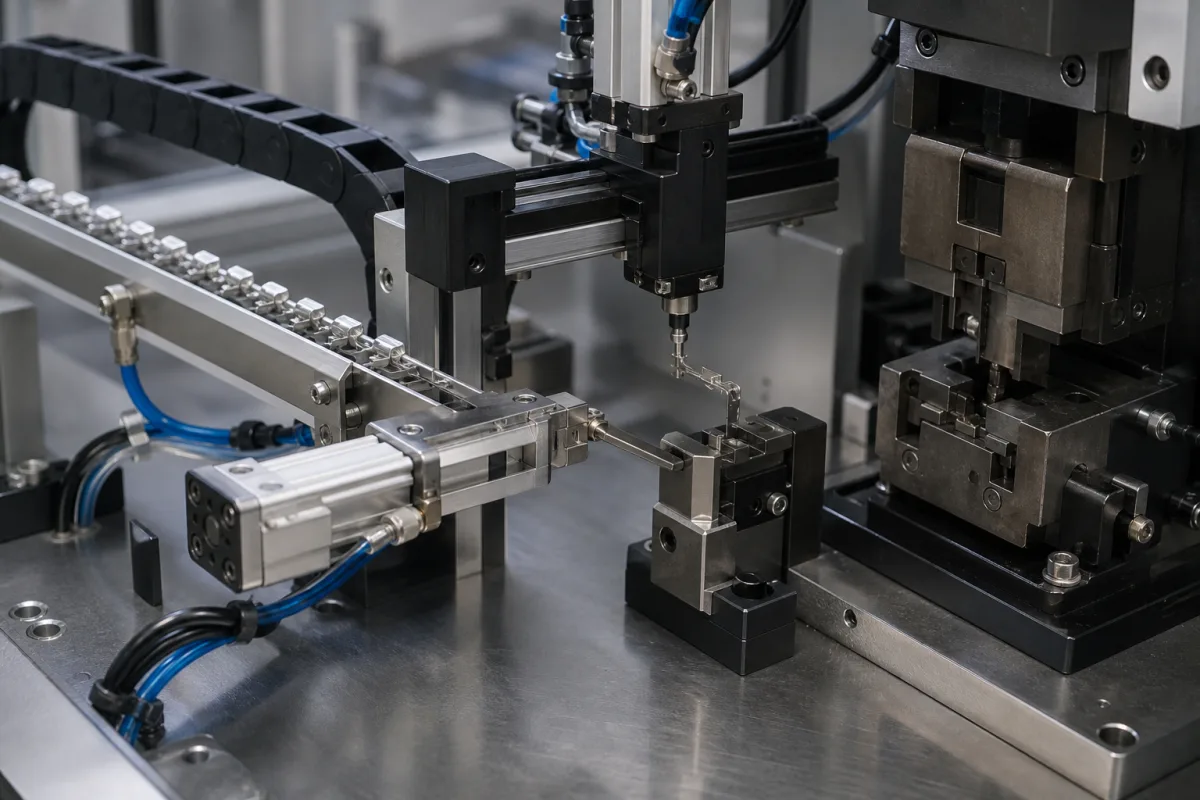
A canonical Transfer Mechanism (Pusher/Pick-and-Place) is characterized by the integration of Actuator and Guide rails. In industrial production environments, manufacturers listed on CNFX commonly emphasize Aluminum alloy construction to support stable, high-cycle operation across diverse manufacturing scenarios.

A mechanical component within a terminal feeder that transfers components or materials between stations using pushing or pick-and-place actions.
Product Specifications

Technical details and manufacturing context for Transfer Mechanism (Pusher/Pick-and-Place)

Definition
The transfer mechanism is a critical sub-component of terminal feeder systems that facilitates the movement of components, parts, or materials between different processing stations. It employs either pusher mechanisms (linear pushing actions) or pick-and-place systems (gripping and repositioning) to ensure precise, controlled transfer within automated production lines.
Working Principle
The mechanism operates through pneumatic, hydraulic, or electric actuation. Pusher types use linear actuators to push items along tracks, while pick-and-place types use robotic arms or grippers to lift, move, and place items. Both types are controlled by programmable logic controllers (PLCs) or other automation systems to synchronize with the feeder's overall operation.
Common Materials
Aluminum alloy, Stainless steel, Engineering plastics
Technical Parameters
  • Stroke length determines the maximum travel distance for pusher or pick-and-place movements (mm) Customizable
Components / BOM
  • Actuator
    Provides the motive force for pushing or picking movements
    Material: Aluminum alloy
  • Guide rails
    Ensures precise linear movement and alignment during transfer
    Material: Stainless steel
  • Gripper head (for pick-and-place)
    Securely grips components during transfer operations
    Material: Engineering plastic
Engineering Reasoning
0.5-2.5 m/s linear velocity, 0.05-0.2 mm positioning accuracy, 5-25 N pushing force
Exceeds 3.0 m/s velocity causing bearing deformation >0.3 mm, or exceeds 30 N force causing actuator shaft deflection >0.5 mm
Design Rationale: Exceeding yield strength of AISI 304 stainless steel (205 MPa) in actuator components leads to plastic deformation; excessive inertial forces at high acceleration (>15 m/s²) cause bearing raceway spalling
Risk Mitigation (FMEA)
Trigger Pneumatic cylinder seal degradation due to 0.1 mm particulate contamination exceeding ISO 8573-1:2010 Class 2 standards
Mode: Compressed air leakage >0.5 L/min at 6 bar causing 15% velocity reduction and positional drift >0.1 mm
Strategy: Install 5 μm absolute filtration with automatic drain valves and implement 0.1 mm H9/g6 clearance seals
Trigger Servo motor encoder signal interference from 50 Hz electromagnetic fields exceeding 10 V/m near VFD cables
Mode: Positional error accumulation >0.3 mm per cycle due to quadrature signal phase distortion
Strategy: Implement shielded CAT7 cables with 360° grounding, install ferrite cores on all signal lines, maintain 200 mm minimum separation from power cables

Industry Taxonomies & Aliases

Commonly used trade names and technical identifiers for Transfer Mechanism (Pusher/Pick-and-Place).

Applied To / Applications

This component is essential for the following industrial systems and equipment:

Industrial Ecosystem & Supply Chain DNA

Complementary Systems
Downstream Applications
Specialized Tooling

Application Fit & Sizing Matrix

Operational Limits
pressure: 0 to 10 bar
other spec: Max payload: 5 kg, Cycle rate: up to 60 cycles/min, Positioning accuracy: ±0.1 mm
temperature: -20°C to 80°C
Media Compatibility
✓ Electronic components (SMD chips, connectors) ✓ Small mechanical parts (gears, fasteners) ✓ Pharmaceutical capsules/tablets
Unsuitable: Corrosive chemical slurries or abrasive particulate media
Sizing Data Required
  • Component dimensions and weight (LxWxH, mass)
  • Required transfer distance and axis of motion
  • Production cycle time (parts per minute)

Reliability & Engineering Risk Analysis

Failure Mode & Root Cause
Misalignment-induced wear
Cause: Improper installation or foundation settling leading to misaligned components, causing excessive friction and premature failure of bearings, guides, or linkages.
Actuator or drive system failure
Cause: Overloading, electrical faults, or hydraulic/pneumatic leaks compromising the power transmission, resulting in incomplete or erratic transfer motions.
Maintenance Indicators
  • Unusual grinding or knocking noises during operation indicating mechanical interference or component wear
  • Visible misalignment or irregular transfer paths, such as skewed movements or incomplete placement cycles
Engineering Tips
  • Implement regular laser alignment checks and real-time vibration monitoring to detect and correct misalignment early
  • Establish a preventive maintenance schedule for actuator systems, including lubrication, seal inspections, and load testing to prevent overload conditions

Compliance & Manufacturing Standards

Reference Standards
ISO 10218-1:2011 (Robots and robotic devices - Safety requirements - Part 1: Industrial robots) ANSI/RIA R15.06-2012 (Industrial Robots and Robot Systems - Safety Requirements) CE Marking (Machinery Directive 2006/42/EC)
Manufacturing Precision
  • Positioning Accuracy: +/-0.05mm
  • Repeatability: +/-0.02mm
Quality Inspection
  • Functional Safety Test (Emergency Stop, Safety Interlocks)
  • Cycle Time and Positioning Repeatability Test

Factories Producing Transfer Mechanism (Pusher/Pick-and-Place)

Verified manufacturers with capability to produce this product in China

✓ 94% Supplier Capability Match Found

P Project Engineer from United Arab Emirates Jan 21, 2026
★★★★★
"The Transfer Mechanism (Pusher/Pick-and-Place) we sourced perfectly fits our Machinery and Equipment Manufacturing production line requirements."
Technical Specifications Verified
S Sourcing Manager from Australia Jan 18, 2026
★★★★★
"Found 29+ suppliers for Transfer Mechanism (Pusher/Pick-and-Place) on CNFX, but this spec remains the most cost-effective."
Technical Specifications Verified
P Procurement Specialist from Singapore Jan 15, 2026
★★★★★
"The technical documentation for this Transfer Mechanism (Pusher/Pick-and-Place) is very thorough, especially regarding technical reliability."
Technical Specifications Verified
Verification Protocol

“Feedback is collected from verified sourcing managers during RFQ (Request for Quote) and factory evaluation processes on CNFX. These reports represent historical performance data and technical audit summaries from our B2B manufacturing network.”

17 sourcing managers are analyzing this specification now. Last inquiry for Transfer Mechanism (Pusher/Pick-and-Place) from Thailand (47m ago).

Supply Chain Compatible Machinery & Devices

Hydraulic Press

Industrial machine using hydraulic pressure to compress, form, or assemble materials

Explore Specs →
Heavy-Duty CNC Plasma Cutting Machine

Industrial machine for precision metal cutting using plasma arc technology

Explore Specs →
Automated Assembly Line System

Integrated production system for sequential component assembly operations

Explore Specs →
Automated Powder Coating System

Integrated industrial system for applying dry powder coatings to metal substrates.

Explore Specs →

Frequently Asked Questions

What industries commonly use this transfer mechanism?

This transfer mechanism is primarily used in machinery and equipment manufacturing, specifically in automated assembly lines, packaging systems, and terminal feeder applications where precise component transfer between stations is required.

What are the main advantages of using aluminum alloy in this mechanism?

Aluminum alloy provides an optimal balance of strength and lightweight properties, reducing overall mechanism weight while maintaining durability. This improves energy efficiency, reduces wear on actuators, and allows for faster transfer cycles in industrial applications.

How does the pick-and-place function differ from the pusher function?

The pick-and-place function uses a gripper head to lift and reposition components vertically and horizontally, while the pusher function slides components along guide rails horizontally. Pick-and-place offers more precise positioning for delicate components, while pusher mechanisms provide faster linear transfer for robust items.

Can I contact factories directly on CNFX?

CNFX is an open directory, not a transaction platform. Each factory profile provides direct contact information and production details to help you initiate direct inquiries with Chinese suppliers.

Get Quote for Transfer Mechanism (Pusher/Pick-and-Place)

Request technical pricing, lead times, or customized specifications for Transfer Mechanism (Pusher/Pick-and-Place) directly from verified manufacturing units.

Your business information is encrypted and only shared with verified Transfer Mechanism (Pusher/Pick-and-Place) suppliers.

Thank you! Your message has been sent. We'll respond within 1–3 business days.

Need to Manufacture Transfer Mechanism (Pusher/Pick-and-Place)?

Connect with verified factories specializing in this product category

Add Your Factory Contact Us
Previous Product
Transfer Mechanism (e.g., Robotic Arm, Walking Beam)
Next Product
Transfer Pump