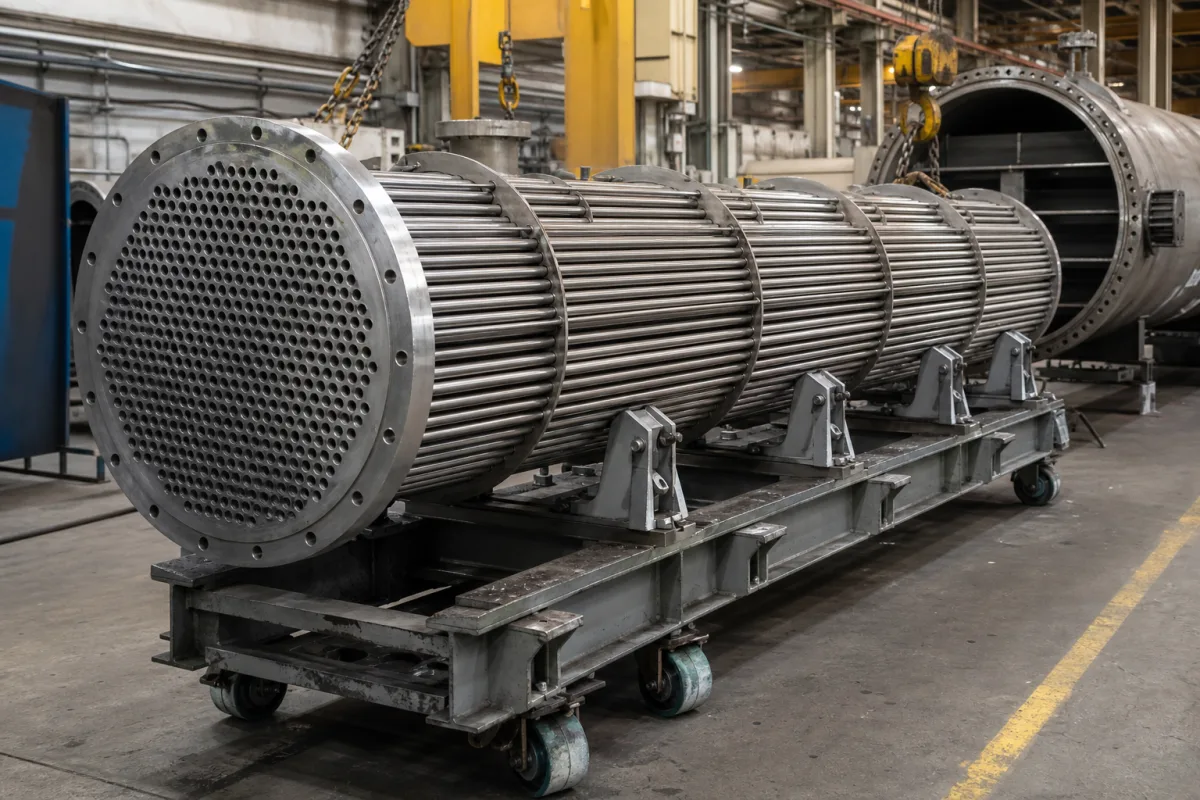
Heat exchanger internals · Tube layout and pitch, baffles, tubesheet joints and replacement bundles
A tube bundle is the removable or fixed core of a shell-and-tube heat exchanger: tubes, tubesheets, baffles, tie rods and spacers. Ask three things first: whether the shell side must be cleaned mechanically, what tube size, material and count the duty needs, and whether you are ordering a new exchanger or a replacement bundle to fit an existing shell.
Tube bundles for shell-and-tube heat exchangers, air coolers, boilers and fired heaters, including replacement bundles. Complete exchanger thermal sizing is covered on the heat exchanger page; tube-bundle dryers are a different machine and are outside this page.
CNFX editorial research · Sources checked October 11, 2026 · 4 sources
A lecture on shell-and-tube exchangers by Abhishek Kumar Chandra defines the tube bundle as the assembly of tubes, baffles, tubesheets, spacers and tie rods, and explains that triangular and rotated-triangular layouts (30° and 60°) are compact, give better shell-side heat transfer and fit about 15% more tubes in a given shell for the same pitch ratio, but cannot be cleaned mechanically on the shell side, only chemically or by water jet; square and rotated-square layouts have lower pressure drop and heat transfer. [1]
A second lecture gives the recommended pitch as 1.25 times the tube outside diameter unless the process dictates otherwise, and a minimum clearance between tubes of 6.4 mm (0.25 in) where a square pattern is used for cleaning; square layouts are used for heavily fouling shell-side fluids. [2]
Editorial calculation: for 20 mm tubes, 1.25 × 20 = 25 mm pitch leaves 25 − 20 = 5 mm between tubes, less than the 6.4 mm cleaning clearance, so a mechanically cleaned square layout would need at least 20 + 6.4 = 26.4 mm pitch. [2]
Give the supplier the exchanger type and shell size, tube OD, wall, length, material and count, layout and pitch, number of passes, baffle type, cut and spacing, tubesheet material and thickness, tube-to-tubesheet joint, design pressure and temperature, design code and, for replacements, the existing drawing.
02
Set baffles, supports and tubesheet joints
The lecture notes that segmental baffle cuts range from 20% to 49%; cuts below 20% raise pressure drop and larger cuts create stagnant zones. Baffle spacing ranges from one-fifth to one shell diameter, and the lecture allows larger inlet and outlet spacings to clear the nozzles, and TEMA sets minimum baffle thickness. [1]
Tie rods are screwed into the stationary tubesheet and run to the last baffle, where locknuts hold them, and with spacers they keep baffles in place and can block bypass lanes. Tubes are expanded into grooved tubesheet holes by rolling, which must seal without over-thinning the tube; fixed-tubesheet designs may need an expansion joint in the shell, and the lecture lists TEMA classes R, C and B. [1]
Editorial calculation: heat transfer area is tube count × π × tube OD × effective length. For 738 tubes of 20 mm OD and 6 m length, area ≈ 738 × π × 0.020 × 6 ≈ 278 m², matching the worked example in the second lecture. [2]
A 2024 Scientific Reports paper from Northeast Petroleum University reports that in one Daqing Petrochemical exchanger, 15 of 128 tubes failed and were plugged, the causes being touching abrasion against baffle plates and fatigue cracking from bundle vibration. In that five-baffle exchanger the authors group tubes by support: type B passes through all five baffles (high stiffness), type A through three baffles and two baffle-gap areas, and type C through two baffles and three baffle-notched areas (low stiffness); the failed tubes sat at the interface between tube types. Their simulation of a square bundle at pitch ratio 1.28 found the target tube's amplitude smallest when neighbouring tubes had equal stiffness, and that lower stiffness upstream or downstream can reduce the critical flow velocity, "making it more prone to experiencing fluid-elastic instability". [4]
Editorial calculation: 15 ÷ 128 = 11.7% of the tubes in that exchanger were lost to vibration damage; ask the supplier for a flow-induced vibration check covering the tubes in the baffle windows and at the inlet and outlet spans. [4]
03
Where the listed bundles go: air coolers, refrigeration, boilers and fired heaters
Sinton and Ever list tube-bundle and shell-and-tube heat exchangers; Datang lists tube-bundle exchangers, air-cooler tube bundles and U-bend tubes; Shenglin lists air-cooler tube bundles and shell-and-tube exchangers; VR Cooler lists tube bundles for refrigeration; Xuyi lists titanium U-tube and shell-and-tube exchangers; ORL lists convection tube bundles for boilers; Tuopu lists tube bundles for fired heaters and DRI plants.
04
Name the tube specification, wall basis and unit system
ASTM International's abstract for A179/A179M-19 states that it covers minimum-wall-thickness, seamless cold-drawn low-carbon steel tubes for tubular heat exchangers, condensers and similar heat transfer apparatus, and that the tubes shall be made by the seamless process and cold drawn. Its scope covers tubes from 1/8 to 3 in. [3.2 to 76.2 mm], inclusive, in outside diameter. [3] Heat and product analysis must show conformance on carbon, manganese, phosphorus and sulfur, and the steel must pass hardness, flattening, flaring, flange and hydrostatic tests. Mechanical property requirements do not apply to tubing smaller than 1/8 in. [3.2 mm] in outside diameter or with a wall thickness under 0.015 in. [0.4 mm]. [3]
The scope also states that values in inch-pound and SI units are not exact equivalents, that each system must be used independently of the other, and that combining values from the two systems may result in nonconformance with the specification; the inch-pound units apply unless the order specifies the "M" designation. [3]
Editorial note: when ordering a carbon-steel bundle to this specification, state the wall as a minimum (not nominal) value, give the designation with or without "M" to fix the unit system, and ask for certificates showing the chemical analysis and each listed mechanical and hydrostatic test. [3]
05
What holds a bundle together: tubesheets, baffles, tie rods and seals
The baffle row carries the vibration finding from the 2024 paper as well as the lecture, because tubes in the baffle windows have fewer supports.
Tube count, pitch and joint details a bundle drawing must fix
Pitch, layout angle and area follow the lecture rules worked through above; design pressure, temperature, tube material and weight have no published value here and must come from your duty or the supplier. For a replacement bundle, take the values from the existing drawing.
Explore company information and manufacturing capabilities, then discuss the scope of your project with a relevant supplier.
Share this page
Compiled and source-reviewed by the CNFX editorial team.
Each manufacturer above links to the page on that company's own website where the product is listed, with the date we checked it. How we source and review
· Page last updated 13 October 2026
Buyer questions
Triangular or square tube layout?
Triangular layouts fit about 15% more tubes and give better shell-side heat transfer but cannot be cleaned mechanically outside the tubes; square layouts allow mechanical cleaning and give lower pressure drop. [1]
What tube pitch should a bundle use?
The recommended pitch is 1.25 times tube OD; square layouts for cleaning need at least 6.4 mm clearance between tubes. [2]
What baffle cut range does the lecture give?
The lecture gives segmental baffle cuts from 20% to 49%, and explains that cuts below 20% raise pressure drop while larger cuts create stagnant zones. [1]
What does ASTM A179 cover for heat-exchanger tubes?
ASTM International's abstract says A179/A179M covers minimum-wall, seamless cold-drawn low-carbon steel tubes from 1/8 to 3 in. [3.2 to 76.2 mm] outside diameter, tested for hardness, flattening, flaring, flange and hydrostatic pressure. [3]
Why do tube-bundle tubes fail at the baffles?
A 2024 study of a Daqing Petrochemical exchanger found 15 of 128 tubes plugged after touching abrasion at baffle plates and fatigue cracking caused by flow-induced vibration, concentrated where tubes with different baffle support met. [4]
Sources and what still needs a direct check
Sources checked 2026-10-11. Two sources are university lecture notes on shell-and-tube heat exchanger design that refer to TEMA; the ASTM abstract covers carbon-steel exchanger tubes, and a 2024 open-access paper from Northeast Petroleum University analyses tube-bundle vibration. Supplier pages describe their own offers.