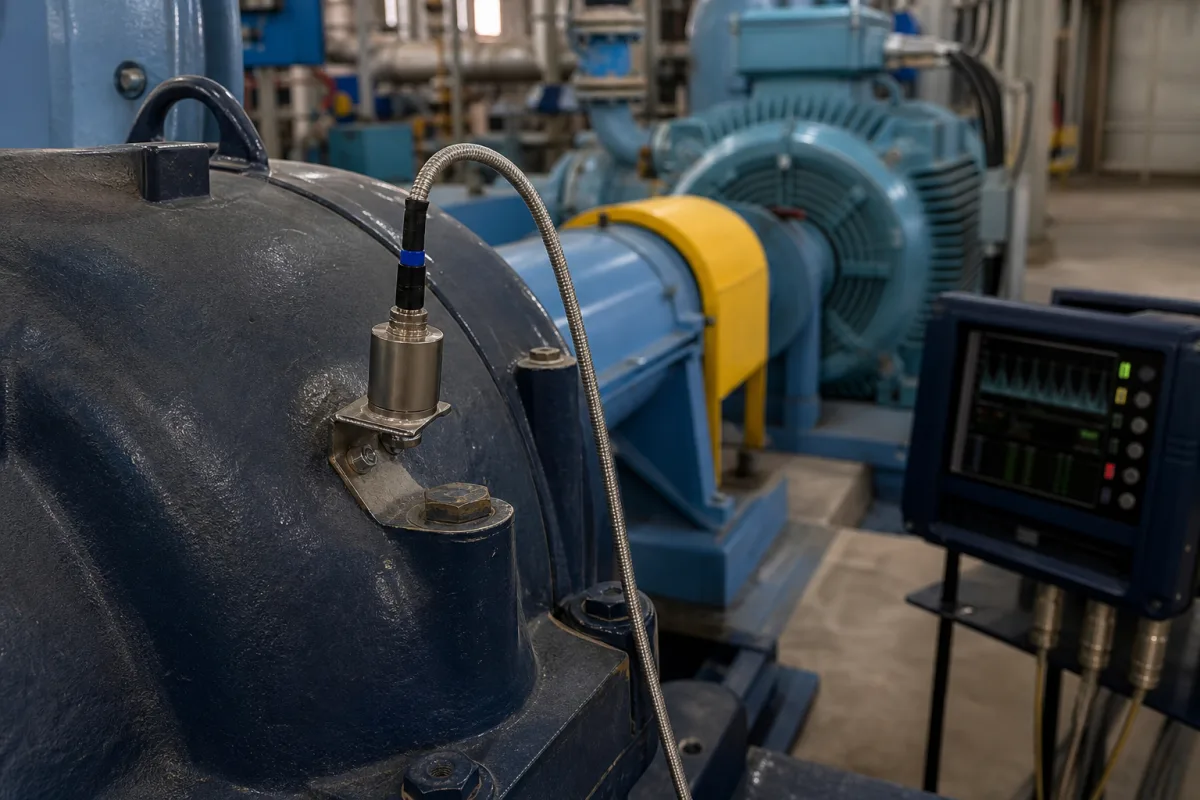
Machine condition monitoring · Sensor type, frequency range, mounting, output and environment
A vibration sensor measures the acceleration, velocity or displacement of a machine surface. Ask three things first: which frequencies and levels matter for the faults you want to find, how the sensor will be mounted, and what output and power the monitoring system expects.
Accelerometers and vibration transmitters for machine condition monitoring and testing: piezoelectric and IEPE, MEMS 4–20 mA and wireless sensors. Smart-home vibration alarms and sensor connectors are outside this page.
CNFX editorial research · Sources checked October 12, 2026 · 4 sources
PCB Piezotronics' selection note explains that piezoelectric and other AC-coupled accelerometers cannot follow slow motion without zero-offset error, so DC-response types such as piezoresistive or variable-capacitance (MEMS) sensors suit motion and near-DC measurement; high-frequency work such as gear noise or high-speed machinery needs a high resonance frequency, and "high resonance designs usually mean very low output sensitivity". [1]
For machine health monitoring the note lists ruggedness, hermetic sealing and low cost per point, and says "IEPE types are more widely used due to their lower cost and the ability to operate in very dirty environments"; above 200 °C only charge-mode piezoelectric sensors are an option. [1]
Mounting changes what the sensor sees: "stud mounting is the most reliable method for measurement above 10kHz", couplant grease should be used where possible, and adhesive mounting can reduce base-strain errors at low frequency. [1]
Give the supplier the machine, speeds and fault frequencies of interest, expected vibration level, temperature, mounting surface, output and power required, cable length, hazardous-area needs and number of points.
02
Check output, range and installation
Rion's AKF398 MEMS sensor, for example, gives three-axis 4–20 mA outputs with ranges from ±2 g to ±40 g, sensitivity from 4 to 0.2 mA/g (±10%), 500 Hz frequency response, 1,000 Hz bandwidth, 2.4–5.5 kHz resonance, 9–36 V supply, −40 to +85 °C and a 2,000 g shock rating. [2] The same page also calls it a voltage-output sensor, so confirm the output type.
Editorial calculation: a 4–20 mA loop spans 16 mA, so over a ±2 g range (4 g in total) sensitivity is 16 ÷ 4 = 4 mA/g, and over ±40 g it is 16 ÷ 80 = 0.2 mA/g, matching the listed figures. [2] A wider range means less current per g; choose the smallest range that covers the largest expected level.
Wireless sensors trade reporting rate against battery life. Minew's LSV01 LoRaWAN sensor measures three axes to below 400 Hz and 16 g, velocity from 0.1 to 199.9 mm/s and temperature, in an IP67 housing; it quotes about 120 days of battery life at 1-minute reporting and up to 5 years at 10-minute reporting. [3]
03
Check the frequency band of digital MEMS sensors against the faults you track
A 2024 study in Sensors by Fidali and co-authors tested digital vibration sensors built on capacitive MEMS accelerometers against a reference piezoelectric accelerometer of 100 mV/g on bearings with seeded faults at 600, 1,500 and 3,000 rpm. Its comparison table lists the Balluff BCM0002 (3 axes, ±16 g, 2–2,500 Hz, ±10% from 2 to 1,800 Hz and ±3 dB to 2,500 Hz, IO-Link 1.1, −25 to +70 °C), the Banner QM30VT2 (2 axes, 0–46 mm/s velocity, 10–4,000 Hz, ±10% at 25 °C, RS-485 Modbus RTU, −40 to +105 °C) and the Sick MPB10 (3 axes, ±8 g, 0–100 mm/s at 88 Hz, 0.78–3,200 Hz, ±6%, IO-Link 1.1, −40 to +80 °C). The authors note that the frequency band of these sensors does not exceed 4 kHz, which suits basic machine diagnostics under ISO 10816 and ISO 20816, while non-linearities at the band limits may restrict precise measurement. [4]
Editorial calculation: a 4 kHz upper limit is 40% of the 10 kHz above which PCB recommends stud mounting, so any fault signature you track above 4 kHz falls outside these three sensors' bands and needs a sensor whose flat band reaches it. Ask suppliers for the flat band with its tolerance, the interface (IO-Link, Modbus, 4–20 mA) and which diagnostic values are computed in the sensor. [4][1]
Rion sells wired MEMS transmitters and Minew a battery LoRaWAN unit; the other listed companies range from condition-monitoring system makers to acoustic-meter and fan-accessory suppliers. [2][3]
Rion lists MEMS vibration sensors with 4–20 mA, voltage, RS232 and Modbus outputs; Minew lists the LSV01 wireless sensor; Broadsens lists wireless vibration, temperature and speed sensors for machine and structural monitoring; RONDS lists sensors and wireless systems for condition monitoring; Fire-Power lists vibration accelerometers and IMUs; BSWA and Aihua list vibration sensors with acoustic and vibration meters; Ziasiot lists a vibration sensor among pressure and position sensors; Jingcai lists vibration sensors as fan accessories. [2][3]
05
Sensing element, conditioning, housing, mount, link and power
Whether the element is piezoelectric or MEMS decides the low-frequency limit; the mounting base decides how much of the high end survives.
Part
Role
Fix in the order
Sensing element
Piezoelectric, piezoresistive or capacitive MEMS. [1][2]
Range, band, sensitivity, output and environment for the quotation
Fault frequencies, levels and the receiving system come from your machines. Rion, Minew, PCB and the Fidali study supply the example values in the middle column.
Field
What it means and published values
Ask the supplier for
Measuring range (mm/s)
E.g. 0.1–199.9 mm/s velocity; ±2 to ±40 g acceleration. [3][2]
Range in your units.
Frequency range (Hz)
E.g. 500 Hz response; below 400 Hz; 2–2,500 to 10–4,000 Hz (digital MEMS). [2][3][4]
11 companies list this product among what they make. Company figures are quoted from each
company's own website; every card states where the relationship came from.
Shenzhen RION Technology Co., Ltd.
Manufacturing site to be confirmed for the order
Lists MEMS vibration sensors with 4–20 mA, voltage, RS232 and Modbus outputs.
Explore company information and manufacturing capabilities, then discuss the scope of your project with a relevant supplier.
Share this page
Compiled and source-reviewed by the CNFX editorial team.
Each manufacturer above links to the page on that company's own website where the product is listed, with the date we checked it. How we source and review
· Page last updated 13 October 2026
Buyer questions
Which vibration sensor is used for machine health monitoring?
PCB says "IEPE types are more widely used due to their lower cost and the ability to operate in very dirty environments"; MEMS and wireless sensors are alternatives for low frequency or easier installation. [1][3]
How should a vibration sensor be mounted?
PCB calls stud mounting "the most reliable method for measurement above 10kHz", with couplant; adhesive mounting can reduce base-strain error at low frequency. [1]
How long does a wireless vibration sensor battery last?
It depends on reporting interval; one LoRaWAN sensor quotes about 120 days at 1-minute and up to 5 years at 10-minute reporting. [3]
What frequency range do digital MEMS vibration sensors cover?
A 2024 study comparing three industrial digital MEMS sensors found bands of 2–2,500 Hz, 10–4,000 Hz and 0.78–3,200 Hz, none above 4 kHz, suiting basic ISO 10816/20816 diagnostics. [4]
Sources and what still needs a direct check
Sources checked 2026-10-12. PCB Piezotronics is an accelerometer maker; its technical note gives selection guidance. Rion and Minew are suppliers listed on this page; their values are catalogue figures.