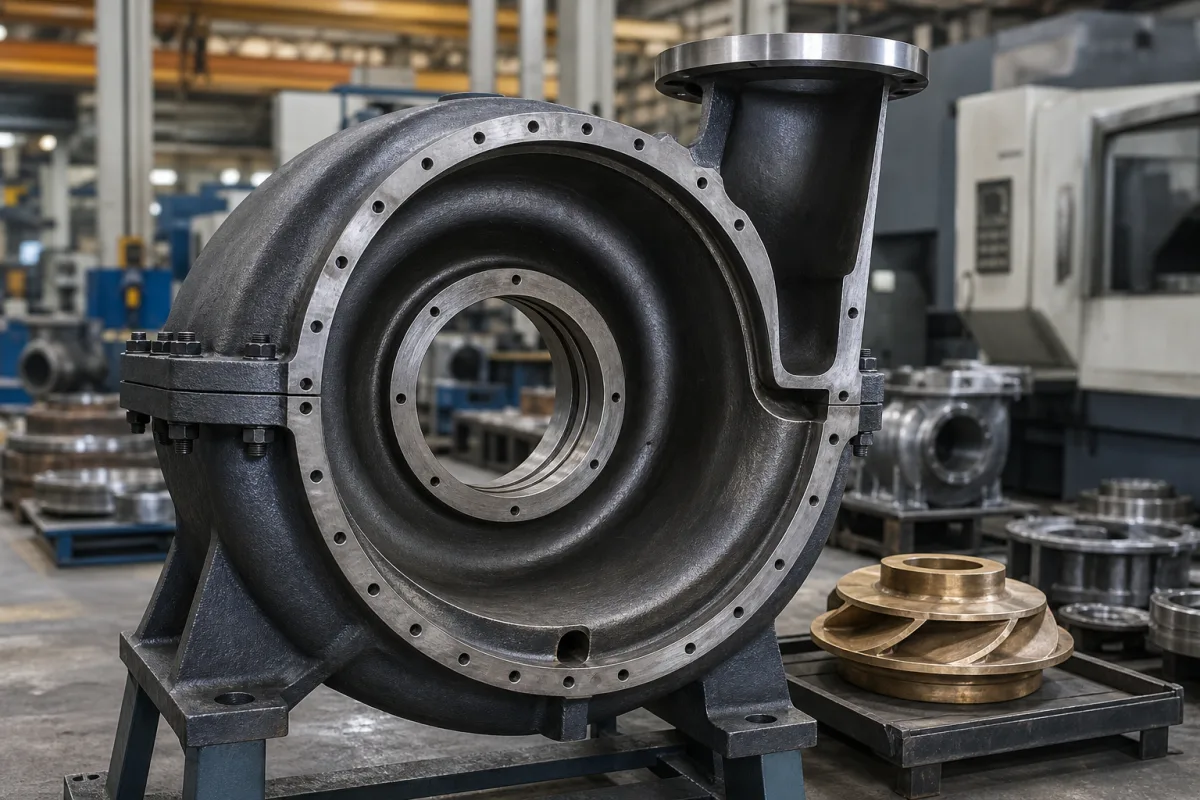
Volute casing for centrifugal pumps: single or double volute, cast pressure housing
Centrifugal pump volute casings as cast pressure parts · single or double volute against radial thrust, wall thickness and stress at the volute junction, casting route and finish
A volute casing is the spiral housing around a centrifugal pump impeller: it collects the flow leaving the impeller and converts its kinetic energy into pressure on the way to the discharge nozzle, and it is also the pump's main pressure-containing casting. Bought on its own, as a replacement or as an OEM casting, it is specified by its hydraulic form and as a pressure part. Ask three things first: single or double volute, the pressure and temperature the casting must hold and its wall thickness, and the casting material, route and surface finish of the hydraulic passage.
Volute casings for single-stage and two-stage centrifugal pumps, supplied as castings or machined casings: single, double and split volutes, end-suction and radially split designs, specified by volute type, pressure and temperature rating, wall thickness, material, casting route and finish. Complete industrial pumps, their head, NPSH and operating-region selection are covered on the Industrial pumps page. Diffuser and stage casings of multistage pumps, impellers, wear rings sold separately and turbocharger or fan volutes are outside this page.
CNFX editorial research · Sources checked October 12, 2026 · 5 sources
Choose a single or double volute for the radial thrust
KSB's centrifugal pump lexicon explains that the steady hydraulic radial force in a volute casing pump comes from the interaction of impeller and casing, changes in magnitude and direction with the ratio of flow to best-efficiency flow, and rises rapidly in the low-flow and overload ranges. To balance it, a double volute is used instead of a single volute: two partial volutes with the same effect, offset by 180° and ending in the same discharge nozzle. [1][2]
KSB's example also shows that impeller position in the casing matters: with the impeller centred, the radial force is smallest at the best efficiency point, while an eccentricity of 2% of the impeller radius gives larger minimum forces that lie away from the best efficiency point. For pumps with diffusers, which in theory have no radial force, it estimates the force caused by manufacturing inaccuracies with a radial force coefficient of K = 0.09. [1]
Volute casing pumps are built to standardised main dimensions under EN 733, ISO 2858 and ISO 5199, while leaving room for design variants; the discharge nozzle can be tangential or radial (through a "gooseneck") and placed at the top, bottom or sides as long as it clears the pump feet. [3]
Editorial note: a replacement casing must reproduce the original volute type, throat area and impeller clearance; ask for the hydraulic drawing or a scan of the original, not only the flange dimensions.
Send the pump model or hydraulic drawing, volute type (single, double, split), impeller diameter and clearance, design pressure and temperature, test pressure, fluid, casing material and casting standard, flange standard and rating, wall thickness and corrosion allowance required, surface finish of the passage, inspection and NDT, and the number of castings.
02
Check the casting as a pressure part
A 1992 Westinghouse Savannah River Company report for the US Department of Energy analysed the casings of double-suction, double-volute, radially split process water pumps. The casing and suction cover were Type 304 CF8 stainless steel, with casing wall thickness from 1.25 in to 1.75 in, operating at up to 196 °F with inlet and outlet pressures of 16 and 225 psig; a start-up peak of 267 ± 4 psig was rounded to 300 psig for analysis. [4]
The finite-element analysis, using the minimum 1.25 in wall throughout, found maximum principal stresses from pressure of about 18 ksi in the discharge volute near the junction of the suction and discharge volutes, with considerable bending through the wall caused by the sudden pressure change and abrupt geometry there; the volute's built-in splitter, not modelled, was expected to reduce these stresses, and nozzle loads had negligible effect. The report notes that ASME Code Case N-481 calls for a detailed stress analysis in lieu of volumetric examination of such pump casings. [4] Editorial calculation: 1.25–1.75 in ≈ 32–44 mm; 300 psig ≈ 2.07 MPa; 18 ksi ≈ 124 MPa.
Editorial note: because the analysis placed the peak stress at the junction of the suction and discharge volutes, specify NDT coverage of that region and a hydrostatic test pressure in the order.
03
Choose the casting route, material and passage finish
Aopu Alloy, an investment caster, lists volute casings in stainless steel, (super) duplex stainless steel, carbon steel, nickel-based alloy and high-chromium cast iron, and states that its investment-cast volutes reach a surface roughness of Ra 3.2–Ra 6.3, better than sand castings, so the hydraulic channel does not need polishing in the normal case. [5]
Editorial note: casting route, material and finish should follow the fluid and the casing's pressure duty; give the casting standard, chemical and mechanical test requirements and the finish of the volute passage separately from the finish of machined faces.
04
Volute casing data to put on the drawing and order
These are the order fields for a volute casing, read against the sources above.
Field
What sets it
Ask the supplier for
Nominal diameter (mm)
Suction and discharge nozzle sizes; main dimensions may follow EN 733, ISO 2858 or ISO 5199. [3]
Nozzle sizes and flange standard.
Flow rate (m³/h)
Duty of the pump the casing belongs to; radial force varies with Q/Qopt. [1]
Design flow and range.
Head (m)
Pump duty.
Design head.
Operating pressure (MPa)
300 psig (≈2.07 MPa) design case in the DOE-funded analysis. [4]
Explore company information and manufacturing capabilities, then discuss the scope of your project with a relevant supplier.
Share this page
Compiled and source-reviewed by the CNFX editorial team.
Each manufacturer above links to the page on that company's own website where the product is listed, with the date we checked it. How we source and review
· Page last updated 13 October 2026
Buyer questions
What does a double volute do?
KSB describes two partial volutes offset by 180° into one discharge nozzle, used instead of a single volute to balance radial thrust. [2]
Where is the highest stress in a volute casing?
In the Savannah River analysis it was about 18 ksi at 300 psig in the discharge volute near where the suction and discharge volutes meet. [4]
How smooth can a cast volute passage be?
An investment caster quotes Ra 3.2–6.3 for its volute castings, so the channel need not be polished in the normal case. [5]
Sources and what still needs a direct check
Sources checked 2026-10-12. KSB's lexicon explains volute hydraulics and radial thrust from a pump maker's view; the Westinghouse Savannah River report for the US DOE analyses a real cast double-volute casing; Aopu Alloy describes its own investment-cast volutes.