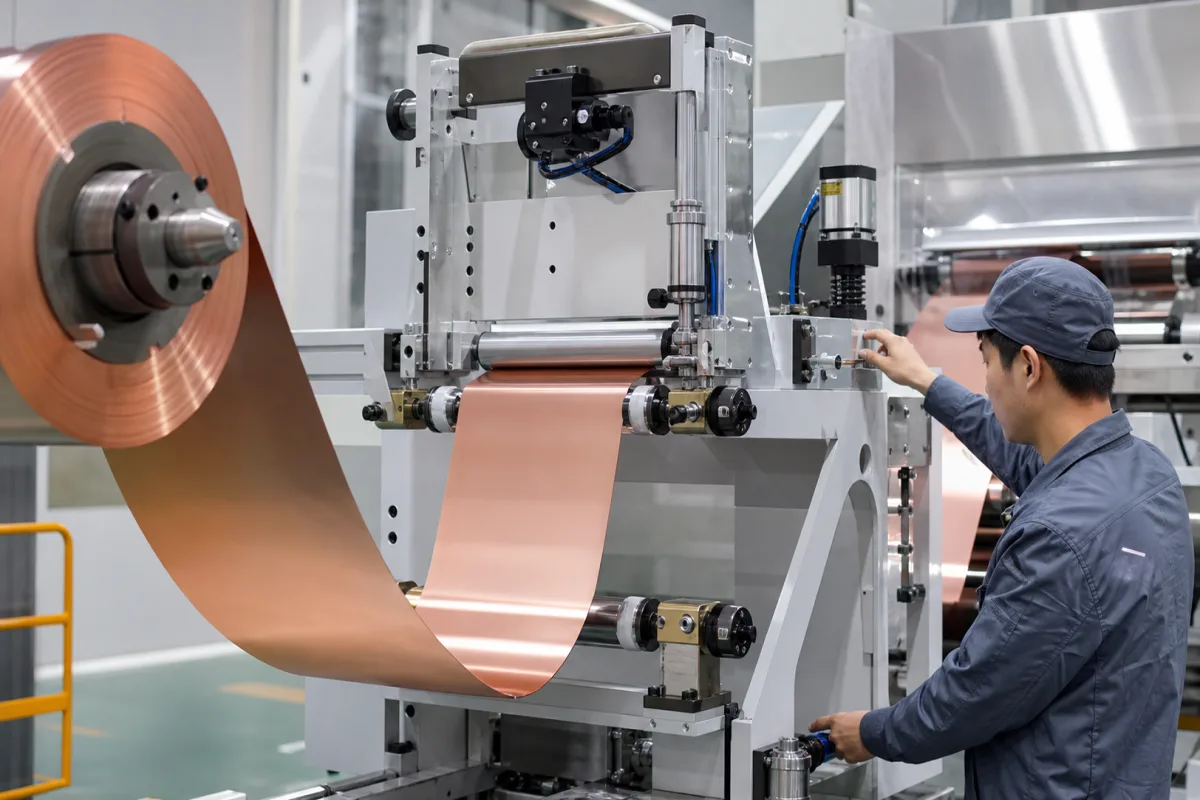
Web tension control unit for battery electrode coating: holding thin copper and aluminium foil through the coater and drying oven
Tension control through the coating and drying section of a battery electrode line · copper foil 2–10 µm at 40–70 kgf/mm², a coater holding ±2 N through a 60–80 m oven at up to 100 m/min, and the slack that intermittent coating puts into the foil
On an electrode coating line the current-collector foil is a few micrometres thick, it is wet on one side for part of its path, and it travels tens of metres through an oven before it is wound again. The tension control unit (load-cell rolls, driven guide rolls, unwind and rewind drives and the controller between them) must keep it taut enough to coat and track evenly but far from the load that would tear it. This page puts numbers on the foil's limit, on what one high-speed coater holds, and on the disturbance intermittent coating adds.
Web tension control on lithium-ion battery electrode coating and drying lines: unwind and rewind tension, load-cell and driven guide rolls in the coating head area and the drying oven, and tension disturbance from intermittent (patterned) coating on copper and aluminium current-collector foil. General web tension control with dancers, load cells and controllers is covered on the Web tension control page; tension on electrode slitting and rewinding machines on the Tension control system for lithium-ion battery electrode slitting and rewinding page; tension around the calender nip on the Web tension control system for battery electrode calenders page. The coating line as a whole (heads, dryers, solvent recovery) is covered on the Lithium-ion battery electrode coating machine page, and the calender itself on the Battery electrode calendering machine page.
CNFX editorial research · Sources checked October 13, 2026 · 3 sources
What 6–10 µm electrodeposited copper foil can carry: 40–70 kgf/mm² and a few newtons per millimetre of width
ILJIN Materials' patent US10686191B2 covers electrodeposited copper foil for lithium-ion battery current collectors and gives the properties a coater's tension unit works against. [1]
ILJIN notes that a large corner curl can lead to corners being torn or folded and to wrinkles forming while the active material is coated. [1]
Editorial calculation: 40 kgf/mm² is 392 MPa and 70 kgf/mm² is 686 MPa. Multiplying by thickness gives the force per millimetre of width at which the foil breaks: 6 µm foil at 392 MPa breaks at about 2.4 N/mm, and at 686 MPa at about 4.1 N/mm; 10 µm foil at 392 MPa at about 3.9 N/mm. Across a 1,600 mm web, 6 µm foil at the lower strength breaks at about 3,770 N in total. Ask the supplier to state each tension setpoint as a fraction of this break load.
Give foil material, thickness, width, tensile strength and elongation from the foil supplier's certificate, and ask the coater supplier for the tension setpoint range in N and in N per mm of width.
02
±2 N through a 60–80 m oven at up to 100 m/min: tension figures on a double-deck electrode coater
Hymson's high-speed coating machine coats copper or aluminium foil with slurry, dries it and rewinds it, and lists its tension performance alongside the line dimensions. [2]
Editorial note: the same page gives ±2 N for tension control during operation and ≤±3 N for tension fluctuation outside acceleration and deceleration; ask the supplier which figure is guaranteed, at which tension setpoint, and what the deviation is during ramps and splices.
Editorial calculation: at 100 m/min, foil spends 36 to 48 s in a 60–80 m oven. Against the 3,770 N break load of a 1,600 mm, 6 µm web worked out above, ±2 N is about 0.05% of that load; the published figure says nothing about the setpoint itself.
Give line speed, oven length, number of driven rolls and tension zones you expect, and ask for the tension trend through a speed ramp and a roll change.
03
Slack when the backing roll retracts: the tension disturbance of intermittent coating
In intermittent (patterned) coating the backing roll moves away from the coating roll to leave uncoated gaps. FDK and Hirano Tecseed's patent US5582868A describes what that does to foil about 400 mm wide and 10 µm thick. [3]
When the backing roll is displaced with the guide rolls around it fixed, the foil between them goes slack; tension from the take-up roll removes the slack, the patent giving less than half a second as an example, but because the spans between backing roll and guide rolls are short, the deflection angles are large and re-tightening can leave wrinkles or folds. Wrinkled foil coats unevenly, which the patent links to capacity imbalance between electrodes in spiral cells. [3]
Its solution is mechanical: the first guide roll is mounted on the same movable frame as the backing roll so they move together, and a feed roll is placed below the second guide roll at a distance of 90 to 210 times the backing roll's travel, so the deflection angle stays small and the foil swings back around a guide roll in the drying furnace instead of buckling. [3]
Editorial calculation: if the backing roll retracts 1 mm (an illustrative figure, not one from the patent), the feed roll would sit 90 to 210 mm below the second guide roll. The point for the tension unit is that each gap in the coating is a periodic disturbance, so its response has to be judged at the patch-and-gap frequency, not only at steady speed.
Say whether coating is continuous or intermittent, the coated and uncoated lengths, and the backing-roll travel, and ask how tension is held through each gap.
04
What to send for a coater web tension control unit
Paste it into your enquiry below or into an email to a maker, then replace every bracket.
Foil: [Cu or Al; thickness; width; tensile strength; elongation]
Line: [speed; oven length; tension zones]
Tension: [setpoint per zone in N; allowed deviation steady and in ramps]
Coating: [continuous or intermittent; patch and gap lengths]
Hardware: [load-cell rolls; driven guide rolls; unwind/rewind type]
Data: [tension trend logging]
Explore company information and manufacturing capabilities, then discuss the scope of your project with a relevant supplier.
Share this page
Compiled and source-reviewed by the CNFX editorial team.
Each manufacturer above links to the page on that company's own website where the product is listed, with the date we checked it. How we source and review
· Page last updated 13 October 2026
Buyer questions
How strong is battery copper foil?
ILJIN's patent gives electrodeposited copper foil 2–10 µm thick a tensile strength of 40–70 kgf/mm² before and after 1 h at 180 °C, with elongation of 4% or more in its embodiment. [1]
How closely does an electrode coater hold tension?
Hymson states ±2 N tension control during operation and tension fluctuation within ±3 N outside acceleration and deceleration, on a coater up to 1,600 mm wide running at up to 100 m/min. [2]
Why does intermittent coating cause wrinkles in the foil?
FDK and Hirano Tecseed's patent explains that the foil goes slack when the backing roll retracts, and short spans with large deflection angles let it wrinkle as it re-tightens. [3]
How long does foil spend in the coater's drying oven?
At Hymson's 100 m/min maximum, a 60–80 m oven gives 36–48 s (editorial calculation). [2]
Sources and what still needs a direct check
Sources checked 2026-10-13. Foil thickness, strength, elongation and curl come from ILJIN Materials' patent US10686191B2; coater tension, width, speed and oven data from Hymson's high-speed coating machine page; intermittent-coating slack and its remedy from FDK and Hirano Tecseed's patent US5582868A.