Industry-Verified Manufacturing Data (2026)

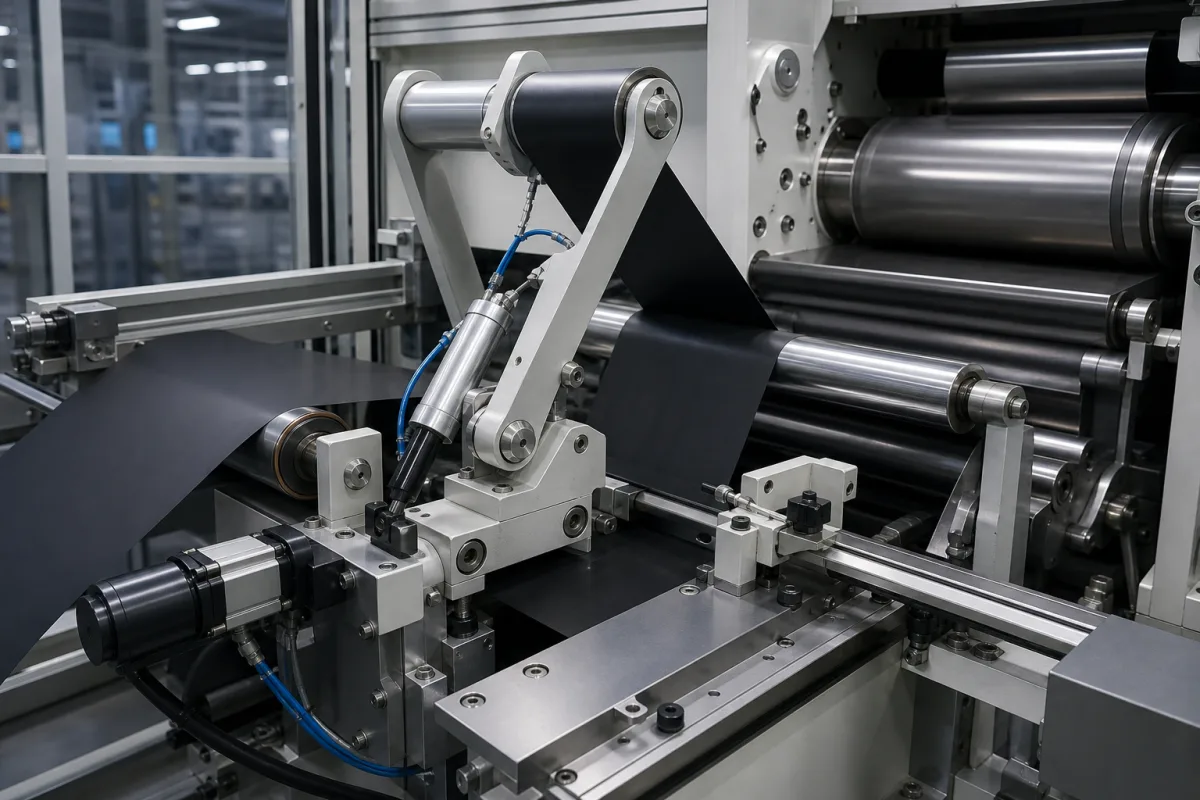
Web Tension Control System

Based on aggregated insights from multiple verified factory profiles within the CNFX directory, the standard Web Tension Control System used in the Machinery and Equipment Manufacturing sector typically supports operational capacities ranging from standard industrial configurations to heavy-duty production requirements.

Technical Definition & Core Assembly

A canonical Web Tension Control System is characterized by the integration of Tension Sensor and PLC Controller. In industrial production environments, manufacturers listed on CNFX commonly emphasize Stainless steel housing construction to support stable, high-cycle operation across diverse manufacturing scenarios.

A precision control system that maintains consistent tension in electrode material webs during the calendering process.

Product Specifications

Technical details and manufacturing context for Web Tension Control System

Definition
A critical subsystem within Battery Electrode Calendering Machines that precisely regulates and maintains optimal tension levels in electrode material webs (typically anode or cathode coatings on metal foils) as they pass through the calendering rollers. This system ensures uniform material density, prevents wrinkles or tears, and maintains consistent electrode thickness by dynamically adjusting tension based on real-time feedback from sensors.
Working Principle
The system continuously monitors web tension using load cells, dancer rollers, or ultrasonic sensors. A programmable logic controller (PLC) processes this data and adjusts the speed of unwind/rewind motors or applies braking force to maintain preset tension values. Closed-loop feedback ensures stable tension despite variations in material properties, speed changes, or environmental conditions.
Common Materials
Stainless steel housing, Aluminum alloy components, Polymer rollers, Electronic sensors and controllers
Technical Parameters
  • Tension range typically 50-500 N/m for electrode materials (N/m) Customizable
Components / BOM
  • Tension Sensor
    Measures real-time tension in the electrode web
    Material: Stainless steel with strain gauges
  • PLC Controller
    Processes sensor data and sends control signals
    Material: Electronic components in aluminum housing
  • Brake/Clutch Assembly
    Applies controlled resistance to regulate web tension
    Material: Electromagnetic components with steel housing
  • Dancer Roller
    Provides mechanical feedback and web path guidance
    Material: Aluminum core with polymer coating
Engineering Reasoning
0.5-15 kN/m
Tension deviation exceeding ±2.5% of setpoint for >500 ms
Design Rationale: Hooke's law elastic limit violation causing plastic deformation in electrode material microstructure
Risk Mitigation (FMEA)
Trigger Load cell drift exceeding 0.1% FS/year due to Wheatstone bridge thermal coefficient mismatch
Mode: PID controller integral windup causing 12% overshoot in tension response
Strategy: Quadrature encoder feedback loop with 0.01 mm resolution and 1000 Hz sampling rate
Trigger Servo motor cogging torque ripple at 1.2 N·m peak-peak amplitude
Mode: Web flutter at 8-12 Hz resonance frequency exceeding 3 mm amplitude
Strategy: Dancer roll assembly with 0.5 kg·m² inertia and 0.0003 N·m·s/rad viscous damping coefficient

Industry Taxonomies & Aliases

Commonly used trade names and technical identifiers for Web Tension Control System.

Industrial Ecosystem & Supply Chain DNA

Complementary Systems
Downstream Applications
Specialized Tooling

Application Fit & Sizing Matrix

Operational Limits
pressure: 0-10 bar (web tension control range)
web width: 100-2000 mm
temperature: 10°C to 50°C (ambient operating range)
max line speed: 0-100 m/min
tension accuracy: ±0.5% of setpoint
Media Compatibility
✓ Lithium-ion electrode slurry coatings ✓ Separator films (PE/PP/Ceramic) ✓ Copper/aluminum current collector foils
Unsuitable: Abrasive particulate slurries with >50μm particle size
Sizing Data Required
  • Web width (mm)
  • Maximum line speed (m/min)
  • Required tension range (N/m or kg/m)

Reliability & Engineering Risk Analysis

Failure Mode & Root Cause
Encoder Signal Loss
Cause: Accumulation of dust, debris, or moisture on optical encoder surfaces, leading to signal degradation or complete loss; often exacerbated by poor environmental sealing and inadequate maintenance intervals.
Load Cell Drift
Cause: Thermal expansion/contraction from ambient temperature fluctuations, mechanical fatigue from cyclic loading, or contamination (e.g., oil ingress) altering strain gauge calibration, resulting in inaccurate tension readings.
Maintenance Indicators
  • Audible: High-frequency squealing or grinding from tension roller bearings, indicating lubrication failure or imminent bearing seizure.
  • Visual: Erratic or oscillating web movement during steady-state operation, suggesting control loop instability from sensor faults or actuator wear.
Engineering Tips
  • Implement predictive maintenance via vibration analysis on tension rollers and motor drives to detect early bearing wear, and use infrared thermography to identify electrical hotspots in drive components.
  • Install environmental controls (e.g., air purifiers, humidity regulators) around encoder and load cell assemblies, and perform quarterly calibration checks using traceable reference weights to maintain measurement accuracy.

Compliance & Manufacturing Standards

Reference Standards
ISO 9001:2015 - Quality management systems IEC 61508 - Functional safety of electrical/electronic/programmable electronic safety-related systems CE Marking - Compliance with EU directives for machinery safety (2006/42/EC)
Manufacturing Precision
  • Shaft alignment: +/-0.05mm
  • Load cell calibration accuracy: +/-0.5% of full scale
Quality Inspection
  • Functional safety validation test (SIL verification)
  • Environmental stress screening (temperature, vibration, humidity)

Factories Producing Web Tension Control System

Verified manufacturers with capability to produce this product in China

✓ 95% Supplier Capability Match Found

P Procurement Specialist from Brazil Jan 03, 2026
★★★★★
"As a professional in the Machinery and Equipment Manufacturing sector, I confirm this Web Tension Control System meets all ISO standards."
Technical Specifications Verified
T Technical Director from Canada Dec 31, 2025
★★★★★
"Standard OEM quality for Machinery and Equipment Manufacturing applications. The Web Tension Control System arrived with full certification."
Technical Specifications Verified
P Project Engineer from United States Dec 28, 2025
★★★★★
"Great transparency on the Web Tension Control System components. Essential for our Machinery and Equipment Manufacturing supply chain."
Technical Specifications Verified
Verification Protocol

“Feedback is collected from verified sourcing managers during RFQ (Request for Quote) and factory evaluation processes on CNFX. These reports represent historical performance data and technical audit summaries from our B2B manufacturing network.”

7 sourcing managers are analyzing this specification now. Last inquiry for Web Tension Control System from Turkey (37m ago).

Supply Chain Compatible Machinery & Devices

Hydraulic Press

Industrial machine using hydraulic pressure to compress, form, or assemble materials

Explore Specs →
Heavy-Duty CNC Plasma Cutting Machine

Industrial machine for precision metal cutting using plasma arc technology

Explore Specs →
Automated Assembly Line System

Integrated production system for sequential component assembly operations

Explore Specs →
Automated Powder Coating System

Integrated industrial system for applying dry powder coatings to metal substrates.

Explore Specs →

Frequently Asked Questions

What is the primary application of this web tension control system?

This system is specifically designed to maintain consistent tension in electrode material webs during the calendering process in battery manufacturing and related industries, ensuring uniform material properties and preventing defects.

How does the system maintain precise tension control?

The system uses electronic tension sensors to monitor web tension in real-time, with a PLC controller adjusting the brake/clutch assembly and dancer roller position to maintain consistent tension throughout the calendering process.

What materials are used in the construction of this tension control system?

The system features a durable stainless steel housing, lightweight aluminum alloy components, wear-resistant polymer rollers, and precision electronic sensors and controllers for reliable operation in industrial environments.

Can I contact factories directly on CNFX?

CNFX is an open directory, not a transaction platform. Each factory profile provides direct contact information and production details to help you initiate direct inquiries with Chinese suppliers.

Get Quote for Web Tension Control System

Request technical pricing, lead times, or customized specifications for Web Tension Control System directly from verified manufacturing units.

Your business information is encrypted and only shared with verified Web Tension Control System suppliers.

Thank you! Your message has been sent. We'll respond within 1–3 business days.

Need to Manufacture Web Tension Control System?

Connect with verified factories specializing in this product category

Add Your Factory Contact Us
Previous Product
Web Guiding System
Next Product
Web Tension Control Unit