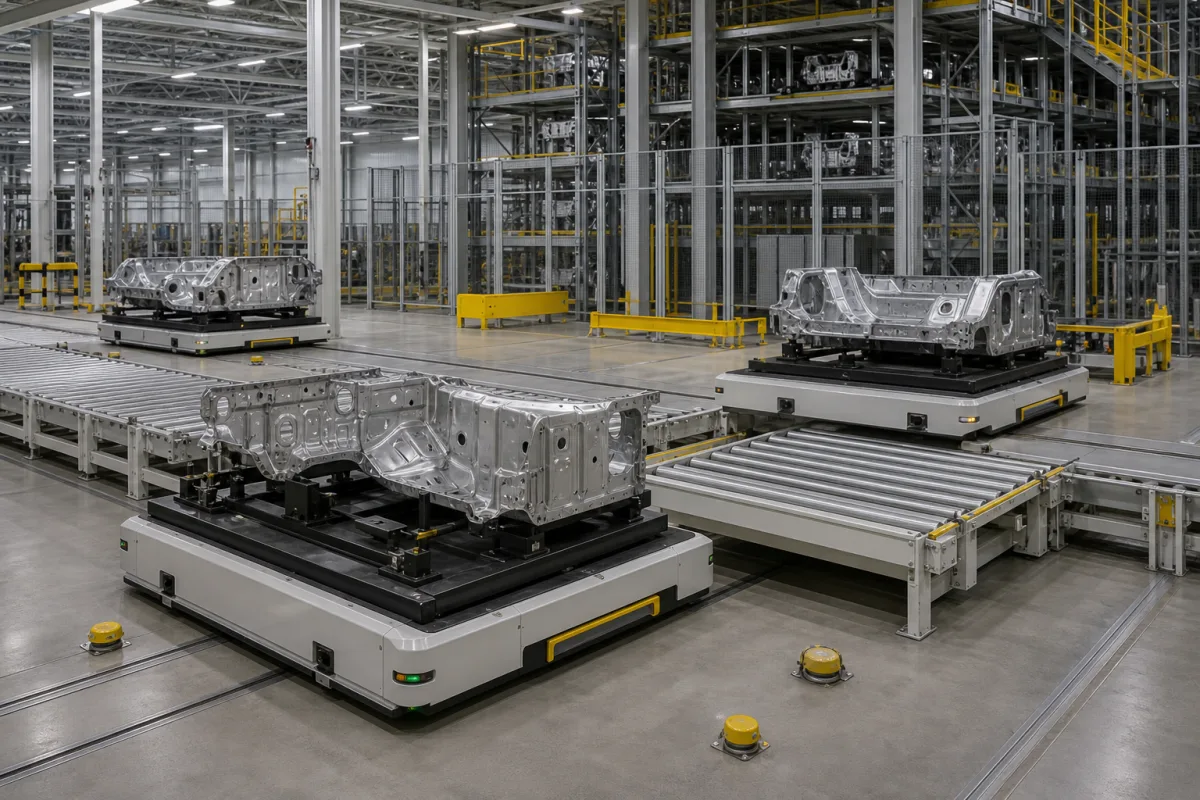
Body-in-white transport system on AGVs: carrying underbodies and welded car bodies between body-shop lines, roller-bed handovers and body buffers
Car body shops · moving underbodies and complete bodies-in-white between welding lines, roller-bed handover points and body buffers on driverless carriers
In a body shop the underbody is joined and welded to the side walls and roof, then the add-on parts follow. Between those lines the body has to travel: on a steel skid that runs on roller beds, or on a driverless carrier that picks it up, drives it to the next line and sets it down on a fixture or roller bed. This page is about that carrier system: how many vehicles a body shop link needs and how they navigate among welding dust, what the body and its skid weigh, how a lift-table platform hands the body over, and how parked bodies are buffered.
Automated guided vehicles and their fleet control used to carry underbody assemblies and complete bodies-in-white inside a car body shop: heavy-load and omnidirectional carriers with lift tables or locating fixtures, skid and skidless body transport, the handover stations to roller beds, and body buffers served by the vehicles. General-purpose AGV systems for line-side parts delivery and synchronised assembly carriers are covered on the Automated guided vehicle system (AGVS) page; reflector laser navigation on the AGV laser navigation system page; safety laser scanners, bumpers and safety relays on the AGV on-board safety system page; rail-guided stacker cranes in a high-bay aisle on the Pallet stacker crane for drum and chemical storage page. Line PLCs and HMIs of the welding lines are covered on the Central control system for robotic body-in-white welding lines page, the joining stations themselves on the Mixed-material body-in-white joining line page; work pallets with locating fixtures that run on the welding line on the Pallet-mounted positioning fixture for vehicle floor-pan welding lines page; and overhead body carriers on the Overhead power-and-free conveyor with load carriers page.
CNFX editorial research · Sources checked October 13, 2026 · 5 sources
Linking a whole body shop with about 100 AGVs: 11 intersecting loops, magnetic-grid navigation and a 92-hour stand-by
KUKA's account of the body shop it linked for Mercedes-Benz in Tuscaloosa is one of the few published descriptions of an AGV fleet that carries body components and complete car bodies between body-shop lines.
The reason given for the project was safety: transport of body parts between the body-shop lines became forklift-free, and the AGVs deliver the components of each vehicle model to the right station at the right time, where they are assembled without intermediate buffers. [1] When people or obstacles enter the driving area, optical sensors make the vehicles stop and give an acoustic and optical warning, and the transport resumes only when the road is clear. [1]
The navigation choice is specific to the welding environment. KUKA states that optical sensors can be contaminated by welding dust in a body shop, and that it chose inductive magnetic-grid navigation because it is insensitive to that. [1] The same account describes a graphical interface for planning and simulating new routes, so that the link can be changed when a new model series is integrated. [1] KUKA's KMP 1500 platform, which its brochure describes as suited to the matrix body shop, takes the other route: its navigation software moves the vehicle without conventional guidance or navigation elements in the floor. [2]
Tuscaloosa body shop AGV link
Published detail
Fleet size
Nearly 100 AGVs, carrying body components and complete car bodies [1]
Route network
11 intersecting loops connecting the different areas of the body shop [1]
Navigation
Magnetic points embedded in the floor at a set distance; on-board sensors read them and report position to the central guidance system [1]
Control
Central guidance system for traffic and vehicle control, connected to the plant production control system [1]
Production breaks
Automatic stand-by lasting up to 92 hours; vehicles resume if production restarts within that period [1]
Charging
Vehicles drive to the charging stations themselves under the guidance system [1]
For a body-shop link, give the supplier the number of body variants, the stations each variant visits, the cycle time per station, whether parts arrive just in time with no buffer, and which areas carry welding dust or spatter that could foul optical navigation.
02
What the carrier has to lift: a 400 kg body on a 150 kg skid, and lift-table platforms rated at 1,500 kg
The load on a body-shop carrier depends on whether the body travels on a skid. Eisenmann's skidless conveying patent quotes the example it set out to avoid: a vehicle body of about 400 kg conveyed on a skid of about 150 kg. [4]
Editorial calculation from the patent example: body and skid together come to about 550 kg, so the skid is about 27 % of the mass moved. [4] The patent also notes that present-day bodies already carry standardised holding plates on the floor that lock to the skid, which is what lets a carrier pick a body up by the same points with or without a skid. [4] Against a 1,500 kg rating on either carrier, the editorial margin for a 550 kg body-plus-skid is about 2.7 times; the welding fixture or locating frame that sits on the vehicle in a body shop has to be added to that figure, and neither source gives its weight.
The lift table sets the handover time. Editorial calculation: a full 200 mm stroke at the KMP 1500's maximum 50 mm/s takes at least 4 s each way. [2] The sideways speed matters as much as the straight-line one when a carrier crabs into a station: KUKA lists 0.56 m/s diagonally and sideways against 1 m/s straight ahead. [2] Eisenmann's white paper describes a 360° LiDAR protective field on its vehicle that lowers speed when an obstacle enters the detection range, so that people and vehicles share the travel paths. [3]
Optional lift table, max. 200 mm stroke at max. 50 mm/s, +144 kg [2]
StoreMover version drives under the body and lifts it, with or without skid [3]
Size and weight
2,000 × 800 × 470 mm with scanners; 711 kg, or 935 kg with lift and battery extender [2]
Not stated in the white paper
Energy
52 Ah / 96 V for at least 4 h, 1 h charge; extender 104 Ah for at least 8 h, 2 h charge [2]
Runs a full shift without recharging; contactless charging at up to 93 % efficiency [3]
State the heaviest body variant, whether it travels on a skid, the mass of any fixture or frame on the vehicle, the pick-up points on the body floor, the lift height needed at each station and the positioning tolerance the welding fixture can accept.
03
Handing the body to a roller bed or parking it: transport-plane height, skid runners and AGV area storage instead of a high-bay
Where AGVs meet the existing conveyors, the body has to arrive at the height and on the runners the roller bed expects.
Eisenmann's skid patent describes the conventional arrangement: skids with two parallel support runners carry vehicle bodies between processing and treatment stations, the runners rest on roller conveyors built from parallel steel profiles with recessed, partly driven rollers, and buffer areas are provided where loaded or empty skids are parked. [5] Its transfer station places the rollers in one transport plane with the adjoining roller conveyor, given as an example 500 mm above the floor, and lets a self-propelled drive unit pass beneath it to couple to the skid; the skid's own running wheels are given as an example 200 mm in diameter. [5] Editorial note: a lift table with a 200 mm stroke, as on the KMP 1500, does not by itself reach a 500 mm transport plane, so a handover station of that height needs a raised carrier deck or a matching lift in the station. [2]
For parked bodies, Eisenmann offers an AGV area storage as the alternative to a high-bay warehouse with stacker cranes and pre-rack conveyors, which it names as the largest saving; the vehicles drive under parked bodies, so stored bodies do not block the transport aisles, and every stored body stays accessible. [3] Eisenmann presents this storage for the paint shop; in a body shop the same question is whether the buffer between lines sits in racking served by cranes or on the floor served by the carriers. KUKA's Tuscaloosa link was set up so that components reach the stations without intermediate buffers. [1]
Give the transport-plane height of each roller bed or fixture the carrier must serve, the skid runner spacing and type if skids are kept, the number of bodies to be buffered and whether the buffer may occupy floor area instead of racking.
04
Data for a body-in-white AGV transport enquiry
Paste it into your enquiry below or into an email to a maker, then replace every bracket.
Bodies: [variants; heaviest mass; with or without skid; pick-up points on the floor]
Fixtures: [locating frame or welding fixture carried on the vehicle; mass]
Stations: [list with cycle times; handover height; positioning tolerance]
Routes: [loops and crossings; aisle widths; areas with welding dust or spatter]
Navigation: [magnetic grid, reflector laser or free navigation; floor works allowed]
Buffers: [bodies to park; floor storage or racking]
Energy: [shifts; opportunity or contactless charging; stand-by over weekends]
Interfaces: [plant production control; line PLCs; safety concept with people in the area]
Explore company information and manufacturing capabilities, then discuss the scope of your project with a relevant supplier.
Share this page
Compiled and source-reviewed by the CNFX editorial team.
Each manufacturer above links to the page on that company's own website where the product is listed, with the date we checked it. How we source and review
· Page last updated 13 October 2026
Buyer questions
How many AGVs does a body shop link need?
No rule is given in the sources. As one published case, KUKA linked the Tuscaloosa body shop with nearly 100 AGVs on 11 intersecting loops, carrying body components and complete car bodies. [1]
Why use magnetic-grid navigation in a body shop?
KUKA's account states that optical sensors can be contaminated by welding dust in the body shop and chose magnetic points in the floor as the more robust option. [1]
How heavy is a body on its skid?
Eisenmann's skidless conveying patent gives the example of a body of about 400 kg on a skid of about 150 kg; editorial calculation, about 550 kg together. [4]
Can an AGV carry the body without a skid?
Eisenmann's StoreMover drives under the body and lifts it with or without a skid, and its patent relies on the standardised holding plates on the body floor. [3][4]
How precisely does a lift-table platform stop?
KUKA lists ±5 mm positioning for the KMP 1500, with a 200 mm lift table rising at up to 50 mm/s. [2]
Sources and what still needs a direct check
Sources checked 2026-10-13. A KUKA case study describes a fleet of about 100 AGVs in a car body shop; a KUKA brochure gives the data of a 1,500 kg omnidirectional platform with a lift table; an Eisenmann white paper describes driverless body carriers and floor storage; two Eisenmann patents describe skids, roller-conveyor transfer stations and the mass of a body on its skid.