Multi-protocol network protocol analyzer: portable instrument that captures, decodes and load-tests Ethernet, fibre and TDM links
Portable test and capture instruments · Ethernet, fibre and TDM ports in one box, line-rate capture, RFC 2544 benchmarks, hardware timestamps
A multi-protocol network analyzer sits on a live link or a test bench and does three jobs: it captures and decodes the traffic, it generates test traffic to benchmark a device or circuit, and it timestamps frames so that delay and jitter can be measured. Multi-protocol means the same box has Ethernet on copper and fibre plus older TDM interfaces and timing inputs. The questions are which interfaces it carries, whether it captures every frame at the line rate, which benchmark methods it runs, and how fine and how well synchronised its timestamps are.
Portable and benchtop network protocol analyzers and testers that combine more than one interface family: RJ45 and SFP/SFP+ Ethernet, T1/E1 and T3/E3 electrical ports, timing inputs, and line-rate capture, decode and benchmark testing; also portable capture TAPs that feed a software analyzer. Industrial Ethernet switches are covered on the Industrial Ethernet switches page; RF vector network analyzers on the Vector network analyzers page and spectrum analyzers on the RF spectrum analyzers page. Analyzer software sold without hardware, and fieldbus-only analyzers, are outside this page.
CNFX editorial research · Sources checked October 12, 2026 · 3 sources
Dual RJ45, dual SFP+, T1/E1 and T3/E3 on one handheld: the interface set that makes it multi-protocol
VIAVI's T-BERD/MTS-5800 brochure lists the ports of one handheld tester: dual RJ45 for 10/100/1000 Ethernet; dual SFP+ for 1 and 10 G Ethernet LAN/WAN, SONET/SDH from STM-1 to STM-64 (OC-3 to OC-192), OTN OTU1 and OTU2, Fibre Channel from 1 to 16 G and CPRI/OBSAI from 614 Mbps to 12.2 Gbps; low-speed electrical T1, PRI and E1; high-speed electrical T3, STS-1, E3, E4 and STM-1e; and an external BITS clock input. [2]
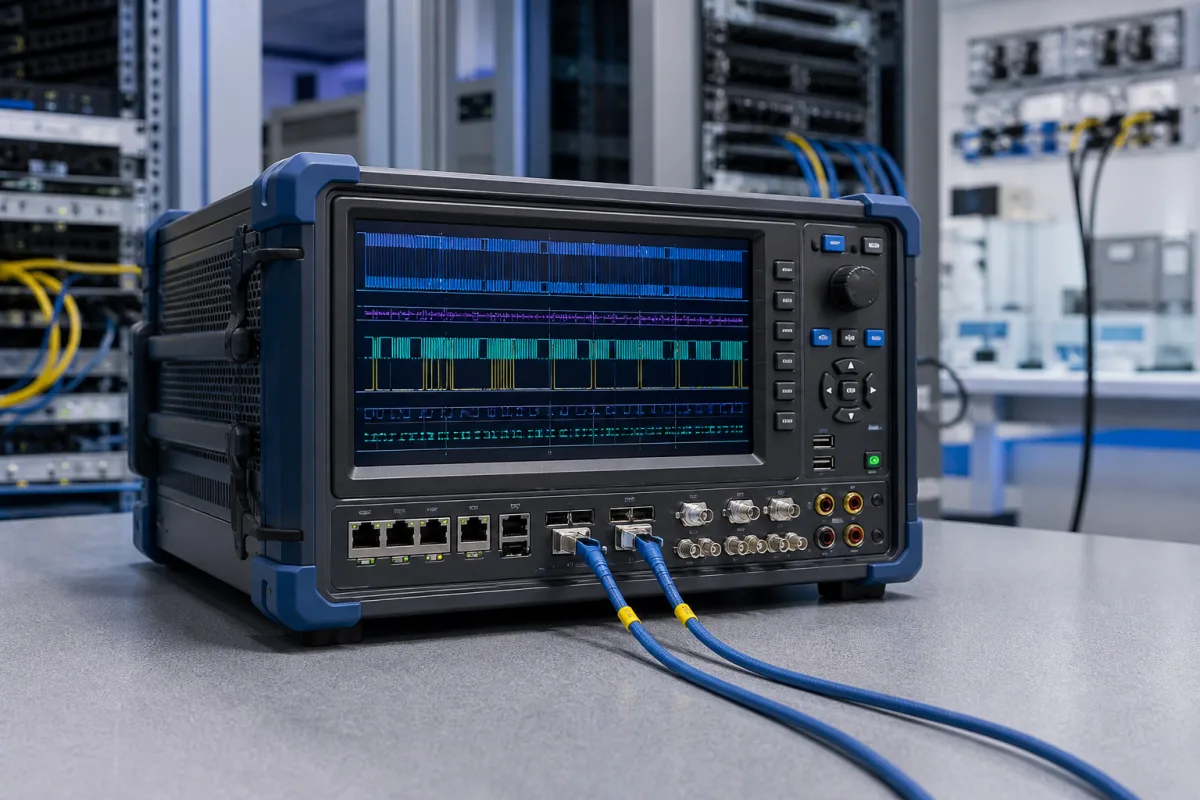
The same brochure gives the instrument as 17.8 × 24.1 × 7.62 cm with a 7 in multi-touch display, and states that dual-port operation runs two tests at once, including 10 G tests. [2] The pictured unit is a benchtop variant of the same idea: RJ45 ports, SFP cages with fibre patch leads, and coaxial connectors for electrical and timing signals beside the screen.
A portable capture TAP is the other format. Profitap's ProfiShark 1G+ is a 105 × 124 × 26 mm in-line TAP, powered from USB 3.0 or a 5 VDC input, with SMA inputs for GPS and PPS, that passes traffic through unaltered and hands captured packets to software analyzers such as Wireshark. [3]
List every interface the analyzer must connect to (copper speed, optics and rates, TDM type and impedance, timing references) and whether two ports must test at the same time.
02
Capturing every frame: 14,880 minimum-size frames per second at 10 Mb/s, about 1.49 million per gigabit direction
RFC 2544's reference table gives the maximum frame rate on 10 Mb/s Ethernet as 14,880 frames per second for 64-byte frames and 812 for 1,518-byte frames, counting 64 bits of preamble and a 96-bit gap with each frame. [1] An analyzer that claims line-rate capture has to keep up with the short-frame case, not the average.
Editorial calculation: a 64-byte frame occupies 64 × 8 + 64 + 96 = 672 bit times on the wire, so at 1 Gb/s it lasts 672 ns and the rate is 10⁹ / 672 ≈ 1.488 million frames per second; the 1 and 10 Gb/s rows scale the RFC 2544 10 Mb/s figures by 100 and 1,000. [1] Profitap states full-duplex GbE capture, timestamping and aggregation at wire speed, 2 Gbit/s in total, for the ProfiShark 1G+; VIAVI states 10 G line-rate packet capture and analysis in its handheld. [3][2]
Editorial calculation: 2 Gbit/s of full-duplex capture is 250 MB/s, about 15 GB per minute if every frame is stored whole. [3] Profitap's long-term capture writes to a NAS in ring-buffer or normal mode and splits files by time or size; ask any supplier where captures go and for how long at your traffic level. [3]
State the link speeds and whether capture must be full duplex at line rate with minimum-size frames, plus the capture duration and storage needed.
03
RFC 2544 benchmarks: seven Ethernet frame sizes, 60 s trials, 120 s latency streams repeated 20 times
RFC 2544, the IETF benchmarking methodology for network interconnect devices, specifies the Ethernet frame sizes 64, 128, 256, 512, 1024, 1280 and 1518 bytes, and says the test portion of each trial SHOULD last at least 60 seconds, though binary-search tests such as throughput MAY use shorter trials before a full-length final determination. [1]
Editorial calculation: one latency result at one frame size takes at least 20 × 120 s = 40 minutes, so all seven Ethernet frame sizes need over four and a half hours before throughput and back-to-back tests are added. [1] That is why handheld testers automate the sequence: VIAVI lists automated enhanced RFC 2544 testing, SAMComplete per ITU-T Y.1564 for multiple classes of service, burst testing per MEF 34 and TCP throughput testing per RFC 6349. [2]
VIAVI's comparison in the same brochure notes that RFC 2544 validates key performance indicators for a single stream, while Y.1564 validates them for multiple classes of service, and that neither validates the control plane or user experience; it lists a separate Layer 2 control-plane transparency test for that. [2]
Stream of at least 120 s, tagged frame after 60 s, repeated at least 20 times and averaged [1]
Back-to-back frames
Longest burst at minimum gap with no loss
Trials of at least 2 s, repeated at least 50 times and averaged [1]
Name the test methods you need (RFC 2544, Y.1564, RFC 6349, BERT on TDM circuits), whether reports must follow the RFC reporting formats, and whether tests run end to end with a second unit or a loopback.
04
Timestamps and synchronisation: 8 ns resolution, GPS and PPS inputs, PTP and SyncE checks
Delay and jitter measurements depend on how finely and how accurately each frame is timestamped. Profitap gives the ProfiShark 1G+ hardware timestamping with 8 ns resolution, a GPS/GLONASS input for UTC timestamps and PPS input/output for synchronisation between units. [3]
Editorial calculation: at 1 Gb/s a minimum-size frame occupies 672 ns, which is 84 steps of 8 ns; at 10 Gb/s it occupies 67.2 ns, about 8 steps, so resolution that is ample at gigabit speed becomes coarse at 10 G. [3][1] Resolution is not accuracy; ask for the stated accuracy when units are synchronised by GPS or PPS.
For networks that carry timing, VIAVI lists emulation of an IEEE 1588v2 master or slave clock with packet-delay variation checks, SyncE frequency accuracy and ESMC message checks, and wander measurement on SyncE, 1PPS, T1, E1 and 2 and 10 MHz signals. [2]
Ask for timestamp resolution and accuracy, the synchronisation inputs (GPS, PPS, 10 MHz, BITS), and whether one-way delay between two units is supported.
05
Data to send for a multi-protocol network analyzer
Paste it into your enquiry below or into an email to a maker, then replace every bracket.
Interfaces: [RJ45 speeds; SFP/SFP+ optics and rates; T1/E1, T3/E3; Fibre Channel; CPRI]
Capture: [full duplex at line rate; minimum frame size; duration; storage]
Tests: [RFC 2544; Y.1564; RFC 6349; BERT; OAM]
Timing: [timestamp resolution and accuracy; GPS, PPS, BITS, 10 MHz; PTP, SyncE]
Format: [handheld, benchtop or TAP plus software; battery; display]
Software: [decode protocols; export to pcap; report format]
Options: [licences included; upgrade path]
Explore company information and manufacturing capabilities, then discuss the scope of your project with a relevant supplier.
Share this page
Compiled and source-reviewed by the CNFX editorial team.
Each manufacturer above links to the page on that company's own website where the product is listed, with the date we checked it. How we source and review
· Page last updated 13 October 2026
Buyer questions
How many frames per second must a gigabit analyzer capture?
RFC 2544 gives 14,880 64-byte frames per second at 10 Mb/s; scaled to 1 Gb/s that is about 1.49 million per direction (editorial calculation). [1]
Which frame sizes does RFC 2544 use for Ethernet?
64, 128, 256, 512, 1024, 1280 and 1518 bytes, with trials of at least 60 seconds for the final result. [1]
What interfaces does a multi-protocol handheld tester carry?
VIAVI's T-BERD/MTS-5800 lists dual RJ45 10/100/1000, dual SFP+ 1/10 G, T1/PRI/E1, T3/STS-1/E3/E4/STM-1e and a BITS clock input. [2]
Sources and what still needs a direct check
Sources checked 2026-10-12. RFC 2544 is the IETF benchmarking methodology; VIAVI's brochure describes one handheld multi-protocol tester; Profitap's product page describes a portable capture TAP.