Editorial Technical Reference

Industrial Power Factor Correction Unit

This page explains how Industrial Power Factor Correction Unit is classified within Manufacture of Electricity Distribution and Control Apparatus. Technical values and manufacturer relationships are research references; confirm the current specification and supplier evidence for each order.

Technical Definition & Core Assembly

Standalone industrial machine for optimizing electrical power factor in distribution systems.
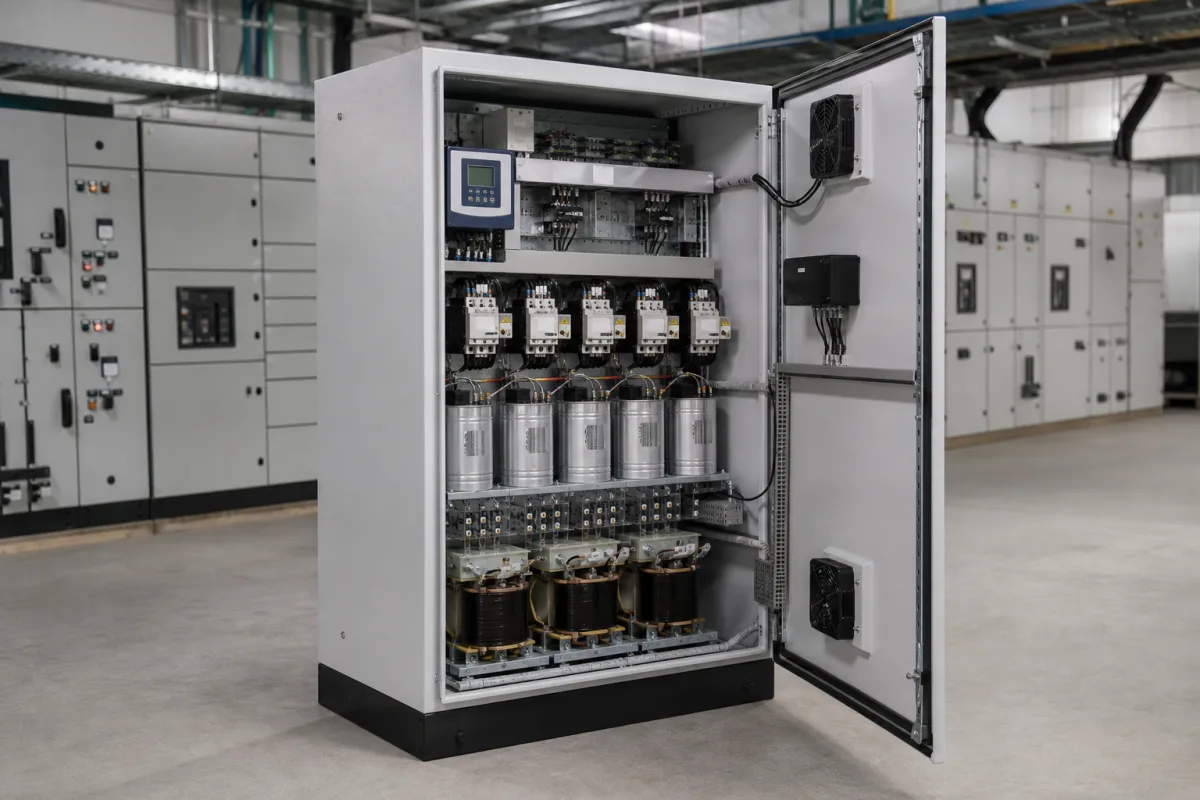
Representative product image. Confirm appearance and specifications with the manufacturer.

Product Specifications

Technical details and manufacturing context for Industrial Power Factor Correction Unit

Definition
An industrial-grade power factor correction unit is a specialized electrical control apparatus that automatically monitors and adjusts reactive power in electricity distribution networks. It improves power factor by switching capacitor banks in response to load variations, reducing energy losses and optimizing electrical system efficiency. These units are essential in manufacturing facilities, commercial buildings, and industrial plants where inductive loads cause poor power factor. They help utilities and industrial operators avoid power factor penalties, reduce electricity costs, and enhance overall grid stability. As a critical component in modern power management systems, they represent a significant segment in the electrical control apparatus manufacturing industry. The unit is housed in a floor-standing cabinet with a galvanized steel or cold-rolled steel powder-coated enclosure, providing protection ratings from IP54 to IP65. It incorporates self-healing polypropylene film capacitors (MKP type) and copper busbars for reliable performance. The unit operates at a rated voltage of 400 V (IEC 60038) and offers compensation capacity from 50 to 200 kvar, with maximum current handling from 300 to 800 A. Response time for detecting and correcting power factor changes is 20 to 40 ms. It is designed for ambient temperatures from -25°C to 55°C (IEC 61439) and maintains total harmonic distortion of voltage at or below 5% (IEC 61000-2-4). The maximum switching frequency is 10 operations per minute. Dimensions vary from 600×1200×400 mm to 800×1800×600 mm, and weight ranges from 150 to 400 kg depending on configuration. These units are intended for industrial and commercial applications where inductive loads are prevalent. For procurement, verify model-specific values and standards with the legal manufacturer or supplier, as the listed parameters are reference ranges.
Working Principle
The unit continuously measures power factor using current and voltage sensors. It then automatically switches capacitor banks on or off via contactors to compensate for inductive reactive power, maintaining optimal power factor close to unity. The control logic responds to load variations within 20 to 40 ms, ensuring rapid correction. The capacitors are of the self-healing polypropylene film type (MKP), which recover from dielectric breakdowns. The enclosure provides protection against dust and water ingress (IP54–IP65). The unit operates within a temperature range of -25°C to 55°C and limits voltage harmonic distortion to ≤5%. Switching frequency is limited to 10 operations per minute to prolong component life. The system requires proper sizing and configuration based on the specific load profile.
Common Materials
Galvanized Steel Enclosure, Polypropylene Film Capacitors, Copper Busbars, Electrolytic Aluminum Heat Sinks
Technical Parameters
ParameterTypical rangeNotes & selection driver
Compensation CapacityRequired50–200 kvarTotal reactive power compensation capability
Rated VoltageRequired400 VOperating voltage ratingIEC 60038
Maximum CurrentRequired300–800 AMaximum load current handling capacity
Response TimeRequired20–40 msTime to detect and correct power factor changes
Operating TemperatureRequired-25–55 °CAmbient temperature operating rangeIEC 61439
Protection ClassIP54–IP65 IPIngress protection rating for enclosureIEC 60529
Harmonic Distortion≤5 %Total harmonic distortion of voltageIEC 61000-2-4
Switching Frequency≤10 times/minMaximum capacitor switching operations per minute
Capacitor TypeMKPSelf-healing polypropylene filmIEC 60831
Enclosure MaterialSPCCCold-rolled steel, powder coatedGB/T 11253
Weight150–400 kgDepends on capacity and enclosure size
Dimensions (W×H×D)600×1200×400–800×1800×600 mmFloor-standing cabinet

Ranges are indicative industry figures for RFQ preparation, not a supplier commitment. Confirm every value and standard with the legal manufacturer before ordering.

Components / BOM
  • Microprocessor Controller
    Monitors power factor and controls capacitor switching
    Material: FR-4 PCB with SMD components
  • Power Capacitor Bank
    Provides reactive power compensation
    Material: Polypropylene film with metalized electrodes
  • Power Contactor Assembly
    Switches capacitor stages on/off
    Material: Silver-cadmium oxide contacts with copper coils
  • Current Transformer
    Measures load current for power factor calculation
    Material: Silicon steel core with copper windings
  • Protection Relay Optional
    Provides overcurrent and overtemperature protection
    Material: Thermoplastic housing with copper contacts
  • Voltage Sensor
    Measures line voltage; together with the current transformer it provides the inputs for power-factor calculation.

Industry Taxonomies & Aliases

Commonly used trade names and technical identifiers for Industrial Power Factor Correction Unit.

Industrial Ecosystem & Supply Chain Structure

Complementary Systems
Downstream Applications
Specialized Tooling

Application Fit & Sizing Matrix

Operational Limits
pressure: N/A (electrical device, not fluid handling)
other spec: Voltage: 200-690V AC, Frequency: 50/60Hz ±5%, IP Rating: IP54 minimum, Altitude: ≤2000m
temperature: -20°C to +55°C (operating), -40°C to +70°C (storage)
Media Compatibility
✓ Industrial manufacturing facilities ✓ Commercial buildings with heavy HVAC loads ✓ Water treatment plants with large pumping systems
Unsuitable: Hazardous locations with explosive atmospheres (unless specifically rated for such environments)
Sizing Data Required
  • Existing power factor measurement (cos φ)
  • Total connected load (kVA or kW)
  • Harmonic distortion levels (THD%)

Reliability & Engineering Risk Analysis

Failure Mode & Root Cause
Capacitor dielectric breakdown
Cause: Overheating due to poor ventilation, harmonic distortion causing excessive current, or voltage surges from the power supply, leading to insulation failure and short circuits.
Contact welding in switching relays/contactors
Cause: Arcing from frequent switching cycles, high inrush currents during capacitor energization, or contact contamination, resulting in fused contacts that fail to open or close properly.
Maintenance Indicators
  • Audible humming or buzzing from the unit, indicating loose connections, failing capacitors, or arcing components.
  • Visible bulging, leaking, or discoloration of capacitor casings, signaling internal pressure buildup, electrolyte leakage, or thermal stress.
Engineering Tips
  • Implement regular infrared thermography scans to detect hotspots in capacitors, connections, and switching components, allowing proactive replacement before failure.
  • Install harmonic filters and ensure proper ventilation around the unit to reduce thermal stress and electrical distortion, extending capacitor and contactor lifespan.

Indicative industry ranges for design and RFQ preparation. Confirm the exact figures and applicable standard with the manufacturer before specifying.

Compliance & Manufacturing Standards

Applicable Standards
IEC 61000-3-2 (CE marking for harmonic current emissions) ANSI C84.1 (voltage ratings and tolerances)

Quoted from the published standard.

Manufacturing Precision
  • Capacitance value: +/-5% of rated value
  • Voltage rating tolerance: +10%/-0% of nominal voltage
Quality Inspection
  • Dielectric withstand test (high-pot test) per IEC 60298
  • Thermal cycling test to verify component reliability under load

Manufacturers of Industrial Power Factor Correction Unit

Manufacturer profiles associated with Industrial Power Factor Correction Unit.

Sourcing Industrial Power Factor Correction Unit from China?
Tell us your specification and target quantity — we will match it against manufacturer records and come back with the factories that fit.
Request manufacturers We manufacture this

Manufacturer listings support early research and capability understanding. They are not certification, ranking, or transaction guarantees.

Technical documentation
Request current drawings, revision history, and a signed specification sheet.
Manufacturing capability
Verify equipment lists, process limits, capacity, and representative production evidence.
Inspection readiness
Confirm test methods, calibrated equipment, sampling plans, and traceable reports.
Supplier transparency
Check the legal entity, factory address, ownership, certifications, and direct contacts.

CNFX does not score or rank suppliers. Buyers must verify all claims and documents with the legal manufacturer before ordering.

Frequently Asked Questions

What is the compensation capacity range of this unit?

The compensation capacity ranges from 50 to 200 kvar, depending on the model. The exact value must be confirmed with the supplier for your specific application.

What standards does the unit comply with?

The unit references IEC 60038 for rated voltage, IEC 61439 for operating temperature, IEC 60529 for protection class, IEC 61000-2-4 for harmonic distortion, and IEC 60831 for capacitor type. Compliance should be verified with the manufacturer.

What is the response time for power factor correction?

The response time is 20 to 40 milliseconds, allowing rapid adjustment to load changes. This ensures minimal deviation from the target power factor.

What are the installation requirements?

The unit is floor-standing with dimensions from 600×1200×400 mm to 800×1800×600 mm and weighs 150-400 kg. It requires adequate ventilation and clearance as per the supplier's instructions.

Data Basis

Editorial classification, named public sources where available, and source-reviewed manufacturer records.

Preliminary Technical Classification
This page supports structured research, RFQ preparation, and supplier evaluation. It does not replace buyer-led supplier qualification, standards review, or technical approval.
Buyer enquiry

Request manufacturing insight for Industrial Power Factor Correction Unit

Ask for use case, specification boundaries, supplier type, and RFQ preparation information for this product.

Where it goes
Straight to the CNFX editorial desk, and to the manufacturer if this product is linked to a claimed profile. Nothing is broadcast to a supplier list.
Your details stay here
We do not sell or rent enquiry data, and we do not add you to a mailing list. Used only to answer this request.
No commission, no middleman
CNFX is a directory. We take no cut of any order and never negotiate on a supplier's behalf.
What we don't claim
A listing is not an endorsement. Qualify every supplier and verify every figure yourself before ordering.

Your business information is used only to process this request.

Thank you! Your message has been sent. We'll respond within 1–3 business days.
Sorry, we couldn't send your message. Please try again, or email us at contact@cnfx.com.

Need to Manufacture Industrial Power Factor Correction Unit?

Compare manufacturer profiles with relevant product and process capability.

First Product
Next Product
Medium Voltage Current Transformer Core Assembly
Get QuotesChat