This page explains how Integrated Multi-Sensor Camera Module Assembly and Calibration System is classified within Manufacture of Optical Instruments and Photographic Equipment. Technical values and manufacturer relationships are research references; confirm the current specification and supplier evidence for each order.
Automated production line for assembling and calibrating complex multi-sensor camera modules.
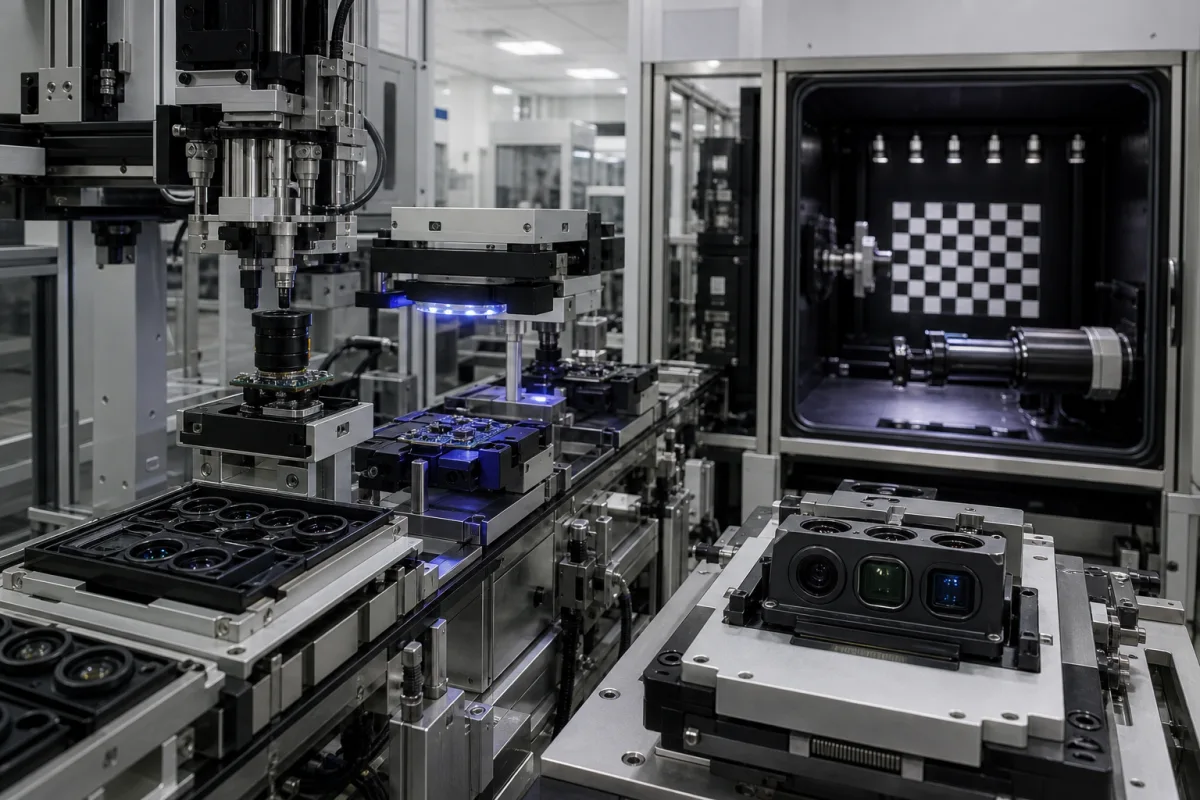
Technical details and manufacturing context for Integrated Multi-Sensor Camera Module Assembly and Calibration System
| Parameter | Typical range | Notes & selection driver |
|---|---|---|
| Maximum Module SizeRequired | 50×50×30 mm | Largest diagonal dimension of camera module substrate handled |
| Active Alignment RepeatabilityRequired | ±0.005 µm | 3-sigma positional repeatability of the optical alignment mechanism |
| Calibration Light Source IntensityRequired | 1000–5000 lux | Controlled intensity of integrated calibration light sources |
| Conveyor SpeedRequired | 0.1–0.5 mm/s | Maximum speed of the module transport system |
| System FootprintRequired | 6×3 m² | Floor area required for the complete integrated system |
| Power ConsumptionRequired | 15 kW | Typical operational power draw of the entire system |
| Operating Temperature | 15–35 °C | Outside range affects calibration accuracy |
| Relative Humidity | 20–80 % RH | Non-condensing |
| Supply Voltage | 380–480 V AC | Three-phase, 50/60 HzIEC 60038 |
| Compressed Air Supply | 0.6–0.8 MPa | Class 1.4.1ISO 8573-1 |
| Machine Weight | 4500 kg | Requires reinforced floor |
| Alignment Accuracy | ±0.01 mm | Absolute accuracy |
| Cycle Time | 30–60 s | Per module |
| Ingress Protection Rating | IP54 | Dust and splash proofIEC 60529 |
Ranges are indicative industry figures for RFQ preparation, not a supplier commitment. Confirm every value and standard with the legal manufacturer before ordering.
Commonly used trade names and technical identifiers for Integrated Multi-Sensor Camera Module Assembly and Calibration System.
| pressure: | Atmospheric (cleanroom environment) |
| other spec: | Humidity: 30-60% RH, Vibration: <0.5g RMS, Particle Count: ISO Class 5 or better |
| temperature: | 15-30°C (operating), 10-40°C (storage) |
Indicative industry ranges for design and RFQ preparation. Confirm the exact figures and applicable standard with the manufacturer before specifying.
Quoted from the published standard.
Manufacturer profiles associated with Integrated Multi-Sensor Camera Module Assembly and Calibration System.
Manufacturer listings support early research and capability understanding. They are not certification, ranking, or transaction guarantees.
A practical evidence checklist for RFQ preparation and supplier evaluation.
CNFX does not score or rank suppliers. Buyers must verify all claims and documents with the legal manufacturer before ordering.
The system is designed for camera modules that incorporate multiple sensors, such as primary image sensors, depth sensors, and ambient light sensors. It can handle modules with a maximum size of 50×50×30 mm. Typical applications include smartphones, automotive vision systems, and industrial inspection cameras.
The active alignment mechanism has a 3-sigma positional repeatability of ±0.005 µm and an absolute accuracy of ±0.01 mm. These values are reference ranges and should be confirmed with the manufacturer for the specific configuration.
The system operates in temperatures of 15–35 °C and relative humidity of 20–80% (non-condensing). It requires a three-phase power supply of 380–480 V AC (IEC 60038) and compressed air at 0.6–0.8 MPa (ISO 8573-1). The system weighs 4500 kg and has an IP54 rating.
The cycle time per module is 30–60 seconds, depending on the complexity of the module and the specific configuration. This is a reference value and should be verified with the manufacturer for your application.
Editorial classification, named public sources where available, and source-reviewed manufacturer records.
Ask for use case, specification boundaries, supplier type, and RFQ preparation information for this product.
Compare manufacturer profiles with relevant product and process capability.