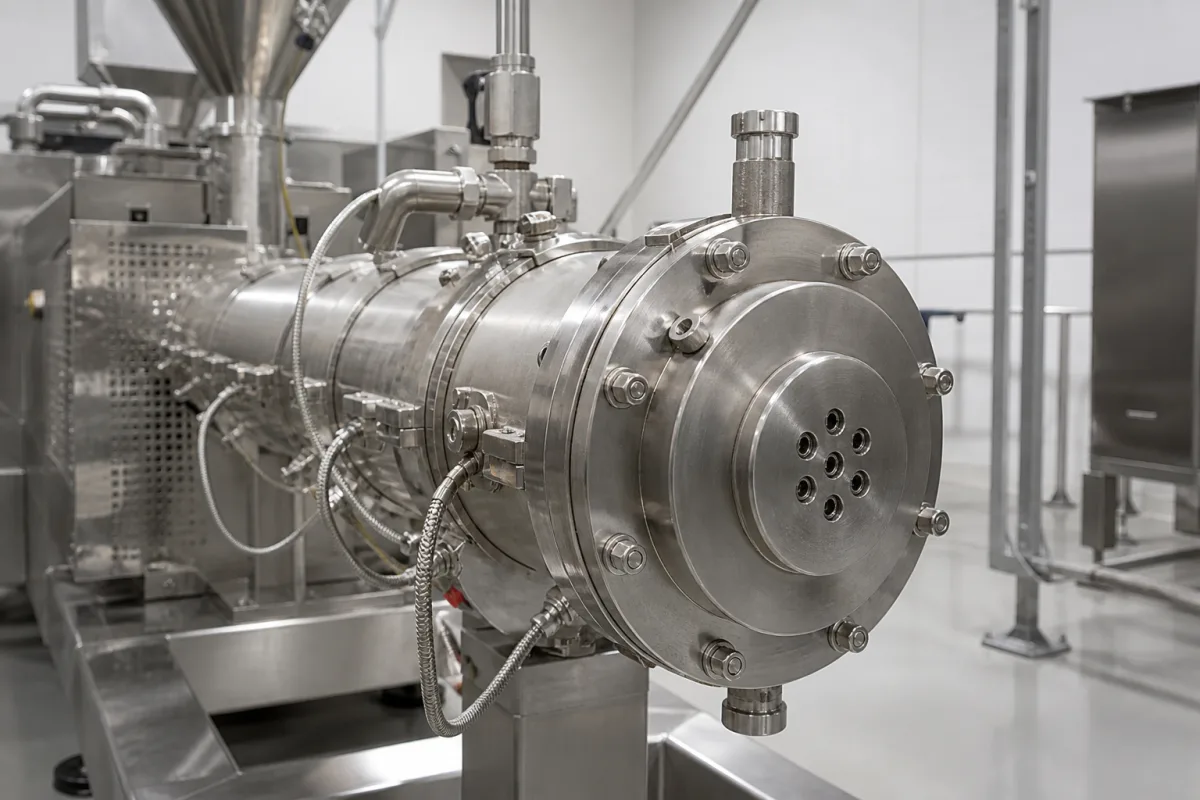
Die head for food and feed cooking extruders: sizing the die plate's open area and orifices, and balancing pressure so every orifice runs at the same speed
Food, snack and feed cooking extruders · the bolted head at the barrel outlet that carries the dough through a transition and distribution chamber to a multi-orifice die plate: open area per tonne, orifice diameter and land length, and pressure in each chamber
On a cooking extruder the die head is the restriction that the whole screw works against. Its open area decides how much pressure and shear the barrel builds before the dough escapes, so the same extruder will make a dense sinking pellet or a light puffed snack depending on how many holes the die plate has and how large they are. Its internal passages decide something else: whether every orifice gets dough at the same pressure, because the knife turns at one speed and any orifice that runs faster than the others cuts longer pieces.
Die heads for food, snack, cereal, pet food and aquafeed cooking extruders: the transition and distribution sections behind the die plate, multi-orifice die plates and inserts, open area against throughput, orifice diameter and land length, chamber pressures, per-orifice flow balancing and dual-face die heads with a diversion valve. Complete cooking extruders and their process windows are covered on the Industrial food extrusion and forming machine page; screw element sets on the Extrusion screw for food and feed extruders page; the knives that cut extrudate at the die face on the Cutting mechanism for food extruders page. Blown film heads are covered on the Annular dies page, thermoplastic profile dies on the Polymer extrusion die plate page, screen-supporting breaker plates on the Orifice array as an extruder breaker plate page, and adjustable throttles between a plastics extruder and its die on the Melt flow control element page.
CNFX editorial research · Sources checked October 13, 2026 · 4 sources
Open area per tonne of throughput, orifice diameter and land length on the die plate
International Pet Food's introduction to extrusion puts the final die's two functions together: it restricts flow so the extruder develops the pressure and shear it needs, and it shapes the extrudate; the expansion wanted is controlled by formula and by the open area in the die. [2]
Editorial calculation: the same 1 t/h needs about 2.6 times the open area for a dense unexpanded pellet as for a highly expanded one, comparing the band midpoints (575 / 225).
Adekola's twin-screw study (59.6 mm screws, L/D 20, yellow corn flour at 20 % moisture, 160 r/min, 160 °C at the last barrel section, 50 kg/h) varied single-orifice dies from 2.5 to 5.0 mm diameter and 16 to 54 mm long. [1] Radial expansion fell as the orifice got wider, by about 42 % on average for a 2 mm difference in diameter, while axial expansion rose from 0.6 with a 3 mm orifice to 1.2 with a 4 mm one; overall expansion was not affected by diameter, and specific mechanical energy fell as diameter rose. [1] Land length moved axial expansion up as the die got longer, and radial expansion rose from 8.9 to 13 as orifice L/D went from 5.33 to 6.4, then dropped to 10.5 at higher L/D, which the author attributes to starch breakdown at the higher pressure, residence time and shear. [1]
Product
Open area per tonne of throughput, as International Pet Food gives it
25–31 mm² per orifice, about 5.6–6.3 mm round holes
Give the die maker the throughput per product, the target bulk density or expansion, and the extrudate diameter after expansion; ask for the open area in mm², the orifice diameter and land length (L/D), and the number of orifices on each plate offered.
02
Inlet chamber, distribution and per-orifice pressure: keeping every orifice at the same exit speed
Adekola describes the die as three parts, transition, distribution and die plate, turning the dough from the screw axis into the orifices. [1] Wenger's US 5,700,510 builds those stages as separate chambers held at descending pressures so that cooking and shaping can be set apart.
In the patent's example a flow-directing bullet feeds six passageways to six die-outlet orifices, and a threaded valve stem protruding into each passageway sets that orifice's pressure. [3] Because the knife turns at constant speed, pellet length follows the extrudate's exit velocity: the operator starts with all stems retracted, measures pellet lengths to find the fastest and slowest orifice, and closes in the fastest until its pellets match the slowest. [3] The patent ties the inlet-chamber pressure to starch level and type, protein quality and fat content, and the secondary-chamber pressure to the formulation and the orifice diameter. [3]
Mixing orifice shapes on one plate is ruled out for the same reason. Nestlé's EP 0 630 572 explains that die openings of more than one cross-section on one plate would give non-uniform flow rates and flow resistances and uneven pieces, so each shape needs its own plate; its die head has two die faces at about 45° to the block axis and a cylindrical diversion valve that sends the dough to one plate or the other, so plates and knife blades can be changed without stopping the extruder. [4]
Stage in Wenger's die apparatus
Pressure stated in the patent
Editorial conversion
Inlet-end chamber (sets cooking)
Greater than 20 psig, ideally 250 to 300 psig; some products as high as 3,000 psig [3]
About 17–21 bar; up to about 207 bar
Secondary chamber
Greater than 10 psig, ideally 10 to 250 psig, over 250 psig in some applications [3]
About 0.7–17 bar
Each die-outlet orifice
Lower than the secondary chamber, set orifice by orifice with a threaded valve stem [3]
—
Ask whether the head has pressure and temperature ports at the inlet chamber, how the dough is distributed to the orifices, and whether individual orifices can be trimmed or plugged; for frequent product changes, ask whether a two-face head with a diversion valve fits the extruder outlet.
03
Data for a die head or die plate enquiry
Paste it into your enquiry below or into an email to a maker, then replace every bracket.
Extruder: [make and model; barrel bore; outlet flange]
Product: [snack, cereal, pet food or aquafeed; target bulk density or expansion]
Throughput: [t/h per product]
Die plate: [open area mm²; orifice number, shape, diameter and land length; inserts]
Head: [transition and distribution design; pressure and temperature ports; heating or cooling]
Changeover: [single face or diverting two-face head; knife mount]
Explore company information and manufacturing capabilities, then discuss the scope of your project with a relevant supplier.
Share this page
Compiled and source-reviewed by the CNFX editorial team.
Each manufacturer above links to the page on that company's own website where the product is listed, with the date we checked it. How we source and review
· Page last updated 13 October 2026
Buyer questions
How much open area should a feed extruder die have?
International Pet Food gives 550 to 600 mm² per tonne of throughput for unexpanded, fully cooked feeds and 200 to 250 mm² per tonne for highly expanded feeds, as guide figures for die design. [2]
Does a larger die orifice give more expansion?
In Adekola's twin-screw corn study, radial expansion fell by about 42 % on average for a 2 mm larger orifice, axial expansion rose, and overall expansion was unchanged. [1]
Why do pieces from different orifices come out at different lengths?
The knife turns at constant speed, so piece length follows exit velocity. Wenger's US 5,700,510 fits a valve stem in each orifice passage and adjusts the fastest orifices until their pellets match the slowest. [3]
Can one die plate carry orifices of different shapes?
Nestlé's EP 0 630 572 says this would give non-uniform flow rates and resistances and uneven pieces; it uses two die plates and a diversion valve instead. [4]
Sources and what still needs a direct check
Sources checked 2026-10-13. A twin-screw study in the CIGR Journal measured orifice diameter and length against expansion; International Pet Food gives open area per tonne; Wenger's and Nestlé's patents describe pressure staging, orifice balancing and two-face die heads.