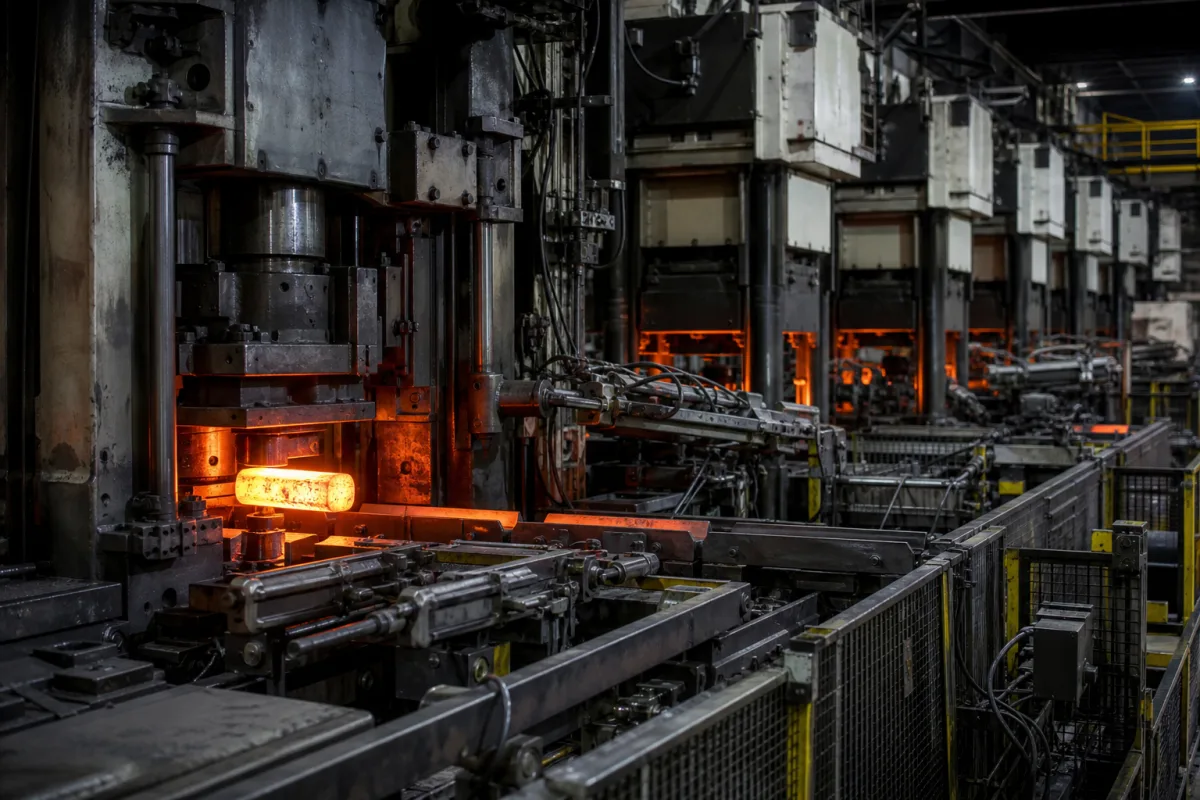
Automated hot forging line: induction-heated billets through multi-station forging presses
Hot die forging, not sheet stamping · induction heating of each billet, multi-station hot formers that upset, punch and pierce in one machine, and the crank-press stroke rate that automatic handling now asks for
A hot forging line turns cut billets or bar into near-shape steel parts — gear blanks, bearing rings, hubs, flanges, nuts — by heating them to forging temperature and pressing them through a sequence of dies. Automating it ties three machines to one rhythm: the induction heater must deliver billets at temperature exactly when the press is ready, the press must stroke at a rate that keeps the transfer fed, and the transfer must move a glowing part from die to die between strokes. The sections below give published numbers for each of the three and show where the press, not the handling, becomes the limit.
Automated hot (and warm) die forging lines for steel and non-ferrous parts: induction billet or bar heaters, multi-station horizontal hot formers, vertical crank forging presses with automatic transfer, and the trimming and handling that link them. Cold sheet-metal press lines, progressive-die and transfer stamping lines are covered on the Automated stamping lines page; open-die forging is on the Hydraulic open-die forging press page induction heaters as stand-alone equipment on the Induction heater page, and die-lubricant spraying on the Spray manipulator page.
CNFX editorial research · Sources checked October 12, 2026 · 3 sources
Induction billet heating: 500 kW, two coils, 2,250 °F ±50 °F and an accept/reject gate
Inductoheat's description of an InductoForge forging line shipped to a hardware and hand-tool maker shows the billet path from bin to press. [1]
Editorial calculation: 2,250 °F is about 1,232 °C, and ±50 °F is about ±28 °C; 300 pieces an hour is one billet every 12 seconds. The press and transfer behind this heater therefore have 12 seconds per part on average, and any press stop leaves billets in the coil, which is why standby and rapid-start set points are stored in the heater's recipe. [1]
Step
Published detail
Loading
6,500 lb capacity automatic bin tipper dumps carbon steel billets into a rotary feeder with automatic refill [1]
Feeding
Rotary feeder sends billets end to end using a start/stop motion sensor to a pinch-wheel infeed that pushes them through the coils on heavy-duty skid rails [1]
Heating
One 500 kW, 3 kHz power module supplying two in-line forging coils [1]
Temperature
To 2,250 °F, ±50 °F; billet temperature profile set in modelling software and stored as a recipe with standby and rapid-start set points [1]
Fast extractor conveyor; infrared pyrometer drives an over- and under-temperature accept/reject system [1]
Ask for the heater's temperature band at the press, not only at the coil exit, and for what happens to billets in the coil when the press stops: hold power, reject on restart, or both.
02
Multi-station horizontal hot formers: three or four dies in one machine, by bar size and part weight
Hatebur's HOTmatic hot formers forge parts from bar through three or four forming stations in one machine, for fully automated production. Its published table sets the size classes. [2]
All values from Hatebur's model pages and specification table. [2] Hatebur lists bearing rings, drivetrain parts for transmissions, differentials and constant-velocity joints, wheel hubs, flanges and nuts among the applications. [2] The AMP 70 is also offered in an H version for up to 180 parts per minute and a WS version with pre-heating close to the shearing knife for high-temperature alloys; the AMP 50-9 HFE version adds hot forward extrusion. [2]
Editorial calculation: an AMP 70 running 50–80 strokes a minute on 5 kg parts would forge 250–400 kg of steel a minute, 15–24 t an hour, if every stroke yields a part at the top weight; actual output depends on part weight and stroke rate set for the part.
Model
Stations
Bar diameter (mm)
Part weight (kg)
Max. outer diameter (mm)
Strokes per minute
Total press capacity (kN)
AMP 20 S
3
14–28
0.02–0.17
~38
140–200
900
AMP 30 S
3
18–40
0.05–0.7
~67
up to 140 parts/min
2,500
AMP 50-9
4
28–55
0.17–2.0
~108
60–100
9,000
AMP 70
4
36–75
0.4–5.0
~145
50–80
15,000
AMP 70 XL
4
36–75
0.4–5.0
~165
50–80
15,000
03
Crank forging press stroke rate under automatic handling: a 25 MN press taken from 28 to 43 strokes a minute
Bělé, Hlaváč and Staněk at the University of West Bohemia start from the point that robots and automatic feeders now handle parts faster than presses can forge them: crank presses designed for 25 working strokes a minute suited manual handling, but automated lines need more. They studied a 25 MN crank forging press with a flywheel drive, aiming at about 25% more strokes without rebuilding the frame. [3]
All values from the paper's text and table 2. [3] Both variants keep the forming energy of about 880 kJ; Variant 2 keeps the existing countershaft-to-crankshaft gear ratio so the press frame can be reused. [3] The paper's case-study section also states that the existing machine gives 21 usable strokes a minute, against 28 in its comparison table; ask the press maker which figure applies to your press and duty.
Editorial calculation: 43 strokes a minute is 1.4 seconds per stroke, against 2.1 seconds at 28; a transfer that needs more than 1.4 seconds to move a hot part between dies would leave Variant 2's extra strokes unused.
Item
Existing drive
Variant 1
Variant 2
Motor
Siemens, 132 kW, 738 rpm
160 kW, 988 rpm
160 kW, 1,486 rpm in the table (1,400 rpm in the text)
Countershaft speed (rpm)
270
481
300
Crankshaft speed, continuous (rpm)
70
96
77.5
Flywheel speed drop in forming (%)
30
22
28
Working strokes per minute
28
35
43
Weight change
—
Flywheel about 2,300 kg lighter; machine about 4,600 kg lighter
Countershaft assembly about 620 kg lighter
04
Data for a hot forging line enquiry
Paste it into your enquiry below or into an email to a maker, then replace every bracket.
Parts: [drawing; steel grade; weight; parts per hour]
Stock: [bar or billet; diameter; cut length]
Heating: [target temperature and band; kW; rate; accept/reject]
Forming: [horizontal hot former or vertical press; stations; press capacity kN or MN; strokes per minute]
Transfer: [gripper or robot; time between strokes]
Downstream: [trimming; controlled cooling; inspection]
Utilities: [power supply; cooling water; die lubrication]
Explore company information and manufacturing capabilities, then discuss the scope of your project with a relevant supplier.
Share this page
Compiled and source-reviewed by the CNFX editorial team.
Each manufacturer above links to the page on that company's own website where the product is listed, with the date we checked it. How we source and review
· Page last updated 13 October 2026
Buyer questions
How hot are billets heated for forging?
Inductoheat's InductoForge line heats carbon steel billets to 2,250 °F (about 1,232 °C), ±50 °F, at 300 pieces an hour with 500 kW at 3 kHz. [1]
How many stations does a hot former have?
Hatebur's HOTmatic range has three-station (AMP 20 S, AMP 30 S) and four-station (AMP 50-9, AMP 70) machines, up to 15,000 kN and 145 mm part diameter. [2]
Why does automation need faster forging presses?
A University of West Bohemia study notes crank presses were designed for 25 strokes a minute for manual handling; it shows a 25 MN press drive raised from 28 to 43 working strokes. [3]
Sources and what still needs a direct check
Sources checked 2026-10-12. Induction heating data from Inductoheat's announcement of an InductoForge line (Foundry-Planet, 2011); hot former data from Hatebur's HOTmatic model pages; crank press drive data from an MM Science Journal paper by the University of West Bohemia.