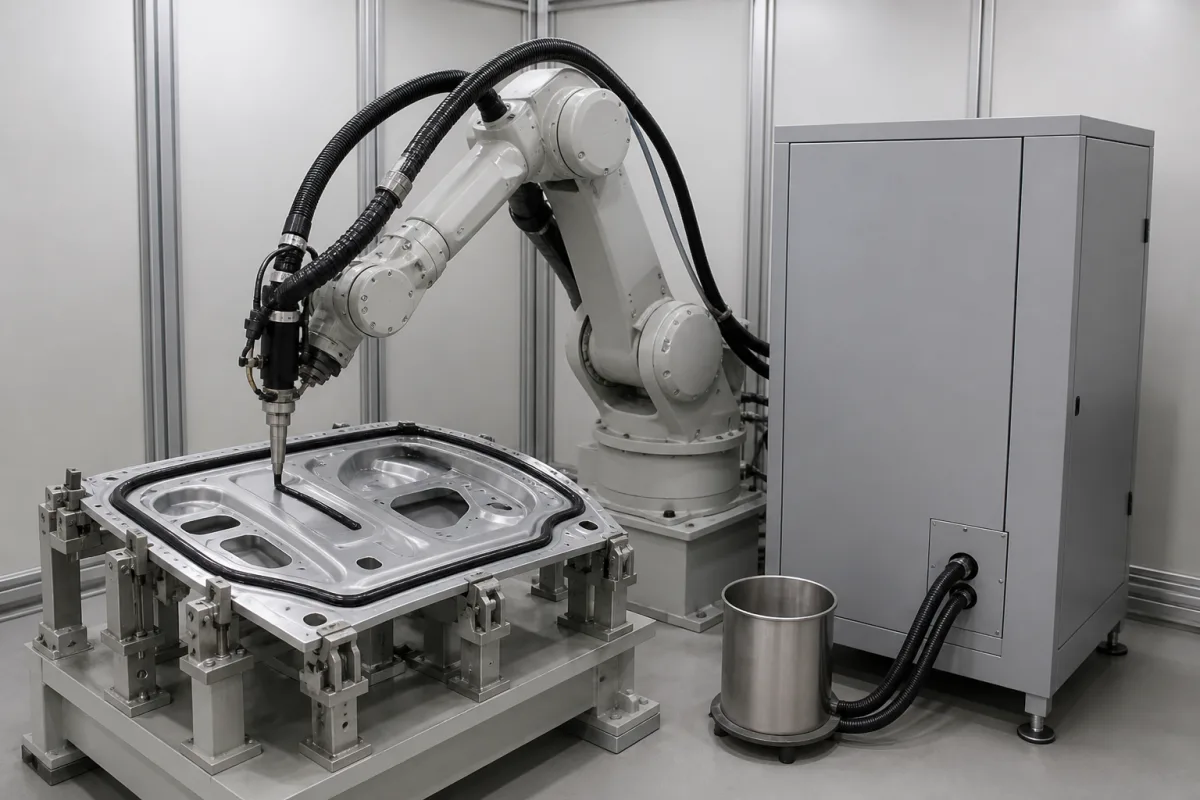
Robotic adhesive application module for body-shop structural adhesive: warm pumping from drum to nozzle and bead volume that follows robot speed
The robot-carried applicator and its warm supply chain for body-shop structural adhesive · a temperature ramp from 30 °C at the follower plate to 50–60 °C at the last hose (typ., Sika), heated hoses rated 276 bar to 100 °C, and a metering pump whose flow follows the robot's speed
In the body shop a structural adhesive arrives in drums as a paste too stiff to pump cold, is warmed on its way through pump, hoses and metering unit, and leaves a robot-mounted nozzle as a bead whose volume must stay constant while the robot speeds up and slows down along the panel edge. The module is that whole chain at the robot, not just the valve that opens and closes.
Robot-mounted adhesive application modules for vehicle body shops: the heated supply from drum pump and follower plate, heated hoses along the robot arm, the metering or dosing unit, the applicator and nozzle, and the control that ties bead volume to robot motion, for warm-applied, heat-curing structural and hem-flange adhesives. Needle, diaphragm, jetting and auger valves themselves are covered on the Dispensing valve for adhesives and assembly page; nozzles and orifice inserts on the Precision dispensing nozzle page.
CNFX editorial research · Sources checked October 13, 2026 · 3 sources
A temperature ramp from 30 °C at the drum pump to 50–60 °C at the applicator, and hoses rated for it
Sika describes SikaPower-492 G as a one-part, warm-pumped, warm-applied, heat-curing epoxy structural adhesive for sheet-metal assembly in the body shop, with an application temperature of 50–60 °C and a viscosity of 210 Pa·s at 45 °C (typ.). It states that every part of the application system in contact with the product must be heated, with a gradual rise from 30 °C at the follower plate and pump to 50–60 °C at the last hose and dispenser (typ.), and that standby temperatures and switch-off times must be set for long breaks such as nights and weekends. [1]
The hose run along the robot has to carry that warm paste at pump pressure. Graco's insulated, PTFE-lined, stainless-braided heated hose 19M414, 20 ft (6.1 m) long with a 0.617 in (15.7 mm) bore and 230 V heating, is rated at 4000 psi (276 bar) from −65 to 212 °F (−54 to 100 °C) and 3000 psi (207 bar) up to 400 °F (204 °C). [2] Editorial note: at the 50–60 °C applied temperature Sika gives, this hose falls within its 276 bar rating band.
Ask for the heated zones from drum to nozzle, the set temperature of each, the standby and switch-off routine, and the hose pressure rating at the operating temperature.
02
Holding bead volume while the robot accelerates: a gear metering pump, pressures either side of it, and a flow setpoint from the robot controller
Hilger u. Kern's patent describes the standard dosing chain for adhesives and thickeners: a pressurised feed, a gearwheel metering pump driven by a speed-controlled motor, and an outlet valve or nozzle that lays a continuous bead. It identifies the error: depending on the pressures upstream and downstream of the pump, the volume flow and the medium's viscosity, the pump slips, positively or negatively, so the volume actually leaving the nozzle departs from the volume set by pump speed, and slip also increases pump wear. [3]
Its control measures pressure before and after the metering pump and adjusts a pressure-regulating valve in the feed until the difference reaches a preset value, preferably zero, storing the valve settings against volume-flow setpoints as a characteristic curve. On the robot, the volume-flow setpoint is generated from a position- or velocity-dependent signal from the robot controller, so the flow follows the path speed and the bead stays even at high process speeds. [3]
Ask whether the metering unit is a gear pump or piston meter, how slip is compensated, whether flow is slaved to robot speed, and how bead volume is verified.
03
Oily panels, glass-bead bondlines and the paint-oven cure the bead has to survive
The adhesive the module lays down is cured later, in the paint oven for example: Sika gives 30 minutes at 180 °C as standard and 15 minutes at 160 °C as minimum (substrate temperature), with no more than 10 minutes above 210 °C. It bonds oiled steel carrying up to 3 g/m² of anti-corrosion or drawing oil, contains fine glass beads that keep bondline thickness even and limit squeeze-out, and can be spot-welded through. [1]
Because moisture taken up between application and cure can form blisters in the oven, Sika asks that this interval be kept as short as possible, or that bodies be pre-cured for 15 minutes at 160 °C. Its listed data include tensile lap-shear strength of 28 MPa at a 0.2 mm bondline on 1.2 mm HDG steel (typ.). [1]
Give the module supplier the adhesive data sheet, the oil load on the panels, the time from application to oven, and whether the line has a pre-cure station.
04
What to send for a robotic body-shop adhesive application module
Paste it into your enquiry below or into an email to a maker, then replace every bracket.
Adhesive: [product and data sheet; application temperature; viscosity]
Supply: [drum or pail; follower plate; pump; heated zones]
Hoses: [length along the robot; bore; pressure rating at temperature]
Metering: [gear pump or piston meter; volume per bead; flow range]
Control: [flow slaved to robot speed; bead inspection]
Process: [panels and oil load; time to oven; standby routine]
Explore company information and manufacturing capabilities, then discuss the scope of your project with a relevant supplier.
Share this page
Compiled and source-reviewed by the CNFX editorial team.
Each manufacturer above links to the page on that company's own website where the product is listed, with the date we checked it. How we source and review
· Page last updated 13 October 2026
Buyer questions
Why is body-shop adhesive heated before application?
Warm-pumped adhesives such as SikaPower-492 G are applied at 50–60 °C; Sika asks for heated system parts with a ramp from 30 °C at the pump to 50–60 °C at the dispenser (typ.). [1]
What pressure can a heated adhesive hose take?
Graco's 19M414 heated hose is rated 4000 psi (276 bar) up to 100 °C and 3000 psi (207 bar) up to 204 °C. [2]
Why does a gear metering pump misdose?
Hilger u. Kern's patent attributes it to pump slip that depends on inlet and outlet pressure, flow and viscosity; it balances the pressures across the pump to remove it. [3]
How does bead volume keep up with robot speed?
In the patented robot, the flow setpoint comes from a position- or velocity-dependent signal of the robot controller. [3]
Sources and what still needs a direct check
Sources checked 2026-10-13. Adhesive temperatures, cure and bondline data come from Sika's SikaPower-492 G data sheet; hose ratings from Graco's product page; metering control from a Hilger u. Kern patent.