Industry-Verified Manufacturing Data (2026)

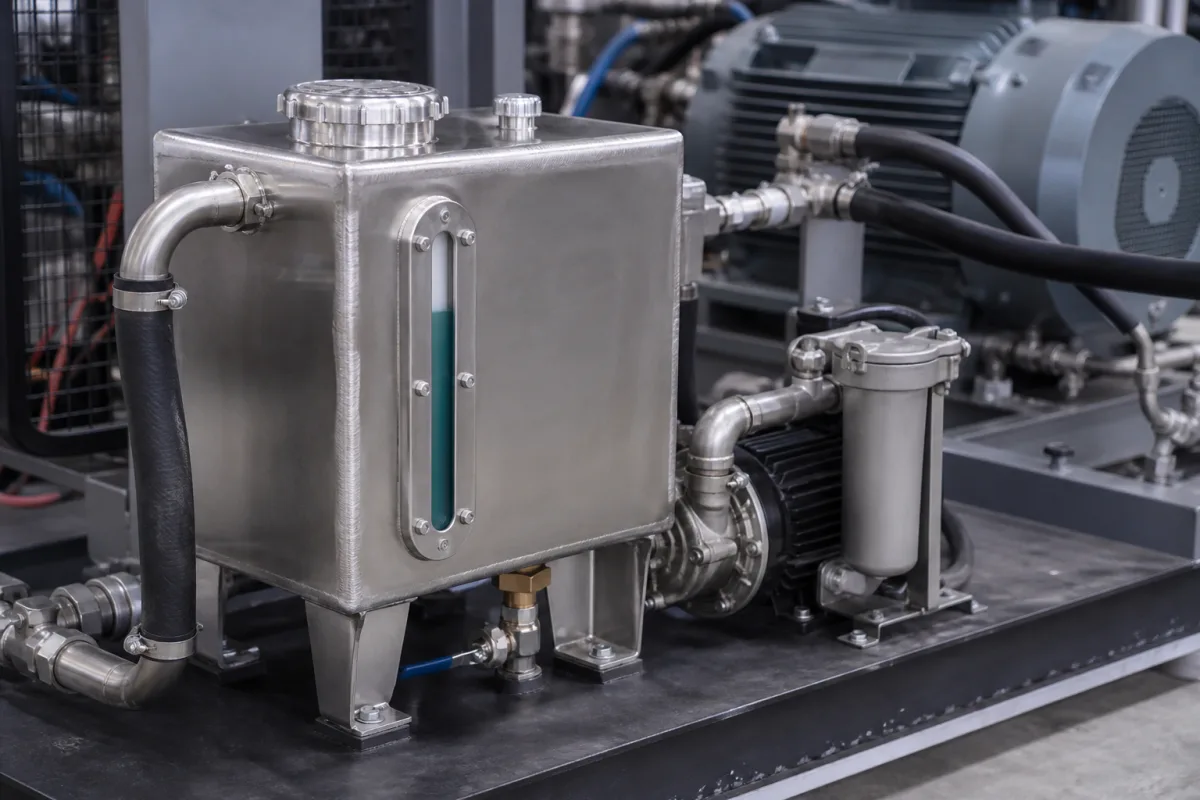
Coolant Reservoir/Tank

Based on aggregated insights from multiple verified factory profiles within the CNFX directory, the standard Coolant Reservoir/Tank used in the Motor Vehicle Manufacturing sector typically supports operational capacities ranging from standard industrial configurations to heavy-duty production requirements.

Technical Definition & Core Assembly

A canonical Coolant Reservoir/Tank is characterized by the integration of Tank Body and Filler Neck. In industrial production environments, manufacturers listed on CNFX commonly emphasize Polypropylene construction to support stable, high-cycle operation across diverse manufacturing scenarios.

A container that stores and supplies coolant fluid to maintain proper levels in the cooling system.
Product Specifications

Technical details and manufacturing context for Coolant Reservoir/Tank

Definition
The coolant reservoir, also known as the expansion tank or overflow tank, is a critical component of the coolant system that stores excess coolant fluid. It allows for thermal expansion of the coolant as temperatures rise, maintains proper system pressure, provides a visual indicator of coolant level, and supplies coolant back to the radiator when needed to prevent air pockets and ensure continuous cooling system operation.
Working Principle
The coolant reservoir operates on the principle of thermal expansion compensation. As engine temperature increases, coolant expands and flows from the radiator into the reservoir through an overflow tube. When the engine cools, coolant contracts, creating a vacuum that draws coolant back from the reservoir into the radiator, maintaining a full cooling system and preventing air intrusion.
Common Materials
Polypropylene, High-density polyethylene, Polyamide
Technical Parameters
  • Capacity of the reservoir tank (L) Per Request
Components / BOM
  • Tank Body
    Main container that holds the coolant fluid
    Material: Polypropylene
  • Filler Neck
    Opening for adding coolant to the reservoir
    Material: Polypropylene
  • Pressure Cap
    Seals the system and maintains proper pressure
    Material: Plastic with rubber seal
  • Overflow Tube Connection
    Connects to radiator overflow tube for coolant transfer
    Material: Polypropylene
  • Return Line Connection
    Connects to radiator for coolant return
    Material: Polypropylene
  • Level Indicator
    Visual or electronic indicator of coolant level
    Material: Transparent plastic or sensor components
Engineering Reasoning
0.3-1.2 bar (gauge pressure)
Plastic deformation at 1.8 bar internal pressure or vacuum collapse at -0.5 bar external pressure differential
Design Rationale: Hoop stress exceeding yield strength (σ_θ = P·r/t) for overpressure; Euler buckling instability (P_crit = π²·E·I/L²) for vacuum collapse
Risk Mitigation (FMEA)
Trigger Electrochemical corrosion from ethylene glycol degradation forming formic acid (pH < 6.5)
Mode: Pinhole leakage at weld seams due to wall thickness reduction below 0.8 mm
Strategy: Anodic protection with 0.1% sodium molybdate inhibitor and 316L stainless steel construction
Trigger Thermal cycling between 20°C and 120°C at 3 cycles/hour
Mode: Stress cracking at injection-molded polypropylene mounting brackets
Strategy: Glass-fiber reinforced nylon 6/6 brackets with coefficient of thermal expansion 23×10⁻⁶/°C

Industry Taxonomies & Aliases

Commonly used trade names and technical identifiers for Coolant Reservoir/Tank.

Applied To / Applications

This component is essential for the following industrial systems and equipment:

Industrial Ecosystem & Supply Chain DNA

Complementary Systems
Downstream Applications
Specialized Tooling

Application Fit & Sizing Matrix

Operational Limits
pressure: 0 to 1.5 bar (22 psi)
flow rate: 0 to 20 L/min
temperature: -40°C to 120°C
slurry concentration: Not applicable - designed for clean coolant fluids only
Media Compatibility
✓ Ethylene Glycol/Water Mix ✓ Propylene Glycol/Water Mix ✓ Deionized Water
Unsuitable: Hydrochloric Acid or other strong corrosive chemicals
Sizing Data Required
  • Total Cooling System Volume (L)
  • Maximum Operating Temperature (°C)
  • Required Reserve Capacity (%)

Reliability & Engineering Risk Analysis

Failure Mode & Root Cause
Corrosion and pitting
Cause: Chemical degradation from coolant additives, contaminants, or improper pH levels leading to material breakdown, especially in seams, welds, or low-flow areas.
Leakage at connections or seams
Cause: Thermal cycling, vibration, or mechanical stress causing fatigue in gaskets, seals, or welded joints, often exacerbated by improper installation or material incompatibility.
Maintenance Indicators
  • Visible coolant seepage or pooling around the tank, connections, or base, indicating seal failure or structural compromise.
  • Unusual audible hissing or dripping sounds from the tank area, suggesting active leakage or pressure issues.
Engineering Tips
  • Implement routine coolant quality monitoring (pH, concentration, contamination) and filtration to minimize corrosive and abrasive damage to tank materials.
  • Use vibration-damping mounts and flexible, corrosion-resistant connections to reduce mechanical stress and thermal expansion effects on tank integrity.

Compliance & Manufacturing Standards

Reference Standards
ISO 9001:2015 Quality Management Systems ASTM D3306 Standard Specification for Glycol Base Engine Coolant for Automobile and Light-Duty Service CE Marking (EU Machinery Directive 2006/42/EC)
Manufacturing Precision
  • Wall Thickness: +/-0.5mm
  • Mounting Hole Position: +/-0.8mm
Quality Inspection
  • Pressure Leak Test (e.g., 1.5x operating pressure)
  • Material Composition Verification (e.g., FTIR Spectroscopy for polymer tanks)

Factories Producing Coolant Reservoir/Tank

Verified manufacturers with capability to produce this product in China

✓ 92% Supplier Capability Match Found

T Technical Director from United States Feb 03, 2026
★★★★★
"Standard OEM quality for Motor Vehicle Manufacturing applications. The Coolant Reservoir/Tank arrived with full certification."
Technical Specifications Verified
P Project Engineer from United Arab Emirates Jan 31, 2026
★★★★☆
"Great transparency on the Coolant Reservoir/Tank components. Essential for our Motor Vehicle Manufacturing supply chain. (Delivery took slightly longer than expected, but technical support was excellent.)"
Technical Specifications Verified
S Sourcing Manager from Australia Jan 28, 2026
★★★★★
"The Coolant Reservoir/Tank we sourced perfectly fits our Motor Vehicle Manufacturing production line requirements."
Technical Specifications Verified
Verification Protocol

“Feedback is collected from verified sourcing managers during RFQ (Request for Quote) and factory evaluation processes on CNFX. These reports represent historical performance data and technical audit summaries from our B2B manufacturing network.”

19 sourcing managers are analyzing this specification now. Last inquiry for Coolant Reservoir/Tank from Vietnam (1h ago).

Supply Chain Compatible Machinery & Devices

Automotive Solid-State Battery Pack

High-energy-density solid-state battery system for electric vehicles

Explore Specs →
Automotive Active Grille Shutter System

Aerodynamic system with motorized shutters for vehicle thermal and efficiency management.

Explore Specs →
Automotive Active Suspension Damping System

Electronically controlled suspension system for vehicle stability and comfort.

Explore Specs →
Ground Assembly Unit

A foundational structural component that provides stable mounting and alignment for equipment within an industrial system.

Explore Specs →

Frequently Asked Questions

What materials are best for coolant reservoir tanks in automotive applications?

Polypropylene, high-density polyethylene (HDPE), and polyamide are preferred for their chemical resistance to coolants, durability under temperature fluctuations, and lightweight properties.

How does a coolant reservoir tank function in a vehicle's cooling system?

It stores excess coolant, allows for expansion as temperatures rise, and supplies coolant back to the system as needed via connections like the return line and overflow tube to maintain optimal levels.

What are key components to look for in a coolant reservoir BOM?

Essential components include the tank body, filler neck for adding coolant, pressure cap to maintain system pressure, level indicator for monitoring, and connections for overflow and return lines.

Can I contact factories directly on CNFX?

CNFX is an open directory, not a transaction platform. Each factory profile provides direct contact information and production details to help you initiate direct inquiries with Chinese suppliers.

Get Quote for Coolant Reservoir/Tank

Request technical pricing, lead times, or customized specifications for Coolant Reservoir/Tank directly from verified manufacturing units.

Your business information is encrypted and only shared with verified Coolant Reservoir/Tank suppliers.

Thank you! Your message has been sent. We'll respond within 1–3 business days.

Need to Manufacture Coolant Reservoir/Tank?

Connect with verified factories specializing in this product category

Add Your Factory Contact Us
Previous Product
Control and Monitoring System
Next Product
Crawler Tracks