Industry-Verified Manufacturing Data (2026)

Fluid Reservoir

Based on aggregated insights from multiple verified factory profiles within the CNFX directory, the standard Fluid Reservoir used in the Motor Vehicle Manufacturing sector typically supports operational capacities ranging from standard industrial configurations to heavy-duty production requirements.

Technical Definition & Core Assembly

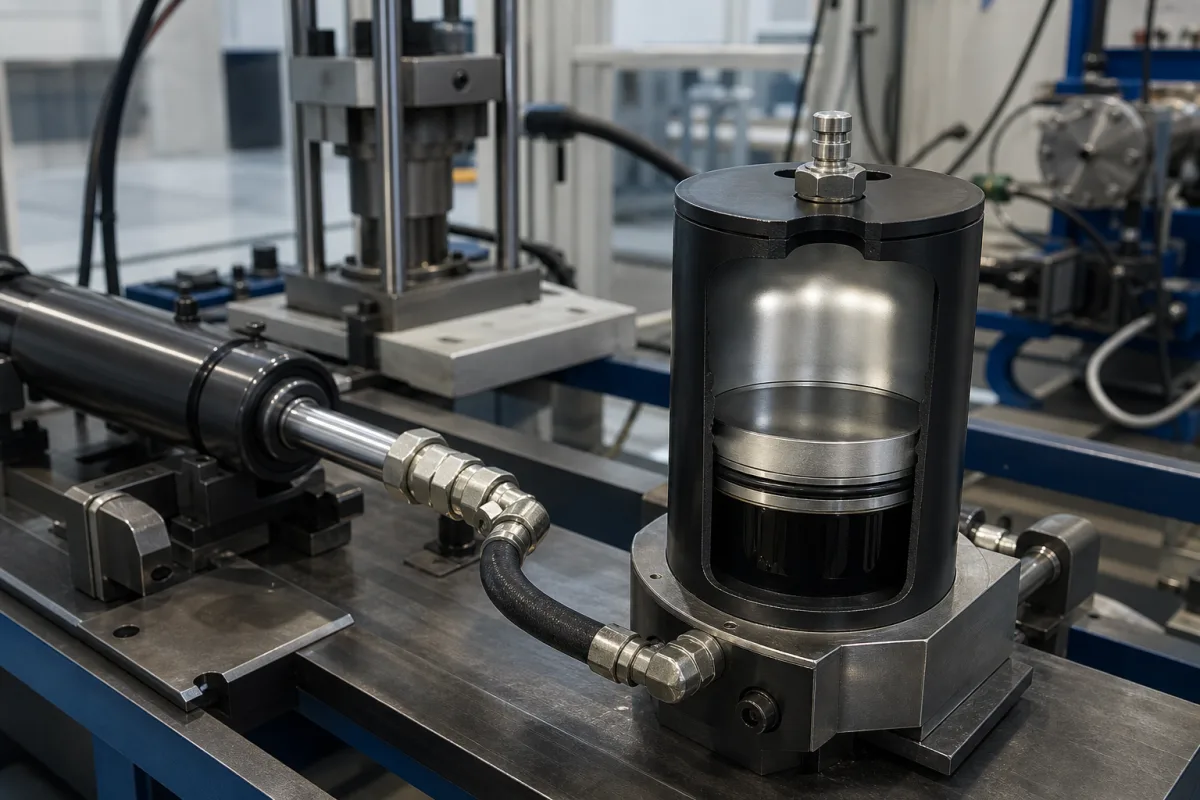
A canonical Fluid Reservoir is characterized by the integration of Reservoir Body and Floating Piston. In industrial production environments, manufacturers listed on CNFX commonly emphasize Aluminum alloy construction to support stable, high-cycle operation across diverse manufacturing scenarios.

A container that stores the magnetorheological fluid within a magnetorheological damper system.
Product Specifications

Technical details and manufacturing context for Fluid Reservoir

Definition
The fluid reservoir is a critical component of a magnetorheological damper, designed to hold and supply the magnetorheological fluid to the damper's working cylinder. It maintains the necessary fluid volume for the damper's operation, compensates for fluid displacement caused by piston rod movement, and often incorporates features to manage fluid expansion, aeration, and pressure equalization. In automotive and transportation applications, it ensures consistent damper performance by providing a stable fluid source.
Working Principle
The reservoir stores excess magnetorheological fluid and connects to the damper's main cylinder. As the damper piston rod moves in and out, it displaces fluid volume. The reservoir accommodates this displacement, preventing cavitation and maintaining system pressure. It may include a floating piston, diaphragm, or gas chamber to separate fluid from a compressible gas (like nitrogen) for volume compensation and to manage thermal expansion of the fluid.
Common Materials
Aluminum alloy, Stainless steel
Technical Parameters
  • Total fluid capacity of the reservoir (L) Per Request
Components / BOM
  • Reservoir Body
    Main structural shell that contains the fluid
    Material: Aluminum alloy
  • Floating Piston
    Separates the magnetorheological fluid from a pressurized gas chamber to compensate for volume changes
    Material: Rubber-coated steel
  • Filler Port
    Sealed opening for adding or replacing magnetorheological fluid
    Material: Stainless steel
Engineering Reasoning
0.1-3.0 MPa (1-30 bar)
4.2 MPa (42 bar) burst pressure or -0.08 MPa (-0.8 bar) vacuum collapse
Design Rationale: Yield strength of 6061-T6 aluminum (276 MPa) exceeded at 4.2 MPa internal pressure with 2.0 mm wall thickness and 100 mm diameter, or buckling collapse under vacuum due to Euler critical load with L/D ratio of 1.5
Risk Mitigation (FMEA)
Trigger Magnetorheological fluid particle sedimentation at 0.5 g/cm³ density differential after 1000 hours static operation
Mode: Clogged 0.5 mm diameter fluid passages causing 95% flow restriction
Strategy: Integrated ultrasonic agitator operating at 40 kHz with 15 W power input during standby periods
Trigger Thermal expansion coefficient mismatch (24×10⁻⁶ K⁻¹ aluminum vs 110×10⁻⁶ K⁻¹ nitrile rubber)
Mode: Seal extrusion failure at 120°C operating temperature with 2.5 MPa pressure
Strategy: PTFE-coated stainless steel spring-energized seals with 0.5 mm radial interference fit

Industry Taxonomies & Aliases

Commonly used trade names and technical identifiers for Fluid Reservoir.

Applied To / Applications

This component is essential for the following industrial systems and equipment:

Industrial Ecosystem & Supply Chain DNA

Complementary Systems
Downstream Applications
Specialized Tooling

Application Fit & Sizing Matrix

Operational Limits
pressure: 0 to 10 bar (gauge)
flow rate: 0 to 5 L/min
temperature: -40°C to 150°C
slurry concentration: Up to 40% by volume
Media Compatibility
✓ Magnetorheological fluid (MRF) ✓ Hydraulic oil (mineral-based) ✓ Silicone-based damping fluid
Unsuitable: Chlorinated solvents or strong oxidizing agents
Sizing Data Required
  • Required fluid volume (L)
  • Maximum operating pressure (bar)
  • System flow rate (L/min)

Reliability & Engineering Risk Analysis

Failure Mode & Root Cause
Corrosion
Cause: Chemical attack from fluid contaminants, moisture ingress, or incompatible fluid chemistry leading to material degradation and pitting.
Seal/Gasket Failure
Cause: Material degradation from temperature cycling, chemical incompatibility, improper installation, or excessive pressure causing leaks and fluid loss.
Maintenance Indicators
  • Visible fluid leaks or seepage around seals, welds, or connections
  • Abnormal fluid discoloration, cloudiness, or presence of particulate matter
Engineering Tips
  • Implement regular fluid analysis and condition monitoring to detect contamination, degradation, and wear particles early
  • Establish proper installation procedures and torque specifications for seals/gaskets, and use compatible materials for fluid service

Compliance & Manufacturing Standards

Reference Standards
ISO 11439:2013 (Gas cylinders - High pressure cylinders for the on-board storage of natural gas as a fuel for automotive vehicles) ASTM D4169-22 (Standard Practice for Performance Testing of Shipping Containers and Systems) DIN 19569-10:2016 (Wastewater treatment plants - Principles for the design of structures and technical equipment - Part 10: Specific principles for the equipment for thermal sludge treatment)
Manufacturing Precision
  • Wall thickness: +/-0.5 mm
  • Weld seam alignment: +/-1.0 mm
Quality Inspection
  • Hydrostatic pressure test
  • Visual and dimensional inspection per ASME BPVC Section V

Factories Producing Fluid Reservoir

Verified manufacturers with capability to produce this product in China

✓ 97% Supplier Capability Match Found

P Procurement Specialist from Canada Feb 24, 2026
★★★★★
"Standard OEM quality for Motor Vehicle Manufacturing applications. The Fluid Reservoir arrived with full certification."
Technical Specifications Verified
T Technical Director from United States Feb 21, 2026
★★★★★
"Great transparency on the Fluid Reservoir components. Essential for our Motor Vehicle Manufacturing supply chain."
Technical Specifications Verified
P Project Engineer from United Arab Emirates Feb 18, 2026
★★★★★
"The Fluid Reservoir we sourced perfectly fits our Motor Vehicle Manufacturing production line requirements."
Technical Specifications Verified
Verification Protocol

“Feedback is collected from verified sourcing managers during RFQ (Request for Quote) and factory evaluation processes on CNFX. These reports represent historical performance data and technical audit summaries from our B2B manufacturing network.”

15 sourcing managers are analyzing this specification now. Last inquiry for Fluid Reservoir from Brazil (56m ago).

Supply Chain Compatible Machinery & Devices

Automotive Solid-State Battery Pack

High-energy-density solid-state battery system for electric vehicles

Explore Specs →
Automotive Active Grille Shutter System

Aerodynamic system with motorized shutters for vehicle thermal and efficiency management.

Explore Specs →
Automotive Active Suspension Damping System

Electronically controlled suspension system for vehicle stability and comfort.

Explore Specs →
Ground Assembly Unit

A foundational structural component that provides stable mounting and alignment for equipment within an industrial system.

Explore Specs →

Frequently Asked Questions

What is the purpose of the floating piston in a magnetorheological fluid reservoir?

The floating piston separates the magnetorheological fluid from the compressed gas (usually nitrogen) in the reservoir, maintaining system pressure while preventing fluid contamination and ensuring consistent damper performance.

Why are aluminum alloy and stainless steel common materials for MR fluid reservoirs?

Aluminum alloy offers lightweight durability and corrosion resistance for weight-sensitive applications, while stainless steel provides superior strength and chemical resistance for harsh environments, both compatible with magnetorheological fluids.

How does the fluid reservoir integrate with a magnetorheological damper system?

The reservoir connects to the damper cylinder via hydraulic lines, storing excess MR fluid displaced during piston movement and maintaining proper fluid volume and pressure for responsive, adaptive suspension control.

Can I contact factories directly on CNFX?

CNFX is an open directory, not a transaction platform. Each factory profile provides direct contact information and production details to help you initiate direct inquiries with Chinese suppliers.

Get Quote for Fluid Reservoir

Request technical pricing, lead times, or customized specifications for Fluid Reservoir directly from verified manufacturing units.

Your business information is encrypted and only shared with verified Fluid Reservoir suppliers.

Thank you! Your message has been sent. We'll respond within 1–3 business days.

Need to Manufacture Fluid Reservoir?

Connect with verified factories specializing in this product category

Add Your Factory Contact Us
Previous Product
Final Inspection Station
Next Product
Frame Positioning Robot