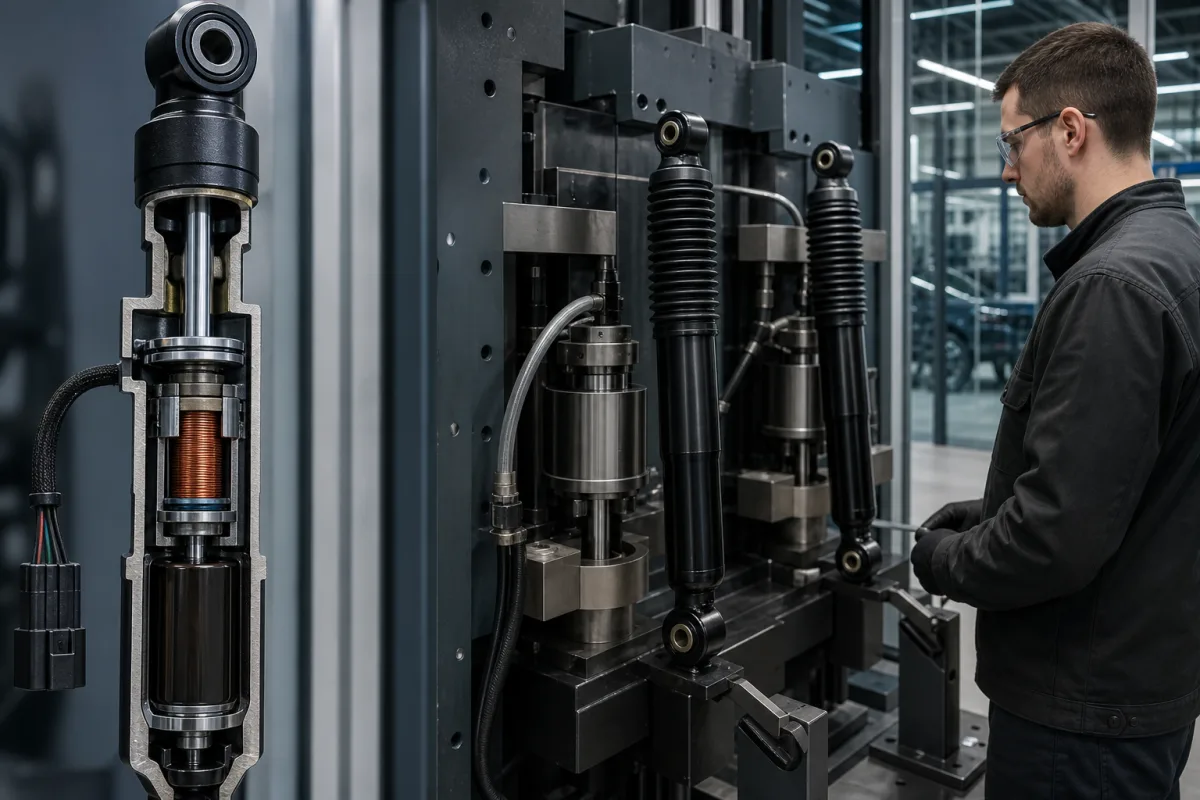
MR damper units · valveless dampers whose MR fluid stiffens in a coil's magnetic field, from seat and suspension dampers to 200 kN structural units
A magnetorheological (MR) damper is a damper filled with a fluid of micron-sized iron particles in oil; a coil in the piston sets up a magnetic field across the fluid gap, the fluid's yield stress rises with the field, and the damping force follows the coil current with no moving valve. Ask three things first: what force the damper gives at zero and at full current and at which velocity, what current, voltage and coil resistance the driver must supply, and what temperature range the fluid and seals are rated for.
Magnetorheological damper units: the cylinder, piston with coil, MR fluid, accumulator and electrical connection, for vehicle seat and suspension use and for structural and cable vibration control, including permanent-magnet adjustable types. Electronically controlled shock absorbers with solenoid valves, and complete semi-active suspension systems with controllers and sensors, are covered on the Automotive active suspension damping system page. MR fluid sold alone and MR brakes and clutches are outside this page.
CNFX editorial research · Sources checked October 12, 2026 · 3 sources
Read the force at zero and full current, at a stated velocity
A university laboratory page reproducing LORD's data for the RD-8041-1 long-stroke damper gives a damper force above 2,447 N (550 lbf) at 5 cm/s and 1 A, and below 667 N (150 lbf) at 20 cm/s and 0 A, with a 74 mm stroke, 248 mm extended length and 8,896 N maximum tensile strength. [1]
The same page lists a large LORD MR damper rated at 200 kN (45 kip) with a 584 mm stroke and 1.47 m extended length. [1] Civil Engineering Journal's 2018 review tabulates a 20-ton MR damper with a 58 cm stroke, 20.32 cm bore, nominal maximum force of 200,000 N, a maximum-to-minimum force ratio of 10.1 at 10 cm/s, a 2 mm gap and maximum input power below 50 W. [2]
Editorial calculation: with a force ratio of 10.1 and 200,000 N maximum, the force at zero field at 10 cm/s is about 200,000 / 10.1 ≈ 19,800 N; that off-state force stays in the structure or vehicle even when the controller asks for minimum damping. [2]
Give the supplier the required force at zero and full current with the test velocities, stroke and extended length, end fittings, mounting orientation, maximum tensile and compressive load, driver supply voltage and current, temperature range, response time needed and expected cycle count.
02
Size the coil driver from current, voltage and resistance
The RD-8041-1 data list a maximum input current of 1 A continuous for 30 seconds and 2 A intermittent, an input voltage of 12 V DC, and coil resistance of 5 Ω at ambient temperature rising to 7 Ω at the 71 °C (160 °F) maximum operating temperature. [1]
Editorial calculation: at 1 A the coil dissipates I²R = 1² × 5 = 5 W at ambient and 7 W hot, and needs 5–7 V; at 2 A intermittent it needs 10–14 V and dissipates 20–28 W, which exceeds the 12 V supply when hot, so a driver that regulates current is needed to hold force as resistance rises. [1]
The laboratory page lists LORD's Wonder Box current controller with closed-loop current control, 30 kHz pulse-width modulation and 2 A maximum output. For the 200 kN damper it gives 4.8 Ω coil resistance and about 5 H inductance, while the journal's table for its 20-ton damper gives three coils of 1,050 turns, 3 × 1.3 Ω and 6.6 H; the two documents may describe different builds, so ask the supplier for the coil data of the exact unit. [1][2]
03
Check the fluid's yield stress, response and temperature range
Civil Engineering Journal's review describes MR fluid as magnetic iron particles in a carrier oil with surfactants; carbonyl iron of 0.1–100 µm diameter is used for its 2.1 T saturation. Its table of typical MR fluid features lists maximum yield stress of 50–100 kPa, a power supply of 2–24 V at 1–2 A, operational field up to 248 kA/m and operating temperature from –40 °C to +148 °C. [2]
The review states that response time varies from 10 to 20 ms depending on magnetic circuit design, while its feature table gives a response time of a few milliseconds; ask which figure the supplier measured and whether it is fluid or complete-damper response. [2]
OVM describes its permanent-magnet adjustable MR damper, which uses MR fluid for damping force and permanent magnets for regulation, as stable and reliable from –45 °C to 150 °C and suited to high-frequency, small-displacement vibration such as bridge cables. [3]
04
Compare MR damper types
Data come from the cited sources for the named units.
The listed unit is a permanent-magnet adjustable magnetorheological damper for bridge-cable vibration control, sold beside viscous fluid and eddy-current tuned mass dampers.
Liuzhou OVM Machinery Co., Ltd.
Manufacturing site to be confirmed for the order
Lists a permanent-magnet adjustable magnetorheological damper for bridge-cable vibration control, alongside viscous fluid and eddy-current tuned mass dampers.
Explore company information and manufacturing capabilities, then discuss the scope of your project with a relevant supplier.
Share this page
Compiled and source-reviewed by the CNFX editorial team.
Each manufacturer above links to the page on that company's own website where the product is listed, with the date we checked it. How we source and review
· Page last updated 13 October 2026
Buyer questions
How much current does an MR damper need?
LORD's RD-8041-1 data list 1 A continuous for 30 seconds and 2 A intermittent at 12 V DC, with 5 Ω coil resistance at ambient and 7 Ω at 71 °C. [1]
How strong does MR fluid get in a field?
Civil Engineering Journal's review lists maximum yield stress of 50–100 kPa for MR fluid, at fields up to 248 kA/m. [2]
Are there MR dampers adjusted by permanent magnets?
OVM lists a permanent-magnet adjustable MR damper that uses permanent magnets for regulation, rated from –45 °C to 150 °C for bridge-cable vibration. [3]
Sources and what still needs a direct check
Sources checked 2026-10-12. The University of Alabama laboratory page reproduces LORD's specifications for dampers it uses; the Civil Engineering Journal paper is a review; OVM is a damper maker describing its own product.