Industry-Verified Manufacturing Data (2026)

Material Handling Conveyors

Based on aggregated insights from multiple verified factory profiles within the CNFX directory, the standard Material Handling Conveyors used in the Motor Vehicle Manufacturing sector typically supports operational capacities ranging from standard industrial configurations to heavy-duty production requirements.

Technical Definition & Core Assembly

A canonical Material Handling Conveyors is characterized by the integration of Drive Motor and Control Sensors. In industrial production environments, manufacturers listed on CNFX commonly emphasize Galvanized steel construction to support stable, high-cycle operation across diverse manufacturing scenarios.

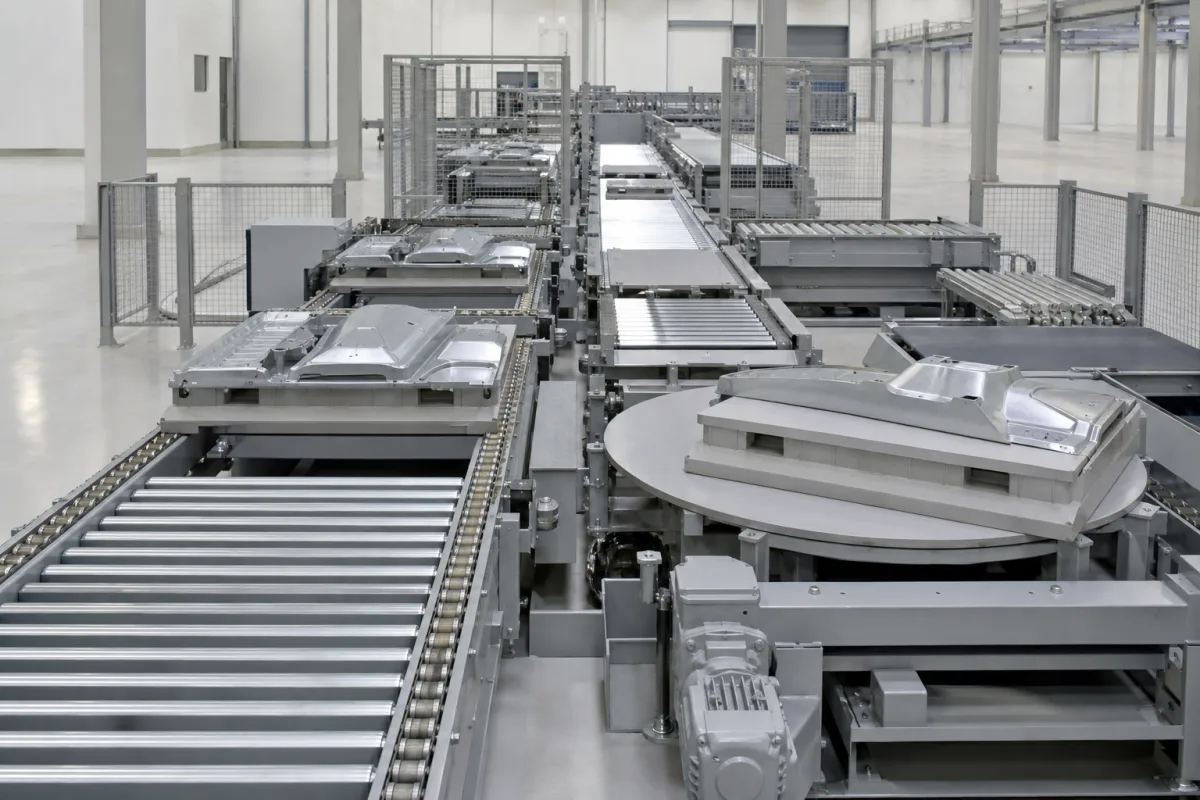
Automated conveyor systems designed to transport vehicle body components through the assembly process

Product Specifications

Technical details and manufacturing context for Material Handling Conveyors

Definition
Specialized conveyor systems within the Smart Robotic Body-in-White Assembly System that precisely move vehicle body panels, frames, and subassemblies between robotic workstations, ensuring proper positioning and timing for welding, joining, and assembly operations.
Working Principle
Utilizes motor-driven belts, rollers, or chains to transport automotive body components along predetermined paths, synchronized with robotic operations through programmable logic controllers and sensors for precise positioning and flow control.
Common Materials
Galvanized steel, Aluminum alloy, High-strength polymers
Technical Parameters
  • Conveyor width and height specifications for accommodating various vehicle body components (mm) Per Request
Components / BOM
  • Drive Motor
    Provides power to move the conveyor belt or rollers
    Material: Steel housing with copper windings
  • Control Sensors
    Detect component position and trigger robotic operations
    Material: Stainless steel with optical/inductive elements
  • Support Frame
    Structural support for the conveyor system
    Material: Galvanized steel
Engineering Reasoning
0.5-2.0 m/s linear velocity, 50-500 kg/m load capacity
Belt tension exceeding 1500 N/m causes permanent deformation, motor torque exceeding 85 N·m causes gearbox shear failure
Design Rationale: Exceeding yield strength of polyurethane belt material (35 MPa) causes plastic deformation; exceeding shear strength of hardened steel gear teeth (450 MPa) causes catastrophic failure
Risk Mitigation (FMEA)
Trigger Misaligned drive pulley causing 3° angular deviation
Mode: Belt edge wear exceeding 5 mm/hour, tracking sensor failure
Strategy: Laser-aligned mounting brackets with 0.1° tolerance, dual redundant optical tracking sensors
Trigger Accumulated electrostatic charge exceeding 15 kV
Mode: Electronic control board arcing, RFID tag data corruption
Strategy: Carbon-fiber grounding brushes with 10^6 Ω resistance, shielded control cabinets with 40 dB attenuation

Industry Taxonomies & Aliases

Commonly used trade names and technical identifiers for Material Handling Conveyors.

Industrial Ecosystem & Supply Chain DNA

Complementary Systems
Downstream Applications
Specialized Tooling

Application Fit & Sizing Matrix

Operational Limits
humidity: Up to 95% RH (non-condensing)
pressure: N/A (mechanical system, not pressurized)
speed range: 0.1 to 2.0 m/s (adjustable for assembly line pacing)
temperature: -10°C to 50°C (operational ambient range)
load capacity: Up to 500 kg/m (typical for automotive components)
Media Compatibility
✓ Automotive body panels (steel/aluminum) ✓ Plastic trim components ✓ Glass windshields/windows
Unsuitable: Corrosive chemical transport (acidic/alkaline environments)
Sizing Data Required
  • Maximum component weight and dimensions
  • Required throughput (units per hour)
  • Assembly line layout/configuration (straight, curved, elevation changes)

Reliability & Engineering Risk Analysis

Failure Mode & Root Cause
Belt misalignment and tracking failure
Cause: Improper installation, worn or damaged rollers, uneven loading, or accumulation of material causing belt drift.
Bearing failure in rollers and pulleys
Cause: Contamination from dust/debris, inadequate lubrication, excessive load, or misalignment leading to overheating and wear.
Maintenance Indicators
  • Unusual grinding or squealing noises from rollers or bearings
  • Visible belt edge wear, fraying, or material spillage along the conveyor path
Engineering Tips
  • Implement regular laser alignment checks and automated tracking systems to maintain proper belt alignment and tension.
  • Establish a proactive lubrication schedule using sealed or self-lubricating bearings, and install protective covers to prevent contamination.

Compliance & Manufacturing Standards

Reference Standards
ISO 9001:2015 - Quality Management Systems ANSI/ASME B20.1 - Safety Standard for Conveyors and Related Equipment EN 619:2002+A1:2010 - Continuous handling equipment and systems - Safety and EMC requirements for equipment for mechanical handling of unit loads
Manufacturing Precision
  • Shaft Alignment: +/-0.05mm per meter
  • Belt Tracking: +/-10mm from centerline over entire length
Quality Inspection
  • Non-Destructive Testing (NDT) - Ultrasonic Testing for weld integrity
  • Load Testing - Verification of rated capacity under operational conditions

Factories Producing Material Handling Conveyors

Verified manufacturers with capability to produce this product in China

✓ 95% Supplier Capability Match Found

S Sourcing Manager from Brazil Feb 21, 2026
★★★★★
"Found 48+ suppliers for Material Handling Conveyors on CNFX, but this spec remains the most cost-effective."
Technical Specifications Verified
P Procurement Specialist from Canada Feb 18, 2026
★★★★☆
"The technical documentation for this Material Handling Conveyors is very thorough, especially regarding technical reliability. (Delivery took slightly longer than expected, but technical support was excellent.)"
Technical Specifications Verified
T Technical Director from United States Feb 15, 2026
★★★★★
"Reliable performance in harsh Motor Vehicle Manufacturing environments. No issues with the Material Handling Conveyors so far."
Technical Specifications Verified
Verification Protocol

“Feedback is collected from verified sourcing managers during RFQ (Request for Quote) and factory evaluation processes on CNFX. These reports represent historical performance data and technical audit summaries from our B2B manufacturing network.”

17 sourcing managers are analyzing this specification now. Last inquiry for Material Handling Conveyors from Mexico (1h ago).

Supply Chain Compatible Machinery & Devices

Automotive Solid-State Battery Pack

High-energy-density solid-state battery system for electric vehicles

Explore Specs →
Automotive Active Grille Shutter System

Aerodynamic system with motorized shutters for vehicle thermal and efficiency management.

Explore Specs →
Automotive Active Suspension Damping System

Electronically controlled suspension system for vehicle stability and comfort.

Explore Specs →
Ground Assembly Unit

A foundational structural component that provides stable mounting and alignment for equipment within an industrial system.

Explore Specs →

Frequently Asked Questions

What materials are used in these automotive conveyors for durability?

Our conveyors use galvanized steel for structural strength, aluminum alloy for lightweight components, and high-strength polymers for wear-resistant parts, ensuring longevity in demanding vehicle manufacturing environments.

How do these conveyors integrate with existing vehicle assembly lines?

These automated conveyor systems feature modular designs with standard BOM components like control sensors, drive motors, and support frames, allowing seamless integration with existing motor vehicle assembly processes and control systems.

What maintenance is required for automotive material handling conveyors?

Minimal maintenance is needed thanks to corrosion-resistant galvanized steel, lightweight aluminum alloy components, and durable polymer parts. Regular inspection of control sensors and drive motors ensures optimal performance in vehicle manufacturing operations.

Can I contact factories directly on CNFX?

CNFX is an open directory, not a transaction platform. Each factory profile provides direct contact information and production details to help you initiate direct inquiries with Chinese suppliers.

Get Quote for Material Handling Conveyors

Request technical pricing, lead times, or customized specifications for Material Handling Conveyors directly from verified manufacturing units.

Your business information is encrypted and only shared with verified Material Handling Conveyors suppliers.

Thank you! Your message has been sent. We'll respond within 1–3 business days.

Need to Manufacture Material Handling Conveyors?

Connect with verified factories specializing in this product category

Add Your Factory Contact Us
Previous Product
Magnetorheological Damper
Next Product
Modular Tooling Fixtures