Industry-Verified Manufacturing Data (2026)

Power Distribution Unit

Based on aggregated insights from multiple verified factory profiles within the CNFX directory, the standard Power Distribution Unit used in the Electrical Equipment Manufacturing sector typically supports operational capacities ranging from standard industrial configurations to heavy-duty production requirements.

Technical Definition & Core Assembly

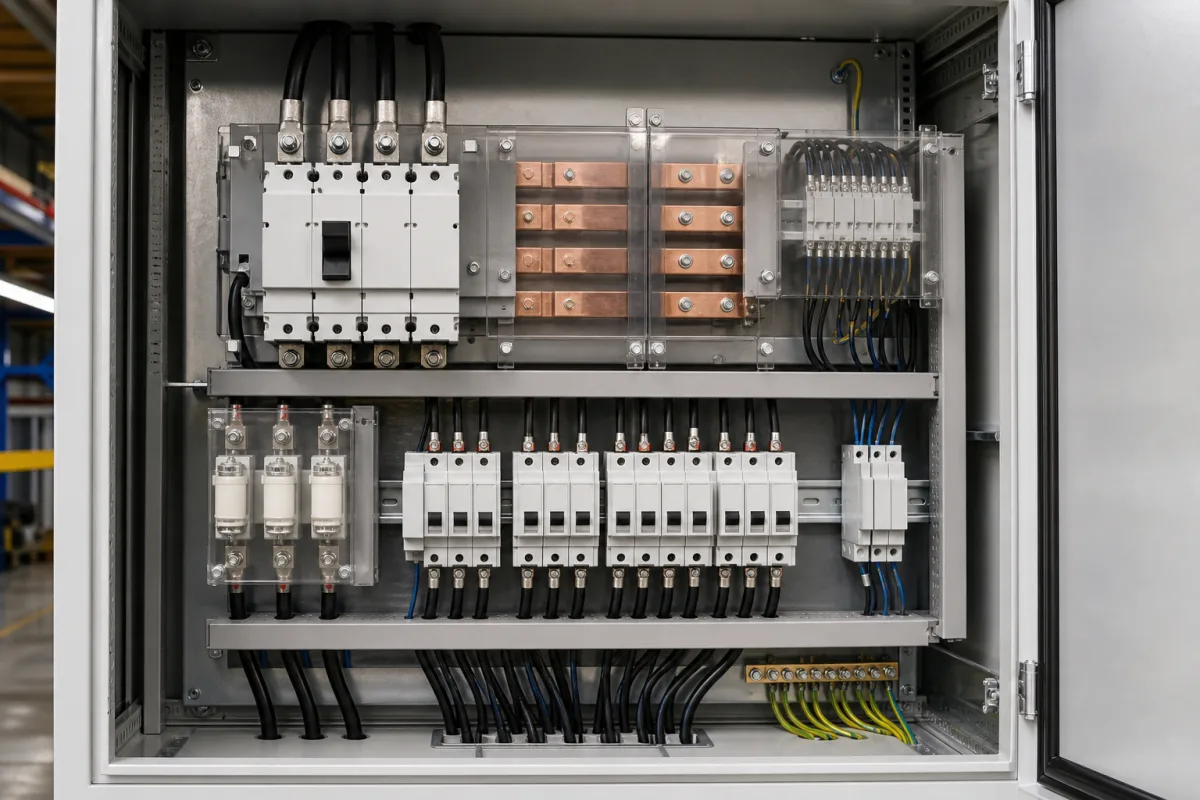
A canonical Power Distribution Unit is characterized by the integration of Input Terminal Block and Main Busbar. In industrial production environments, manufacturers listed on CNFX commonly emphasize Copper (for busbars and conductors) construction to support stable, high-cycle operation across diverse manufacturing scenarios.

A modular electrical component within a control cabinet that distributes power from a main supply to multiple branch circuits.
Product Specifications

Technical details and manufacturing context for Power Distribution Unit

Definition
A Power Distribution Unit (PDU) is a critical component within industrial control cabinets that receives incoming electrical power from a main source and safely distributes it to various connected devices, machines, or subsystems. It typically includes protective devices like circuit breakers or fuses, monitoring capabilities, and connection points to ensure reliable and organized power delivery within an automated system.
Working Principle
The PDU receives AC or DC input power through a main connection. This power is then routed through internal busbars or conductors to multiple output terminals or sockets. Integrated protective devices (e.g., circuit breakers, fuses, surge protectors) monitor the current flow on each branch circuit. If an overload, short circuit, or fault is detected, the protective device interrupts the circuit to prevent damage to downstream equipment and wiring. Some advanced PDUs also include monitoring sensors for parameters like current, voltage, and temperature, communicating this data to the cabinet's control system.
Common Materials
Copper (for busbars and conductors), Thermoplastic or Thermoset Polymer (for housing/insulation), Steel or Aluminum (for chassis/mounting frame)
Technical Parameters
  • Rated input current and voltage (e.g., 63A, 400V AC). (A, V) Customizable
Components / BOM
  • Input Terminal Block
    Connection point for the incoming main power cables.
    Material: Copper alloy, thermoplastic housing
  • Main Busbar
    Conducts electrical power from the input to the distribution points.
    Material: Copper or aluminum
  • Circuit Breaker / Fuse Holder
    Houses the overcurrent protection device for each output branch.
    Material: Thermoplastic, steel spring contacts
  • Output Terminal Block / Socket
    Connection point for outgoing power cables to loads.
    Material: Copper alloy, thermoplastic housing
  • Mounting Frame / Chassis
    Provides structural support and allows DIN-rail or panel mounting within the cabinet.
    Material: Steel or aluminum
Engineering Reasoning
85-264 VAC, 47-63 Hz, 0-40°C ambient temperature
275 VAC sustained for >100 ms, 70°C internal component temperature, 95% relative humidity
Design Rationale: Dielectric breakdown of insulation at >3 kV/mm, thermal expansion mismatch causing solder joint fatigue at ΔT>60°C, electrochemical migration at >0.7 V potential difference in humid environments
Risk Mitigation (FMEA)
Trigger Transient voltage surge exceeding 6 kV with 1.2/50 μs waveform
Mode: Insulation breakdown between primary and secondary windings
Strategy: Integrated gas discharge tube with 8/20 μs 20 kA rating and MOV array with 1500 J energy absorption
Trigger Continuous operation at 90% rated current with 0.85 power factor
Mode: Copper trace delamination due to 120°C hotspot formation
Strategy: 2 oz copper PCB with thermal vias to aluminum baseplate maintaining ΔT<15°C between junction and ambient

Industry Taxonomies & Aliases

Commonly used trade names and technical identifiers for Power Distribution Unit.

Applied To / Applications

This component is essential for the following industrial systems and equipment:

Industrial Ecosystem & Supply Chain DNA

Complementary Systems
Downstream Applications
Specialized Tooling

Application Fit & Sizing Matrix

Operational Limits
current: Up to 100A per circuit
voltage: Up to 600V AC/DC
humidity: 5% to 95% non-condensing
temperature: -20°C to +60°C
Media Compatibility
✓ Industrial control cabinets ✓ Data center racks ✓ Manufacturing equipment panels
Unsuitable: Outdoor marine environments with salt spray
Sizing Data Required
  • Total connected load (kW)
  • Number of branch circuits required
  • Input voltage and phase configuration

Reliability & Engineering Risk Analysis

Failure Mode & Root Cause
Overheating of components
Cause: Excessive current load, poor ventilation, dust accumulation on heat sinks, or loose electrical connections increasing resistance
Insulation breakdown
Cause: Moisture ingress, contamination from dust/oil, thermal cycling causing material degradation, or voltage surges exceeding dielectric strength
Maintenance Indicators
  • Audible buzzing, humming, or crackling sounds from transformers or contactors indicating arcing or loose connections
  • Visible discoloration, scorch marks, or melting on insulation, terminals, or enclosures suggesting overheating
Engineering Tips
  • Implement infrared thermography inspections quarterly to detect abnormal heat patterns in connections, breakers, and busbars before failures occur
  • Maintain clean, dry environment with proper ventilation; use desiccant breathers on enclosures in humid areas and ensure all cable entry points are sealed to prevent contamination

Compliance & Manufacturing Standards

Reference Standards
IEC 60947-6-2: Low-voltage switchgear and controlgear - Multiple function equipment - Control and protective switching devices (or similar) UL 60950-1: Information Technology Equipment - Safety - Part 1: General Requirements (or UL 62368-1 for newer versions) EN 50581: Technical documentation for the assessment of electrical and electronic products with respect to the restriction of hazardous substances (RoHS compliance)
Manufacturing Precision
  • Voltage Regulation: +/- 1% of nominal output voltage under full load
  • Temperature Rise: Not exceeding 30°C above ambient under rated load conditions
Quality Inspection
  • Dielectric Withstand Test (Hi-Pot Test): Verify insulation integrity at specified high voltage
  • Load Bank Testing: Verify performance and temperature under simulated full-rated load conditions

Factories Producing Power Distribution Unit

Verified manufacturers with capability to produce this product in China

✓ 92% Supplier Capability Match Found

T Technical Director from United States Jan 30, 2026
★★★★★
"As a professional in the Electrical Equipment Manufacturing sector, I confirm this Power Distribution Unit meets all ISO standards."
Technical Specifications Verified
P Project Engineer from United Arab Emirates Jan 27, 2026
★★★★☆
"Standard OEM quality for Electrical Equipment Manufacturing applications. The Power Distribution Unit arrived with full certification. (Delivery took slightly longer than expected, but technical support was excellent.)"
Technical Specifications Verified
S Sourcing Manager from Australia Jan 24, 2026
★★★★★
"Great transparency on the Power Distribution Unit components. Essential for our Electrical Equipment Manufacturing supply chain."
Technical Specifications Verified
Verification Protocol

“Feedback is collected from verified sourcing managers during RFQ (Request for Quote) and factory evaluation processes on CNFX. These reports represent historical performance data and technical audit summaries from our B2B manufacturing network.”

8 sourcing managers are analyzing this specification now. Last inquiry for Power Distribution Unit from Poland (47m ago).

Supply Chain Compatible Machinery & Devices

Transformer Winding Machine

Industrial machine for winding copper wire onto transformer cores

Explore Specs →
Circuit Breaker Trip Unit

Protective control module for electrical circuit breakers

Explore Specs →
Circuit Breaker Arc Chute

Electrical component that extinguishes arcs in circuit breakers

Explore Specs →
Medium Voltage Switchgear Assembly Line

Automated production system for assembling medium voltage electrical switchgear.

Explore Specs →

Frequently Asked Questions

What materials are used in this power distribution unit for durability and safety?

This PDU uses copper for efficient busbars and conductors, thermoplastic or thermoset polymer for insulated housing, and steel/aluminum for a sturdy mounting frame/chassis.

How does this modular PDU integrate into a control cabinet setup?

It mounts securely within the cabinet via its frame, connects to the main power supply through the input terminal block, and distributes power via the main busbar to output terminals or sockets for branch circuits.

What are the key components included in the PDU's bill of materials?

The BOM includes a circuit breaker or fuse holder for protection, input and output terminal blocks, a main busbar for power distribution, and a mounting frame or chassis for installation.

Can I contact factories directly on CNFX?

CNFX is an open directory, not a transaction platform. Each factory profile provides direct contact information and production details to help you initiate direct inquiries with Chinese suppliers.

Get Quote for Power Distribution Unit

Request technical pricing, lead times, or customized specifications for Power Distribution Unit directly from verified manufacturing units.

Your business information is encrypted and only shared with verified Power Distribution Unit suppliers.

Thank you! Your message has been sent. We'll respond within 1–3 business days.

Need to Manufacture Power Distribution Unit?

Connect with verified factories specializing in this product category

Add Your Factory Contact Us
Previous Product
Power Distribution Module
Next Product
Power Distribution Unit (PDU)