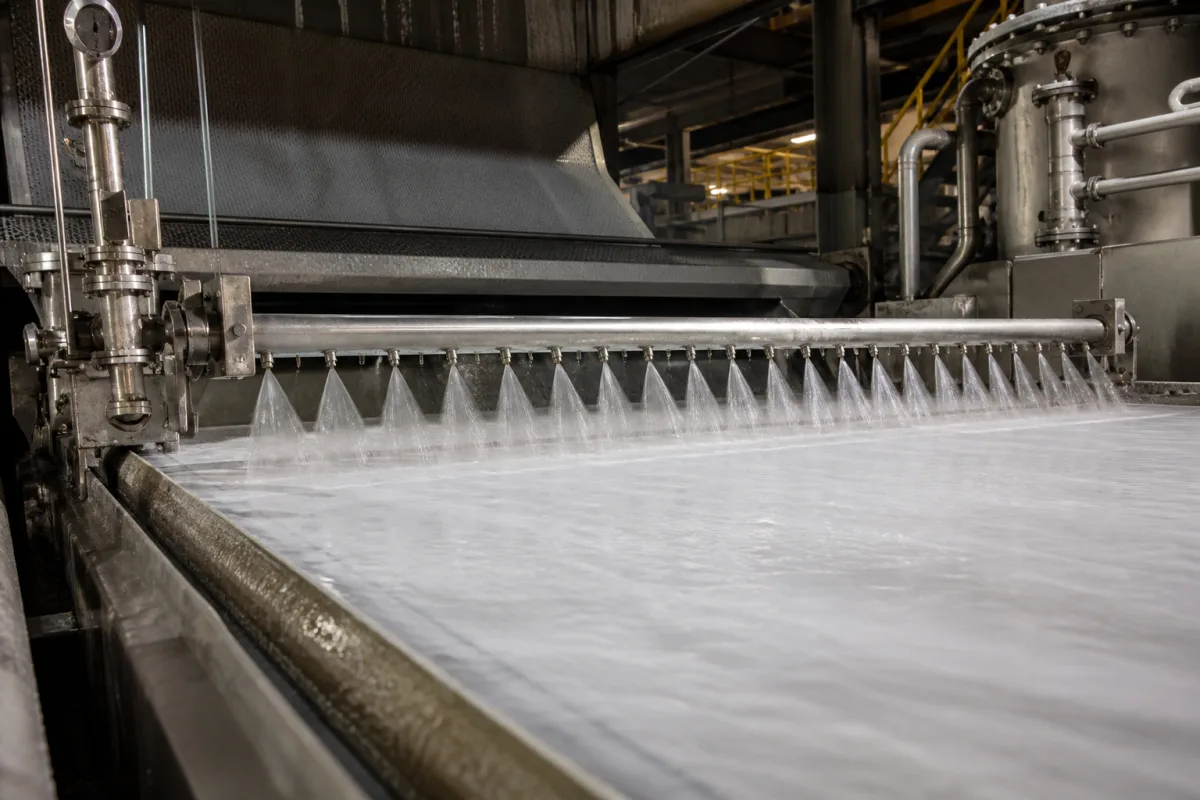
Felt conditioning shower: needle-jet and fan-nozzle shower pipes for cleaning and lubricating paper machine press felts
Shower pipes that spray press felts on the run · 0.040-inch needle jets at 150–250 psi oscillated at twice the nozzle spacing, overlapping fan nozzles for lubrication and chemical feed, and filtration sized to the orifice
A felt conditioning shower is a cross-machine pipe of nozzles aimed at a press felt as it returns from the nip. Some pipes fire thin needle jets at high pressure to dislodge fines, fillers and pitch from the batt and base cloth; others lay overlapping fan sprays at low pressure to flush, lubricate the felt ahead of a suction box, or carry cleaning chemicals. The choices that matter are jet type, pressure, nozzle orifice and spacing, how far the nozzle sits from the felt, and how the oscillator moves it.
Shower pipes, nozzles, oscillators and their filtration for conditioning press felts on paper, board and tissue machines: high-pressure needle-jet showers, low-pressure fan lubrication, flooding and chemical showers, and self-cleaning brush showers. The press section as a whole, including nip design, press felts and suction (Uhle) box design and vacuum, is covered on the Paper machine press section page. Doctor beams, blade holders and doctor cleaning showers are covered on the Paper machine doctoring system page; felt carrying, guide and stretch rolls on the Paper machine felt rolls page; press rolls on the Press roll page. Forming-fabric suction boxes are covered on the Forming-section vacuum suction box page.
CNFX editorial research · Sources checked October 12, 2026 · 3 sources
Needle-jet showers: 0.040 in orifices at 150–250 psi, stroked twice the nozzle spacing
Dubois Chemicals' US 7,597,782 B2 gives, as an example, oscillating needle showers on press felts operating at 150–250 psi with 0.040 in orifice nozzles spaced 3 to 6 in apart. The oscillation is meant to move the jets a cross-machine distance equal to the jet diameter, 0.040 in, within the time of one felt rotation through the nip, which the patent gives as 2–4 seconds; it describes a stroke of twice the nozzle spacing as the arrangement used to give double full coverage in case a nozzle plugs. [1]
Kadant engineer John Neun's TAPPI course reaches the same rules from the other direction: oscillate evenly at twice the nozzle spacing and one nozzle diameter per fabric revolution, and use pressure as low as possible, with 250 psi given as the maximum for felts and 400 psi for forming fabrics. His oscillator speed rule is traversing speed equals machine speed times nozzle diameter divided by fabric length. [2]
Editorial calculation: at 0.040 in per felt revolution and 2–4 s per revolution (the Dubois figures), the shower traverses at about 0.010–0.020 in/s, so one 12 in stroke (twice a 6 in spacing) takes about 600–1,200 s, or 10–20 minutes. [1]
Distance and angle change what the jet does. The Kadant course gives under 4 in from the felt, with laminar flow, for through cleaning from the inside, and a 6 in stand-off on the sheet side, where peak dynamic power lies between 6 and 10 in; it recommends a chisel angle of 15° into the fabric for sheet-side showers and perpendicular or 15° chasing for inside showers. [2]
Give the shower supplier the felt position (inside or sheet side), felt length and machine speed, nozzle orifice and spacing, supply pressure, stand-off, jet angle and the oscillator stroke and drive.
02
Why a 0.040 in needle jet cleans and a fan of the same orifice does not
The Kadant course compares a 0.040 in needle jet with a 0.040 in 60° fan nozzle at 150 psi. [2]
Editorial calculation: 11,000 ÷ 78 is about 140, so on the course's figures the needle jet concentrates roughly 140 times the power per square inch of the fan while using less water. On a 300 in wide felt with nozzles on 6 in centres, 50 needle nozzles at 0.36 gpm each would draw about 18 gpm at 150 psi. [2]
Jet quality matters as much as pressure: the course contrasts a good, glass-rod jet with a poor one whose energy is dispersed over an area six times greater, and suggests changing nozzles about once a year. [2] Spraying Systems' NeedleJet solid-stream nozzle, listed for oscillating showers and for cleaning felts, fabrics and suction rolls, has a 316 stainless steel body with a synthetic ruby orifice insert, flow rates from 0.032 to 11.0 gpm and operating pressures up to 1000 psi (70 bar). [3] That is a nozzle rating; the 250 psi felt ceiling in the Kadant course is the operating limit to plan around. [2]
Fan showers for lubrication, flooding and chemical feed: overlap and oscillation
The Dubois patent names four felt shower types: flooding showers (low pressure, high volume, flushing loose particles), lubricating showers (low pressure, low volume, a fan spray into the nip of the suction box with overlapping coverage, to cut wear and seal the box), chemical showers (low pressure, lower volume, best near the sheet-felt split and far from the suction box) and high-pressure needle showers. [1]
For fan nozzles, the Kadant course shows a 40–45° nozzle with a 0.047–0.054 in orifice and reports flow variation between nozzles of the same type of 2–8% (standard deviation over average). Spacing for the average pattern width gives an even chance of a dry or wet streak; single coverage is the minimum and multiple coverage is better. In its example of a 300 in wide shower with 45° nozzles on 6 in centres and ½ in pattern overlap, average flow is 0.079 gpm/in either way, but the standard deviation falls from 0.019 (24%) without oscillation to 0.003 (4%) with a 12 in oscillator stroke. [2]
For a flooded nip on a felt, the course gives the flow to fill the felt's void volume as fabric width (in) × fabric weight (oz/ft²) × speed (fpm) × 0.000063, minus all other shower flows. [2] Editorial calculation: a 300 in felt of 4 oz/ft² at 3,000 fpm gives 300 × 4 × 3,000 × 0.000063 ≈ 227 gpm before subtracting the other showers; the felt weight and speed here are assumptions for illustration.
For each fan shower, state its job (lubricating, flooding or chemical), nozzle angle and orifice, spacing and overlap, flow per inch and whether it oscillates.
04
Reading felt streaks back to the shower that caused them
The Kadant course lists streak patterns on press felts, drawn for an example with 6 in nozzle spacing and a 12 in oscillator, and ties four of them to the showers. [2]
The Dubois patent adds that improper oscillation of the high-pressure shower produces a streaky felt. [1] Against plugging, the course recommends brush (self-cleaning) showers and sizing the filter so that the nozzle orifice defines the barrier dimension, loading sets the service interval and the filter's open area sets the pressure drop. [2]
Herringbone suction box cover geometry or wear, not the shower [2]
Ask for the filter rating against the smallest orifice on the pipe, the brush or purge mechanism, and how the oscillator avoids dwell at stroke reversal.
05
Felt, nozzle and oscillator data for a felt shower order
Paste it into your enquiry below or into an email to a maker, then replace every bracket.
Felt: [position in the press; length; width; weight; machine speed]
Shower duty: [needle cleaning inside or sheet side; lubricating; flooding; chemical]
Nozzles: [needle or fan; orifice; angle; spacing; material]
Pressure and flow: [supply pressure; flow per nozzle or per inch]
Position: [stand-off; jet angle; on roll or in open run]
Oscillator: [stroke; traverse speed or felt-synchronised drive]
Filtration: [filter rating; brush or self-cleaning pipe]
Explore company information and manufacturing capabilities, then discuss the scope of your project with a relevant supplier.
Share this page
Compiled and source-reviewed by the CNFX editorial team.
Each manufacturer above links to the page on that company's own website where the product is listed, with the date we checked it. How we source and review
· Page last updated 13 October 2026
Buyer questions
What pressure do press felt needle showers run at?
Dubois Chemicals' patent gives 150–250 psi as an example range, and Kadant's TAPPI course gives 250 psi as the maximum for felts. [1][2]
How far should a needle shower oscillate?
About twice the nozzle spacing, moving one jet diameter (0.040 in) per felt revolution, so the felt gets double full coverage if a nozzle plugs. [1][2]
What is a lubricating shower for?
A low-pressure, low-volume fan spray into the nip of the suction box that reduces wear and friction and seals the box. [1]
What nozzle is used in a needle shower?
A solid-stream nozzle; Spraying Systems' NeedleJet has a 316 stainless body, a synthetic ruby orifice and a rating up to 1000 psi. [3]
Sources and what still needs a direct check
Sources checked 2026-10-12. A felt cleaning patent from Dubois Chemicals, a TAPPI course on fabric cleaning by a Kadant engineer, and Spraying Systems' NeedleJet nozzle listing.