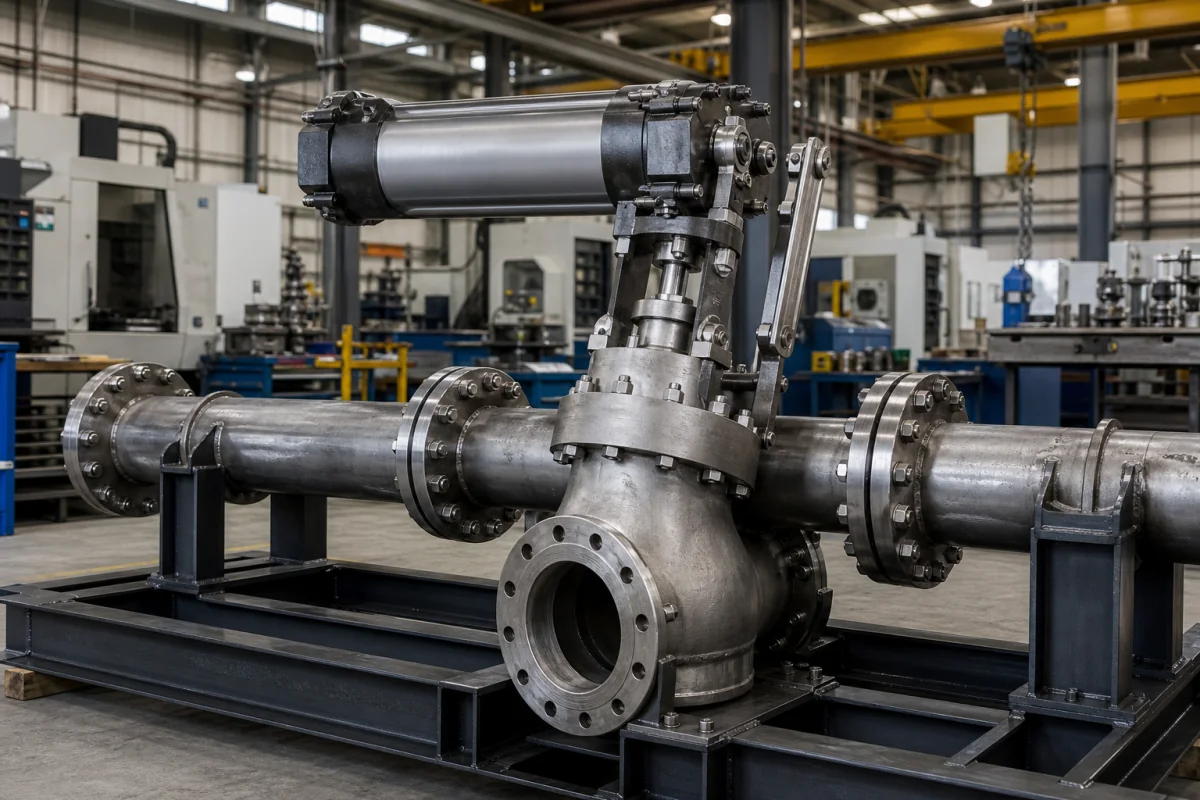
Flush-bottom discharge valve for reactors and process tanks
Flush-bottom discharge valves for reactors and tanks · disc rising into the vessel or lowering into the body, inlet × outlet sizing, Cv, seats and jackets
A flush-bottom discharge valve (tank bottom valve, bottom outlet valve) is an angle valve whose disc or plug closes flush with the inside of a vessel's bottom pad, so that liquids, slurries and viscous or semi-solid batches drain from reactors, tanks and pipelines without a dead leg under the vessel. Ask three things first: whether the disc can rise into the vessel or must lower into the valve body because an agitator sits close above, what inlet and outlet sizes and flow coefficient the drain time needs, and which seat, packing and body material the batch chemistry and temperature allow.
Flush-bottom (tank bottom) discharge valves bolted to the bottom pads of reactors, process tanks and dryers, in disc-rising and disc-lowering designs, manual or actuated. Tumbling and convective blenders for pharmaceutical powders, with their own outlet arrangements, are covered on the Automated pharmaceutical powder blender page; butterfly valves, slide gates and rotary valves at hopper and silo outlets are covered on the Powder hopper valve page.
CNFX editorial research · Sources checked October 12, 2026 · 3 sources
Choose a disc that rises into the vessel or lowers into the valve
PneuCon offers both arrangements as separate series: 510, with the disc opening into the tank, and 520, with the disc opening into the valve body. It describes the upward-opening design as used where there is enough space between the bottom pad and the vessel's stirrer, and notes that the mass of the batch helps close it to a tight shut-off. [2] SchuF, which states it invented the disc drain valve in 1923, adds that the disc-rising valve is a flow-to-close design and that its shorter stroke allows smaller, lighter and faster actuators, while its disc-lowering Model 24 is non-intrusive and can be used on vessels with agitators, dryers, mixers and filters. [3]
The choice changes the flow: Tecnik publishes Cv values for its UNICON 7000/7100 valves with the vessel-opening construction and tells buyers to reduce them by 25% for the valve-opening construction. [1] Editorial calculation: its DN 80 × 50 valve at Cv 100 becomes about Cv 75 with a disc lowering into the body, and its DN 200 × 150 valve at Cv 660 becomes about Cv 495.
SchuF also lists automatic crust breaking on disc-rising versions, flushing ports for cleaning in service, temperature sensors through the valve, and a version combined with a sampling valve. [3]
Give the supplier the vessel bottom pad drawing (inlet flange and the x and d1 dimensions), the distance from pad to agitator, the batch (liquid, slurry, viscous, crystallising), temperature and pressure, drain time, cleaning method, and whether the valve must be jacketed, actuated or fitted with a temperature probe.
02
Size by inlet × outlet and flow coefficient
Tecnik designates each flush-bottom valve by two sizes: the inlet flange fixed to the vessel pad and the smaller port and outlet flange connected to the pipe; the outlet is inclined 45° to the valve axis. [1] PneuCon states the inlet of a standard valve is one size larger than the outlet, with equal sizes possible as special constructions, and an outlet angle of 45° or 60°. [2]
Ranges published by the three makers differ: Tecnik NPS 1" to 8" (DN 25 to 200) in ANSI classes 150, 300 and 600; PneuCon 40 to 200 mm in ANSI 150; SchuF one inch to six inches and larger on request. [1][2][3]
Inlet × outlet (Tecnik, ANSI 150/300)
Published Cv, disc into vessel
Editorial calculation: Cv with disc into valve (−25%)
Pick seat, stem seal, body and actuator for the batch
PneuCon lists a PTFE soft seat, or conical metal-to-metal seating that can be hard-faced with Stellite where aggressive liquids or slurries distort the seat, PTFE V-ring and Grafoil gland packing, and bodies in carbon steel, 304, 316, 304L and 316L stainless, Alloy 20 and Hastelloy. [2] Tecnik lists leakage classes IV and V for metal seats and VI for soft seats to FCI 70-2, design to ASME B16.34 and SFS EN 12516, a temperature range of −73 to 500 °C, and steam, oil or hot-water jacketing for batches that solidify unless discharged hot. [1]
To stop leakage to atmosphere, SchuF offers a stuffing box, a metal or PTFE bellows, or a diaphragm seal, bodies in cast steel, stainless steel, nickel alloys, titanium and zirconium, PTFE or glass lining, and a fire-safe version certified to BS 6755 Pt.2 (ISO 10497). [3]
For actuation, PneuCon lists diaphragm, cylinder or electric actuators, direct or reverse acting, with diaphragm spring ranges of 0.2–1.0 and 0.4–2.0 kg/cm² and an air supply of 1.4–2.5 kg/cm² (20–35 psig). [2] Editorial note: a fail-closed actuator keeps the batch in the vessel on air failure; state which failure position the process needs.
04
Data for a flush-bottom valve enquiry
Paste it into your enquiry below or into an email to a maker, then replace every bracket.
Vessel: [reactor, tank, dryer; bottom pad drawing]
Agitator: [clearance above pad]
Disc: [rising into vessel or lowering into valve]
Size: [inlet × outlet; outlet angle; Cv or drain time]
Batch: [liquid, slurry, viscous, crystallising; temperature; pressure]
Seat and seal: [PTFE or metal; packing, bellows or diaphragm]
Body: [material; lining; jacket]
Actuation: [manual, pneumatic, electric; fail position; switches]
Lists discharge valves in duplex, Hastelloy, Inconel, Monel, nickel, titanium and zirconium, top-mounted discharge valves and an ice-breaking tank bottom valve.
Explore company information and manufacturing capabilities, then discuss the scope of your project with a relevant supplier.
Share this page
Compiled and source-reviewed by the CNFX editorial team.
Each manufacturer above links to the page on that company's own website where the product is listed, with the date we checked it. How we source and review
· Page last updated 13 October 2026
Buyer questions
When should the disc lower into the valve instead of rising into the tank?
When an agitator sits close above the bottom pad: PneuCon uses the rising type where there is enough space to the stirrer, and SchuF describes its disc-lowering valve as non-intrusive for vessels with agitators. [2][3]
Does the disc direction change the flow?
Tecnik reduces its published Cv by 25% for the valve-opening (disc lowering) construction. [1]
Why does a flush-bottom valve have two sizes?
The inlet flange on the vessel pad is larger than the outlet port and flange to the pipe, for example DN 80 × 50. [1][2]
Sources and what still needs a direct check
Sources checked 2026-10-12. Valve data come from three makers' own documents: Tecnik's UNICON 7000/7100 catalogue, PneuCon's Series 500 catalogue and SchuF's disc bottom outlet valve page. Values apply to the ranges named.