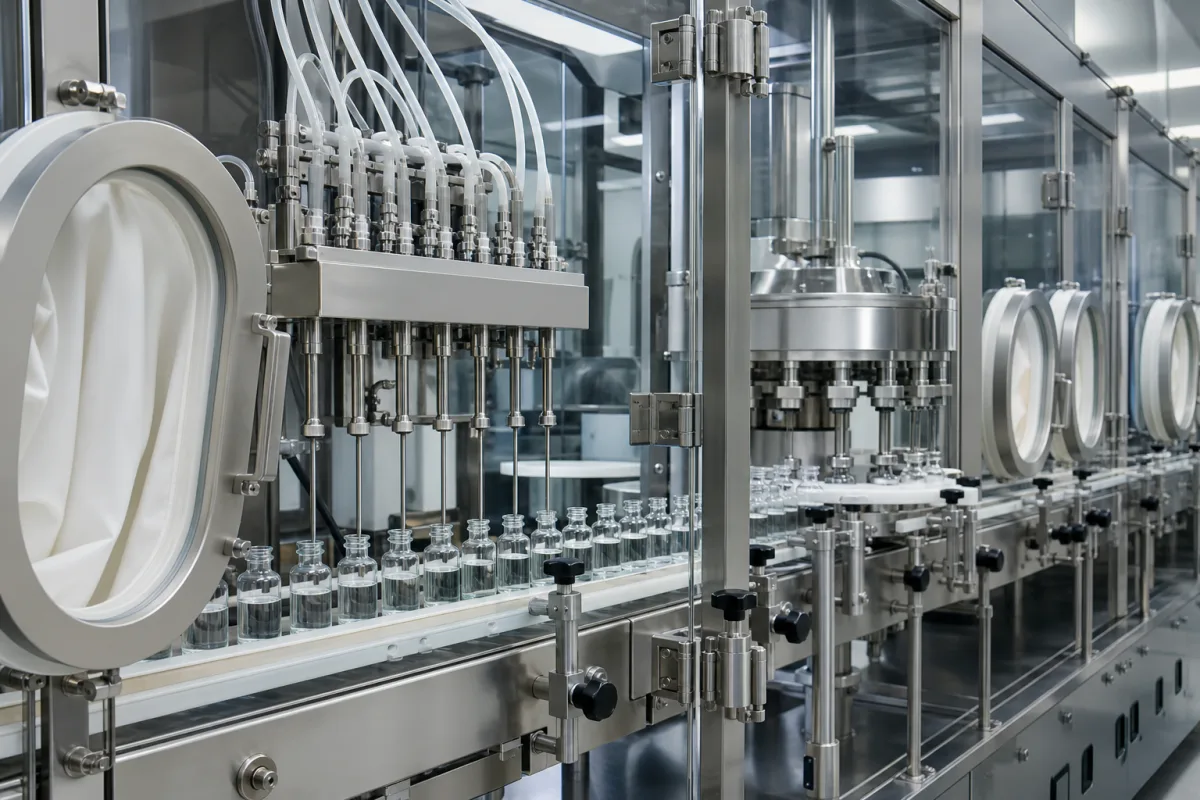
Pharmaceutical aseptic vial filling, stoppering and capping system for sterile injectables
Sterile injectables · the machine that doses liquid into vials, seats the rubber stopper and crimps the aluminium cap inside a RABS or isolator, and how FDA expects the line to be proven with media fills
A sterile injectable in a vial is closed in three steps inside the aseptic zone: a dosing pump fills each vial, a stoppering station presses in the rubber stopper (fully, or only half-way when the vial goes on to a freeze dryer), and a capping head crimps an aluminium or flip-off seal over it. The picture shows such a machine behind glass with glove ports: a row of filling needles over vials on a conveyor and a rotary stoppering turret beyond. Buyers fix three things: the dosing technology and its accuracy at their fill volume, the closing sequence their product needs, and how the line will be proven sterile by process simulation.
Machines and monoblocks that fill sterile liquid medicines into vials, stopper them and crimp aluminium seals under RABS or isolators, with their dosing pumps, weight checks and closing stations. Aseptic fillers for foods and beverages (bottles, pouches, bag-in-box) are covered on the Aseptic filling machine page. The barrier itself is covered on the Aseptic barrier: isolator and RABS page; the crimp seal itself on the Pharmaceutical vial aluminium seal page and the stopper on the Pharmaceutical vial rubber stopper page; vial washers, depyrogenation tunnels and freeze dryers have their own pages, and battery electrolyte filling is a different process covered on the Electrolyte filling systems page.
CNFX editorial research · Sources checked October 12, 2026 · 3 sources
Rotary piston or peristaltic dosing: ±0.5 % against ±1 %, and in-line weighing that keeps hands out of the critical zone
Both machines below let the buyer choose between rotary piston pumps and peristaltic pumps; only NJM publishes the accuracy of each.
FDA's 2004 aseptic processing guidance states that any intervention or stoppage during an aseptic process can increase the risk of contamination, and gives an on-line weight check device as an example of design that removes a repeated manual activity from the critical area; sterilising a preassembled connection in place is another. [1]
Editorial calculation: 120 units per minute is 7,200 an hour, 2.4 times the STERY-SA's 3,000 an hour. On a 2 ml fill, ±0.5 % is ±0.01 ml and ±1 % is ±0.02 ml; on a 100 ml fill the same percentages are ±0.5 ml and ±1 ml. NJM does not state the fill volume or statistic behind its accuracy figures, so ask for them at your own volume. [2][3]
Item
NJM Dara SX-310-PP/D
Marchesini STERY-SA
Machine type
Linear, intermittent motion; two filling, two stoppering and two capping stations [2]
Rotary, table-top filling and stoppering; on-board alu-capping as a monoblock option [3]
Specify fill volumes and their tolerance, product viscosity and any shear or foaming sensitivity, vial formats from 2R upward, output per hour, the weight-check method (100 % or statistical), and the barrier type.
02
Full stoppering and crimping in one block, or half-stoppering and no cap for the freeze dryer
The closing sequence follows the product: liquid fills are stoppered and capped at once, lyophilised products leave with the stopper half inserted.
NJM's machine can be programmed for full stopper insertion followed by an aluminium or flip-off cap, or for half stopper insertion with no capping for lyophilisation; its closing station uses a servo-driven tangential rolling head to minimise particulate generation. [2] Marchesini offers complete or partial stoppering for liquid or lyophilised products, the alu-capping station on board, or the machine configured for capping only (CAPSY-SA). [3]
FDA addresses both paths. A partially closed sterile product should be transferred only in critical areas, and the area between filling line and lyophilizer should provide Class 100 (ISO 5) protection, with transport and loading giving the same. If stoppered vials leave an aseptic zone or room before capping, local protection should be in place until crimping is complete, and devices for on-line detection of improperly seated stoppers can provide additional assurance. [1]
State whether vials are fully stoppered and capped on the machine or half-stoppered for a freeze dryer, the stopper and cap sizes, whether caps are crimped inside or outside the barrier, and whether a stopper-height or presence check is required.
03
Proving the line with media fills: 5,000 to 10,000 units, and one or two contaminated vials as the trigger
A process simulation runs growth medium through the same filling, stoppering and capping steps; FDA's guidance gives run sizes and acceptance limits.
FDA gives 5,000 to 10,000 units as a starting point for run size rather than a fixed number; production sizes under 5,000 need media fills at least equal to the maximum batch size, manually intensive lines need runs at or approaching full batch size, and an isolator process can be simulated with fewer units as a proportion of the operation. Interventions are written into procedures; FDA's example is removing 10 units after an intervention at the stoppering station infeed, and no more units may be removed in a media fill than in production. [1]
The guidance also explains why the media fill matters: a sterility test of 20 units from a 10,000-unit lot with 0.1 % contamination would pass about 98 % of the time. [1] Editorial calculation: 0.999^20 ≈ 0.980, which matches. At NJM's 7,200 units an hour, a 5,000 to 10,000-unit media fill takes about 42 to 83 minutes of machine time, before interventions and line clearances. [2]
Media fill run size
FDA recommended response
Fewer than 5,000 units
No contaminated units should be detected; 1 contaminated unit is cause for revalidation after investigation [1]
5,000–10,000 units
1 contaminated unit: investigation, including a possible repeat media fill; 2: revalidation after investigation [1]
More than 10,000 units
1 contaminated unit: investigation; 2: revalidation after investigation [1]
Ask the supplier which interventions the machine design requires (stopper bowl refills, jam clearance, weight-check rejects), how each is done through gloves or automation, and how the machine supports media fill runs at the planned size.
04
Product, vial and sterility details for an aseptic vial line
Paste it into your enquiry below or into an email to a maker, then replace every bracket.
Product: [liquid or suspension; viscosity; shear or foaming sensitivity; lyophilised or not]
Vials: [formats 2R to 500 ml; glass or plastic; nested or bulk]
Fill: [volumes; tolerance; dosing pump preference]
Closing: [full or half stoppering; stopper size; aluminium or flip-off cap; crimp location]
Output: [vials per hour; batch size]
Barrier: [oRABS, cRABS or isolator; CIP/SIP]
Checks: [100 % or statistical weight control; stopper presence or height]
Validation: [media fill size; IQ/OQ support]
Explore company information and manufacturing capabilities, then discuss the scope of your project with a relevant supplier.
Share this page
Compiled and source-reviewed by the CNFX editorial team.
Each manufacturer above links to the page on that company's own website where the product is listed, with the date we checked it. How we source and review
· Page last updated 13 October 2026
Buyer questions
How accurate are vial filling pumps?
NJM states ±0.5 % for rotary piston pumps and ±1 % for peristaltic pumps on its Dara SX-310-PP/D, without giving the fill volume behind the figures. [2]
What happens to vials going to a freeze dryer?
They are half-stoppered and not capped; FDA recommends that partially closed sterile product is transferred only in critical areas with Class 100 (ISO 5) protection up to the lyophilizer. [2][1]
How many units does an aseptic media fill need?
FDA gives 5,000 to 10,000 units as a starting point, at least the maximum batch size for production under 5,000, and more for manually intensive lines. [1]
Sources and what still needs a direct check
Sources checked 2026-10-12. FDA's 2004 guidance sets out US expectations for aseptic processing; NJM (Dara machine, reported by Manufacturing Chemist) and Marchesini Group describe their own vial filling and stoppering machines.