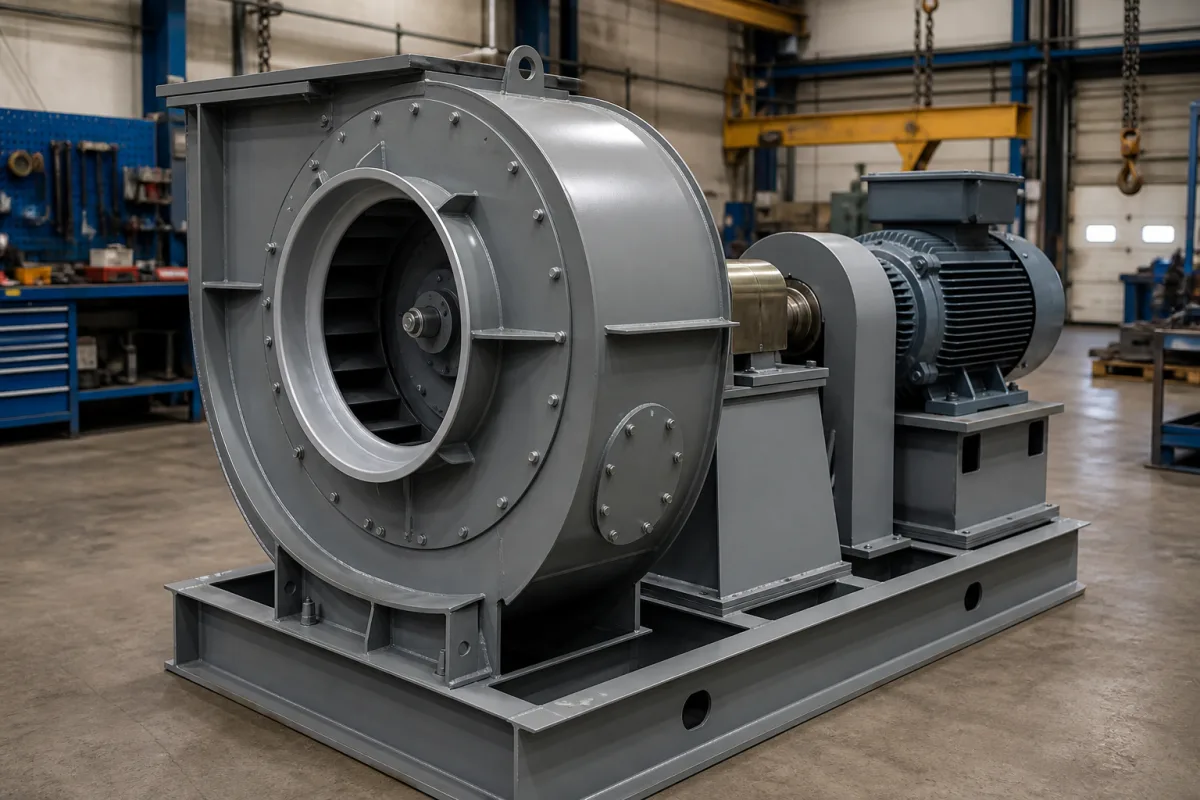
Fan assembly for air handling units: the fan, motor and drive module
Air handling unit fan section · Belt, coupled or EC direct drive, plenum fan sizes and pressure, fan-and-motor efficiency
A fan assembly, as used on this page, is the moving-air module inside an air handling unit or ventilation plant: the impeller, the motor, the drive between them (belts and pulleys, a coupling, or the motor rotor itself) and the bearings and base that carry them. It is the part that is specified, replaced or retrofitted on its own when an air handling unit is rebuilt. Ask three things first: how the motor drives the impeller and what that drive loses, what airflow and pressure each fan must deliver in the space available, and whether the efficiency quoted was measured for the whole fan-and-motor unit.
Fan-and-drive modules for air handling units and ventilation plant: belt-driven and coupled fan sets on a shared base, plenum (plug) fans and EC direct-drive fans, including fan-wall retrofits. Complete air handling units with their casing, coils and filters are covered on the Air handling unit page. Fan balancing machines and fans sold for other duties are outside this page.
CNFX editorial research · Sources checked October 12, 2026 · 3 sources
The U.S. Department of Energy's Motor Systems Tip Sheet #5 states that about one-third of industrial and commercial electric motors use belt drives. V-belt drives can reach a peak efficiency of 95% or more when installed, but efficiency can deteriorate by as much as 5% over time if the belt slips because it is not retensioned; DOE says tension should be checked every 3 to 6 months after break-in. Notched belts run on the same pulleys and are about 2% more efficient than standard V-belts, and synchronous (toothed) belts run at a consistent 98% over a wide load range. [1]
DOE's worked example is a continuously operating 100 hp supply-air fan at 75% average load using 527,000 kWh a year: replacing a 95% V-belt with a 98% synchronous belt saves 527,000 × (1 − 95/98) = 16,130 kWh a year. DOE adds that synchronous belts are noisier, less suited to shock loads and transmit more vibration, and that on centrifugal fans removing slip raises speed, so sprockets must be sized to the required fan speed or flow and power can rise. [1]
ebm-papst's RadiPac brochure describes the alternative of mounting the impeller directly on the rotor of an external-rotor EC motor, so the whole rotating unit is balanced together and the integrated electronics replace an external frequency converter. [2] Editorial note: for a belt-driven module, ask for the belt type, pulley ratio and retensioning interval; for a direct-drive module, ask whether the quoted efficiency includes the motor electronics.
Give the supplier the airflow and static pressure at each duty point, the space available in the unit (width, height, depth), the drive you want (belt, coupling or EC direct drive), supply voltage and frequency, speed control signal, the air temperature range, and whether the fans will run in parallel as a fan wall.
02
Size the fan module and check whose efficiency is quoted
Aerovent's CPLF plenum fan, an airfoil impeller with nine blades in Arrangement 3 for field-fabricated or factory-built air handling units, pressurises the surrounding plenum so discharge ductwork can leave in any direction and the fan housing, transitions and diffusers are removed. Aerovent lists impeller diameters from 315 mm to 2,265 mm (12.25 to 89 in), airflow to 475,700 m³/h (280,000 CFM) and static pressure to 2,490 Pa (10 in w.g.). [3]
ebm-papst rates its RadiPac EC plug fans in sizes 630 to 1,000 at a static overall efficiency of 68% across a wide optimum range, measured on chamber test rigs for the whole unit of motor, electronics and impeller; it says its GreenTech EC motors exceed 90% efficiency and meet IE4, and that the range improved efficiency by over 13% against its previous models. [2]
Its nominal data list size 630 units at 380–480 V, 50/60 Hz, from 1,275 rpm and 2,670 W up to 1,950 rpm and 9,670 W, and the size 1,000 unit at 750 rpm and 6,340 W, all for ambient temperatures of −25 to +40 °C. [2] Editorial note: a plenum fan's catalogue range is a family envelope; ask for the selection at your duty point, inside your unit's cabinet, with the measured input power.
03
Compare fan assembly types
Type
Drive
Check
Belt-driven fan set
V-belt, notched or synchronous belt and pulleys. [1]
Impeller, EC or belt-drive motor, pulleys, bearings, inlet cone and mounting base
Part
Role
Fix in the order
Impeller
Moves the air; airfoil blades in the Aerovent CPLF. [3]
Type, diameter, material.
Electric motor
Drives the impeller; EC motors above 90% efficiency per ebm-papst. [2]
Type, power, efficiency class.
Pulley and belt (if used)
Sets speed ratio; efficiency depends on belt type and tension. [1]
Belt type and ratio.
Shaft and bearings
Carry the impeller on belt or coupled sets.
Bearing type and life.
Inlet ring or cone
Guides air into the impeller; RadiPac includes a pressure tap for flow control. [2]
Nozzle and flow measurement.
Mounting base or bracket
Supports the module in the cabinet.
Base type and vibration isolation.
05
Airflow, static pressure, speed and motor input for an air handling unit fan module
Ask whose efficiency is quoted: the airflow and pressure ranges here are catalogue family limits, and the duty point in your own cabinet decides the input power.
Field
What it means and published values
Ask the supplier for
Airflow Rate (m³/h)
Up to 475,700 m³/h across the Aerovent CPLF family. [3]
Explore company information and manufacturing capabilities, then discuss the scope of your project with a relevant supplier.
Share this page
Compiled and source-reviewed by the CNFX editorial team.
Each manufacturer above links to the page on that company's own website where the product is listed, with the date we checked it. How we source and review
· Page last updated 13 October 2026
Buyer questions
How efficient is a belt drive on a fan?
DOE gives V-belts a peak of 95% or more when new, losing up to 5% if slipping, and synchronous belts a consistent 98%. [1]
What efficiency do EC plug fans reach?
ebm-papst rates its RadiPac sizes 630–1,000 at 68% static overall efficiency across a wide optimum range, measured for the whole unit. [2]
How large can a plenum fan be?
Aerovent lists its CPLF plenum fan from 315 to 2,265 mm impeller diameter, to 475,700 m³/h and 2,490 Pa. [3]
Sources and what still needs a direct check
Sources checked 2026-10-12. DOE's tip sheet is a government energy-efficiency guide; ebm-papst and Aerovent are fan makers describing their own products.