Editorial Technical Reference

Shaft and Bearings

This page explains how Shaft and Bearings is classified within Machinery and Equipment Manufacturing. Technical values and manufacturer relationships are research references; confirm the current specification and supplier evidence for each order.

Technical Definition & Core Assembly

A shaft and bearing assembly is a mechanical component used in fan systems to transmit rotational motion from the motor to the fan blades while maintaining precise alignment and minimizing friction.
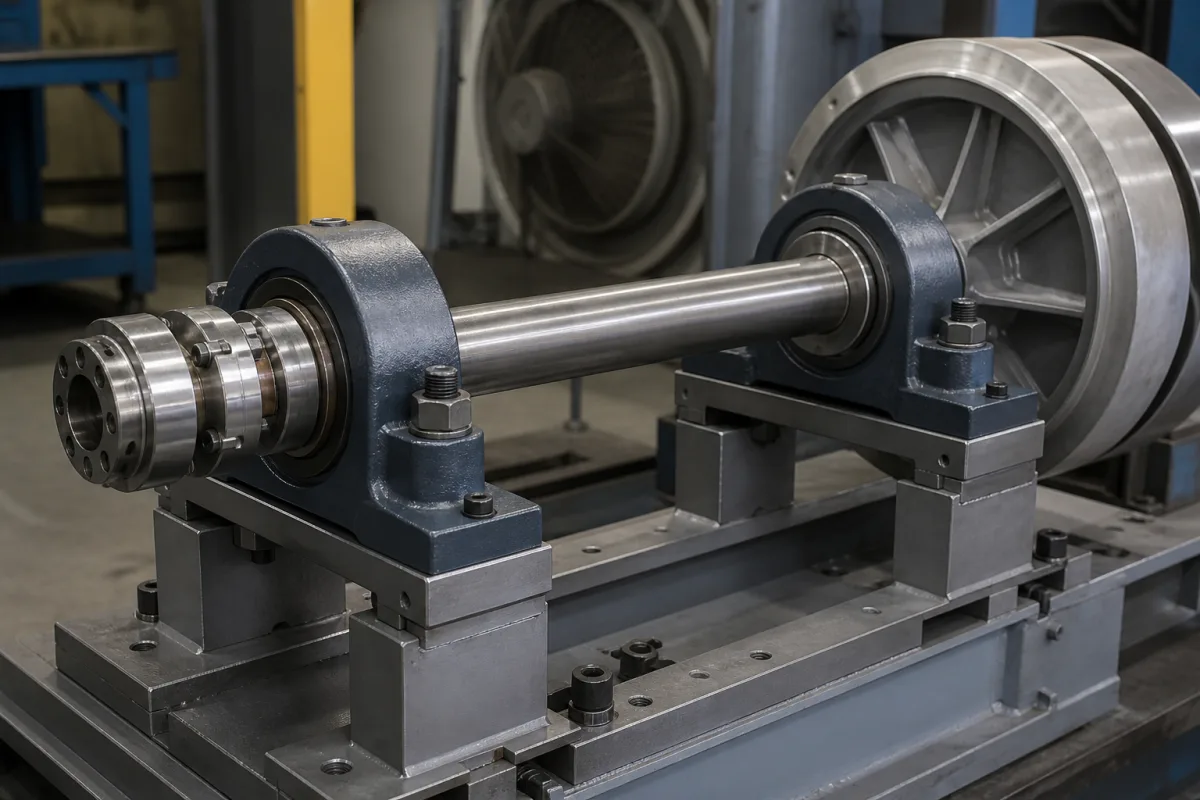
Representative product image. Confirm appearance and specifications with the manufacturer.

Product Specifications

Technical details and manufacturing context for Shaft and Bearings

Definition
A shaft and bearing assembly is a mechanical component used in fan systems to transmit rotational motion from the motor to the fan blades while maintaining precise alignment and minimizing friction. The shaft is a cylindrical part that transfers torque, while the bearings support the shaft and reduce friction between the rotating shaft and the stationary housing. This assembly is critical for smooth operation, energy efficiency, and longevity of the fan. The shaft and bearings are designed to handle radial and axial loads, ensuring stable rotation even under varying operating conditions. The materials commonly used include steel, bronze, and ceramic, each offering different properties such as strength, wear resistance, and thermal stability. The dimensions of the shaft and bearings, specified in millimeters, are key parameters that must be matched to the specific fan model and application. Proper installation, lubrication, and maintenance are essential to prevent premature wear, misalignment, and failure. When selecting or replacing a shaft and bearing assembly, it is important to verify the exact specifications with the original equipment manufacturer or a qualified supplier, as incorrect dimensions or materials can lead to performance issues or safety hazards. Regular inspection for signs of wear, noise, or vibration can help identify potential problems early. The assembly operates within defined boundaries; exceeding load or speed limits can cause overheating, seizure, or catastrophic failure. Therefore, it is crucial to adhere to the manufacturer's guidelines and confirm that the chosen components meet the required standards for the intended application.
Working Principle
The shaft transmits rotational force from the motor to the fan blades. The bearings support the shaft and reduce friction through rolling or sliding contact between the rotating shaft and the stationary housing. This allows smooth rotation with minimal energy loss. The bearings also maintain precise alignment, preventing excessive vibration and wear. The choice of bearing type and material affects load capacity, speed, and durability.
Common Materials
Steel, Bronze, Ceramic
Technical Parameters

What to specify in your RFQ

  • Shaft diameter and bearing dimensions in mm

These are the quantities to specify to the manufacturer when sizing or requesting a quote. The manufacturer's own documentation governs the exact figures and applicable standard.

Components / BOM
  • Shaft Part
    Transmits rotational torque from motor to fan blades
    Material: steel
  • Bearings Part
    Supports shaft rotation while minimizing friction and maintaining alignment
    Material: steel or bronze
  • Bearing Housing Part
    Secures bearings in position and provides mounting surface
    Material: cast iron or aluminum

Applied To / Applications

This component is essential for the following industrial systems and equipment:

Industrial Ecosystem & Supply Chain Structure

Complementary Systems
Downstream Applications
Specialized Tooling

Application Fit & Sizing Matrix

Operational Limits
pressure: Up to 10 bar
axial load: Up to 5 kN
radial load: Up to 15 kN
temperature: -40°C to 150°C
rotational speed: Up to 10,000 RPM
Media Compatibility
✓ Clean air/gas systems ✓ Industrial ventilation fans ✓ HVAC systems
Unsuitable: High-concentration abrasive slurry environments
Sizing Data Required
  • Shaft diameter (mm)
  • Required rotational speed (RPM)
  • Maximum axial/radial load (N)

Reliability & Engineering Risk Analysis

Failure Mode & Root Cause
Fatigue spalling
Cause: Cyclic loading exceeding material endurance limit, often due to misalignment, imbalance, or improper preload, leading to subsurface crack initiation and propagation.
Fretting corrosion
Cause: Micro-motion between bearing rings and shaft/housing under vibration or thermal cycling, combined with inadequate lubrication, causing oxidative wear and loss of fit.
Maintenance Indicators
  • High-frequency vibration or audible squealing during operation, indicating lubrication failure or contamination.
  • Abnormal temperature rise (>70°C above ambient) detected via thermal imaging or touch, signaling excessive friction or overload.
Engineering Tips
  • Implement precision alignment (laser/optical) and dynamic balancing to reduce cyclic stresses; use interference fits with proper tolerances (ISO/ANSI standards) to prevent micro-motion.
  • Establish condition-based lubrication with filtered oil or high-purity grease, monitored via oil analysis and ultrasonic leak detection to maintain film strength and exclude contaminants.

Indicative industry ranges for design and RFQ preparation. Confirm the exact figures and applicable standard with the manufacturer before specifying.

Compliance & Manufacturing Standards

Applicable Standards
ISO 286-1:2010 (Geometrical product specifications - Limits and fits) ANSI/ABMA Std 20 (Radial Bearings of Ball, Cylindrical Roller, and Spherical Roller Types - Metric Design) DIN 7190-1 (Interference fits - Calculation and design rules)

Quoted from the published standard.

Manufacturing Precision
  • Shaft diameter tolerance: h6 (e.g., 50mm shaft: -0.016mm to 0mm)
  • Bearing bore roundness: ≤ 0.003mm for precision bearings
Quality Inspection
  • Dimensional verification with coordinate measuring machine (CMM)
  • Hardness testing (Rockwell C scale) for shaft material

Manufacturers of Shaft and Bearings

Manufacturer profiles associated with Shaft and Bearings.

Sourcing Shaft and Bearings from China?
Tell us your specification and target quantity — we will match it against manufacturer records and come back with the factories that fit.
Request manufacturers We manufacture this

Manufacturer listings support early research and capability understanding. They are not certification, ranking, or transaction guarantees.

Technical documentation
Request current drawings, revision history, and a signed specification sheet.
Manufacturing capability
Verify equipment lists, process limits, capacity, and representative production evidence.
Inspection readiness
Confirm test methods, calibrated equipment, sampling plans, and traceable reports.
Supplier transparency
Check the legal entity, factory address, ownership, certifications, and direct contacts.

CNFX does not score or rank suppliers. Buyers must verify all claims and documents with the legal manufacturer before ordering.

Supply Chain Compatible Machinery & Devices

Hydraulic Press

Industrial machine using hydraulic pressure to compress, form, or assemble materials

Explore Specs →
Heavy-Duty CNC Plasma Cutting Machine

The Heavy-Duty CNC Plasma Cutting Machine is a standalone industrial device designed for cutting conductive metals such as steel, stainless steel, aluminum, and copper alloys.

Explore Specs →
Automated Powder Coating System

Integrated industrial system for applying dry powder coatings to metal substrates.

Explore Specs →
Centrifugal Pump Impeller

The centrifugal pump impeller is a critical rotating component that converts mechanical energy from the motor into kinetic energy in fluid systems.

Explore Specs →

Frequently Asked Questions

What is the function of a shaft and bearing assembly in a fan?

It transmits torque from the motor to the fan blades while supporting the rotating shaft and reducing friction, ensuring smooth and efficient rotation.

What materials are commonly used for shafts and bearings?

Steel, bronze, and ceramic are typical materials, each offering different properties such as strength, wear resistance, and thermal stability.

How do I select the correct shaft and bearing dimensions?

The dimensions, specified in millimeters, must match the fan model and application. Always verify with the manufacturer or supplier to ensure proper fit and performance.

What maintenance is required for shaft and bearing assemblies?

Regular inspection for wear, noise, or vibration, and proper lubrication are essential. Follow the manufacturer's guidelines for maintenance intervals and procedures.

Data Basis

Editorial classification, named public sources where available, and source-reviewed manufacturer records.

Preliminary Technical Classification
This page supports structured research, RFQ preparation, and supplier evaluation. It does not replace buyer-led supplier qualification, standards review, or technical approval.
Buyer enquiry

Request manufacturing insight for Shaft and Bearings

Ask for use case, specification boundaries, supplier type, and RFQ preparation information for this product.

Where it goes
Straight to the CNFX editorial desk, and to the manufacturer if this product is linked to a claimed profile. Nothing is broadcast to a supplier list.
Your details stay here
We do not sell or rent enquiry data, and we do not add you to a mailing list. Used only to answer this request.
No commission, no middleman
CNFX is a directory. We take no cut of any order and never negotiate on a supplier's behalf.
What we don't claim
A listing is not an endorsement. Qualify every supplier and verify every figure yourself before ordering.

Your business information is used only to process this request.

Thank you! Your message has been sent. We'll respond within 1–3 business days.
Sorry, we couldn't send your message. Please try again, or email us at contact@cnfx.com.

Need to Manufacture Shaft and Bearings?

Compare manufacturer profiles with relevant product and process capability.

Previous Product
Servo/Stepper Drive Amplifier
Next Product
Shaft Coupling
Get QuotesChat