Industry-Verified Manufacturing Data (2026)

Material Deposition/Feeding Mechanism

Based on aggregated insights from multiple verified factory profiles within the CNFX directory, the standard Material Deposition/Feeding Mechanism used in the Rubber and Plastic Product Manufacturing sector typically supports operational capacities ranging from standard industrial configurations to heavy-duty production requirements.

Technical Definition & Core Assembly

A canonical Material Deposition/Feeding Mechanism is characterized by the integration of Material Reservoir/Hopper and Metering Pump or Cylinder. In industrial production environments, manufacturers listed on CNFX commonly emphasize Stainless Steel (wetted parts) construction to support stable, high-cycle operation across diverse manufacturing scenarios.

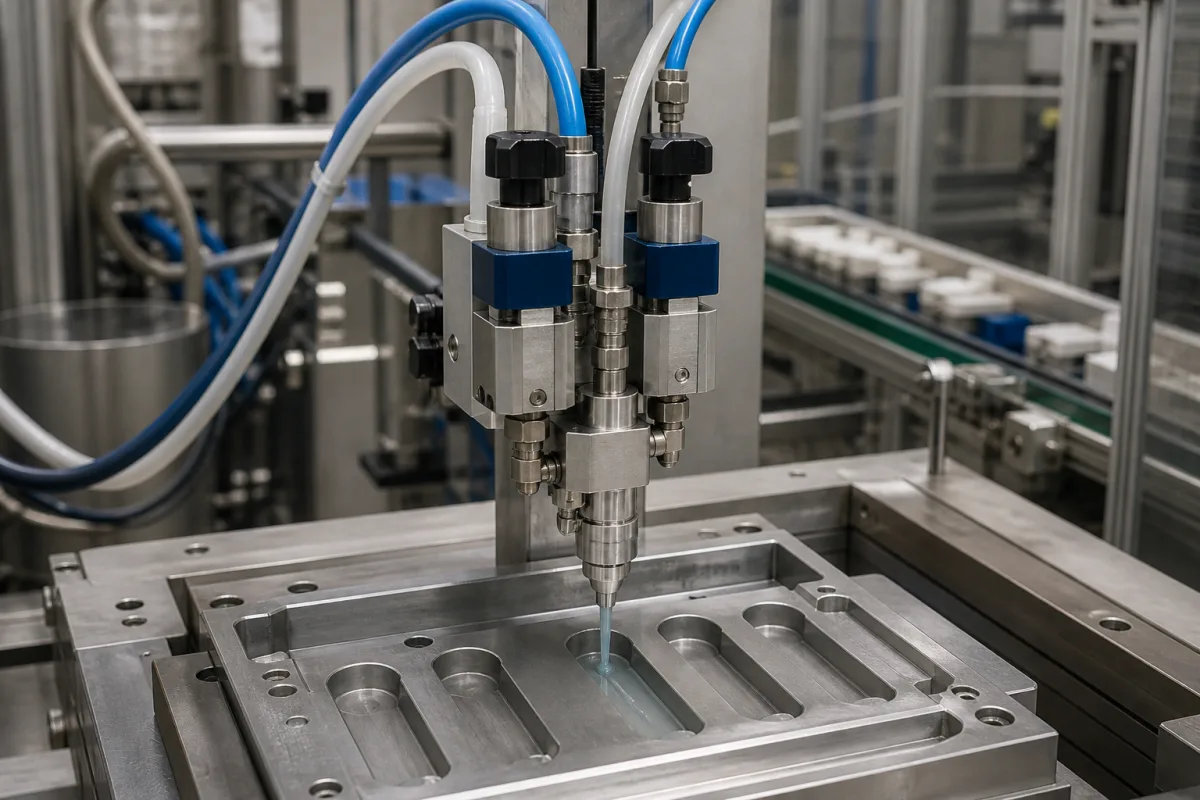
A mechanism that precisely deposits and feeds silicone material into the molding station.
Product Specifications

Technical details and manufacturing context for Material Deposition/Feeding Mechanism

Definition
The Material Deposition/Feeding Mechanism is a critical component of a Silicone Molding Station responsible for the controlled transfer, metering, and placement of liquid or paste silicone material into the mold cavity. It ensures consistent material volume and positioning for high-quality part production.
Working Principle
Typically operates via a positive displacement pump (e.g., piston, gear, or progressive cavity) or a timed valve system. It draws material from a reservoir and deposits a pre-programmed shot volume into the mold. Operation is synchronized with the station's cycle, often controlled by PLC for precision.
Common Materials
Stainless Steel (wetted parts), PTFE (seals/gaskets), Hardened Tool Steel
Technical Parameters
  • Shot Volume Capacity (cm³) Standard Spec
Components / BOM
  • Material Reservoir/Hopper
    Stores the bulk silicone material prior to metering.
    Material: Stainless Steel or Polyethylene
  • Metering Pump or Cylinder
    Precisely measures the volume of material for each shot.
    Material: Stainless Steel, Hardened Steel
  • Dispensing Nozzle/Valve
    Controls the flow and directs material into the mold.
    Material: Stainless Steel, PTFE tip
  • Drive Actuator
    Provides the mechanical force to operate the pump/cylinder (pneumatic, hydraulic, or servo-electric).
    Material: Steel, Aluminum
Engineering Reasoning
0.5-3.0 MPa (5-30 bar) at 0.1-2.0 mm/s feed rate
Material viscosity exceeds 5000 cP at 25°C or plunger seal pressure drop exceeds 0.3 MPa
Design Rationale: Non-Newtonian fluid shear-thinning behavior causing laminar flow disruption at Reynolds number < 2300
Risk Mitigation (FMEA)
Trigger Silicone material phase separation due to 0.5% moisture contamination
Mode: Plunger seal extrusion failure with 0.15 mm radial clearance increase
Strategy: Integrate capacitive moisture sensor with 0.1% detection threshold in material reservoir
Trigger Lead screw thermal expansion of 0.012 mm/°C beyond 60°C operating temperature
Mode: Positional accuracy degradation exceeding ±0.05 mm tolerance
Strategy: Implement closed-loop PID control with 0.01 mm resolution linear encoder feedback

Industry Taxonomies & Aliases

Commonly used trade names and technical identifiers for Material Deposition/Feeding Mechanism.

Applied To / Applications

This component is essential for the following industrial systems and equipment:

Industrial Ecosystem & Supply Chain DNA

Complementary Systems
Downstream Applications
Specialized Tooling

Application Fit & Sizing Matrix

Operational Limits
pressure: Up to 10 bar
flow rate: 0.1 to 100 mL/min
temperature: 20°C to 80°C
slurry concentration: Up to 70% solids by weight
Media Compatibility
✓ Silicone elastomers (RTV, LSR) ✓ Thermoplastic elastomers (TPE) ✓ Polyurethane (PU) resins
Unsuitable: Abrasive ceramic slurries with >50% solids
Sizing Data Required
  • Required deposition volume per cycle (mL)
  • Viscosity range of material (cP)
  • Cycle time requirement (seconds)

Reliability & Engineering Risk Analysis

Failure Mode & Root Cause
Material Bridging/Arch Formation
Cause: Inadequate hopper design, excessive moisture content, or cohesive material properties leading to flow obstruction and inconsistent feeding.
Wear-Induced Inaccuracy
Cause: Abrasive material contact causing progressive wear of screws, belts, or feeders, resulting in dimensional changes and loss of precise metering.
Maintenance Indicators
  • Irregular or pulsating material flow accompanied by audible grinding or motor strain noises.
  • Visible material accumulation or spillage around feed points, indicating misalignment or seal failure.
Engineering Tips
  • Implement regular calibration and wear monitoring using laser scanning or ultrasonic thickness gauges on critical components.
  • Optimize material conditioning (e.g., drying, particle size control) and install vibration aids or air blasters to prevent bridging in storage hoppers.

Compliance & Manufacturing Standards

Reference Standards
ISO 9001:2015 Quality Management Systems ANSI B151.1 Safety Requirements for Injection Molding Machines DIN EN ISO 13849-1 Safety of machinery - Safety-related parts of control systems
Manufacturing Precision
  • Feed Rate Accuracy: +/- 0.5% of set value
  • Nozzle Positioning Repeatability: +/- 0.01mm
Quality Inspection
  • Dimensional Verification via CMM (Coordinate Measuring Machine)
  • Material Flow Rate Calibration Test

Factories Producing Material Deposition/Feeding Mechanism

Verified manufacturers with capability to produce this product in China

✓ 96% Supplier Capability Match Found

P Procurement Specialist from Australia Feb 28, 2026
★★★★★
"Impressive build quality. Especially the technical reliability is very stable during long-term operation."
Technical Specifications Verified
T Technical Director from Singapore Feb 25, 2026
★★★★★
"As a professional in the Rubber and Plastic Product Manufacturing sector, I confirm this Material Deposition/Feeding Mechanism meets all ISO standards."
Technical Specifications Verified
P Project Engineer from Germany Feb 22, 2026
★★★★★
"Standard OEM quality for Rubber and Plastic Product Manufacturing applications. The Material Deposition/Feeding Mechanism arrived with full certification."
Technical Specifications Verified
Verification Protocol

“Feedback is collected from verified sourcing managers during RFQ (Request for Quote) and factory evaluation processes on CNFX. These reports represent historical performance data and technical audit summaries from our B2B manufacturing network.”

14 sourcing managers are analyzing this specification now. Last inquiry for Material Deposition/Feeding Mechanism from USA (1h ago).

Supply Chain Compatible Machinery & Devices

Industrial Conveyor Belt

A continuous loop of material used to transport goods in industrial settings.

Explore Specs →
Modular Injection Molded Plastic Pallet

Interlocking plastic pallet system for logistics and storage.

Explore Specs →
Multi-Layer Co-Extruded Barrier Film

Plastic film with multiple layers for superior barrier properties.

Explore Specs →
High-Precision Silicone Gasket

Custom-molded silicone seal for industrial equipment.

Explore Specs →

Frequently Asked Questions

What materials are compatible with this deposition mechanism?

This mechanism is specifically designed for silicone material deposition in rubber and plastic manufacturing. The wetted parts are made of stainless steel, with PTFE seals and gaskets, ensuring compatibility with various silicone formulations while preventing contamination.

How does this mechanism ensure precise material deposition?

The system utilizes a metering pump or cylinder combined with a precision dispensing nozzle/valve and drive actuator to control material flow with high accuracy. This ensures consistent material deposition for uniform product quality in molding applications.

What maintenance is required for this feeding mechanism?

Regular maintenance includes cleaning the material reservoir/hopper, inspecting PTFE seals and gaskets for wear, and lubricating the drive actuator as needed. The stainless steel and hardened tool steel components provide corrosion resistance and durability, minimizing frequent maintenance requirements.

Can I contact factories directly on CNFX?

CNFX is an open directory, not a transaction platform. Each factory profile provides direct contact information and production details to help you initiate direct inquiries with Chinese suppliers.

Get Quote for Material Deposition/Feeding Mechanism

Request technical pricing, lead times, or customized specifications for Material Deposition/Feeding Mechanism directly from verified manufacturing units.

Your business information is encrypted and only shared with verified Material Deposition/Feeding Mechanism suppliers.

Thank you! Your message has been sent. We'll respond within 1–3 business days.

Need to Manufacture Material Deposition/Feeding Mechanism?

Connect with verified factories specializing in this product category

Add Your Factory Contact Us
Previous Product
Lid Assembly
Next Product
Metering Section