Industry-Verified Manufacturing Data (2026)

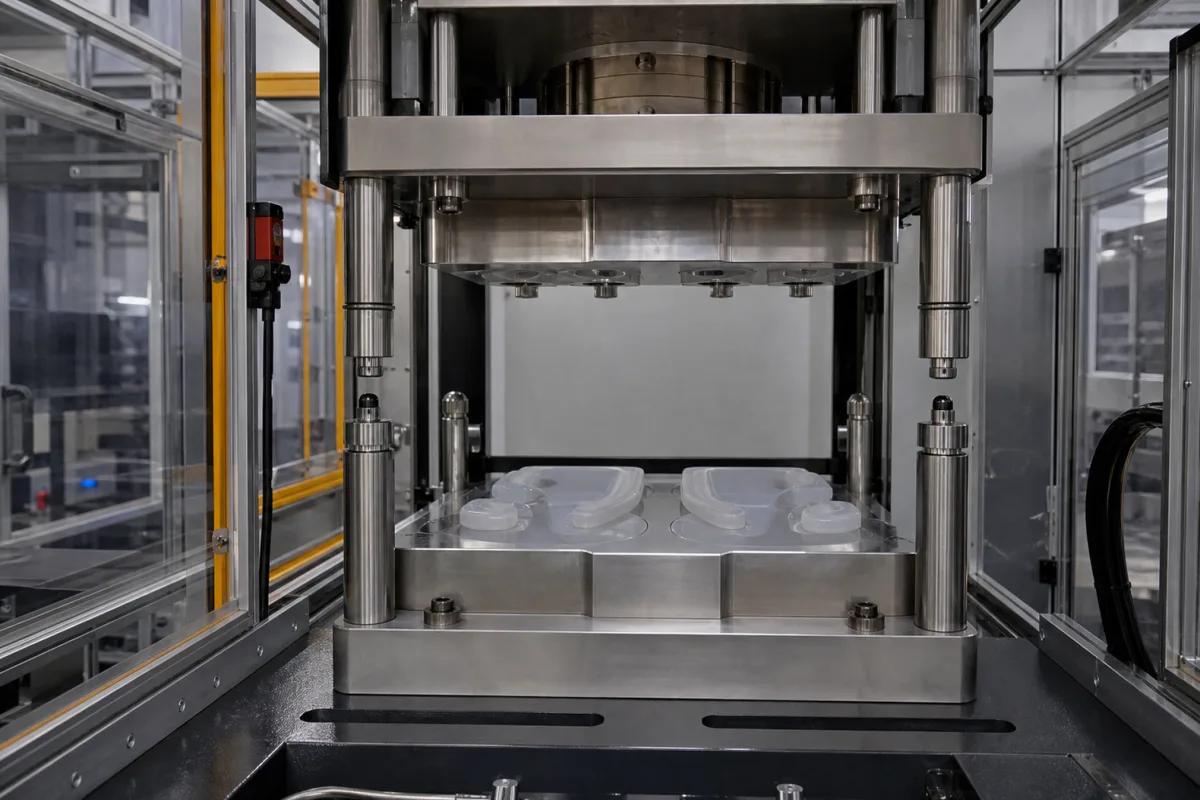
Silicone Molding Station

Based on aggregated insights from multiple verified factory profiles within the CNFX directory, the standard Silicone Molding Station used in the Machinery and Equipment Manufacturing sector typically supports operational capacities ranging from standard industrial configurations to heavy-duty production requirements.

Technical Definition & Core Assembly

A canonical Silicone Molding Station is characterized by the integration of Vibration Platform and Mold Assembly / Fixture. In industrial production environments, manufacturers listed on CNFX commonly emphasize Stainless Steel (frame & structure) construction to support stable, high-cycle operation across diverse manufacturing scenarios.

A specialized station within a modular assembly system designed for the precise molding and curing of silicone components using vibration technology.

Product Specifications

Technical details and manufacturing context for Silicone Molding Station

Definition
The Silicone Molding Station is a critical component of the Smart Modular Vibration Assembly System. It is responsible for receiving, positioning, and processing silicone material or preforms. Its primary function is to facilitate the final shaping and curing of silicone parts through controlled vibration, pressure, and often temperature, ensuring dimensional accuracy, material integrity, and proper bonding within the automated assembly line.
Working Principle
The station typically consists of a mold cavity or fixture. Silicone material (liquid, paste, or pre-form) is deposited or placed into the station. The system then applies controlled mechanical vibration to the mold. This vibration helps to evenly distribute the silicone material, eliminate air bubbles, and ensure it fully conforms to the mold's intricate details. Simultaneously, the station may apply heat or UV light to initiate and control the curing (vulcanization) process of the silicone, transforming it from a pliable state into a solid, elastic component. The process is automated and synchronized with the broader assembly system's cycle.
Common Materials
Stainless Steel (frame & structure), Tool Steel or Aluminum (mold inserts), Silicone Rubber (processed material)
Technical Parameters
  • Mold cavity dimensions and station footprint. (mm) Customizable
Components / BOM
  • Vibration Platform
    Generates and transmits controlled mechanical vibrations to the mold assembly.
    Material: Steel alloy
  • Mold Assembly / Fixture
    Holds the silicone material and defines the final shape of the component. Often includes heating elements.
    Material: Tool steel or Aluminum
  • Material Deposition/Feeding Mechanism
    Automatically places a precise amount of silicone material into the mold cavity.
    Material: Stainless steel, PTFE
  • Control Module
    Regulates vibration parameters, temperature, cycle timing, and interfaces with the main assembly system controller.
    Material: Electronic components, plastic housing
  • Frame and Enclosure
    Provides structural support, safety guarding, and mounting points within the modular system.
    Material: Powder-coated steel
Engineering Reasoning
0.5-2.0 MPa molding pressure, 60-120°C curing temperature, 50-200 Hz vibration frequency
Mold pressure exceeding 2.5 MPa causes permanent deformation, curing temperature above 150°C initiates silicone pyrolysis, vibration amplitude beyond 0.5 mm induces structural resonance
Design Rationale: Exceeding silicone's tensile strength of 7 MPa causes material yield, thermal degradation occurs via Arrhenius kinetics above 150°C, resonance at natural frequency of 180±10 Hz amplifies stress beyond fatigue limit
Risk Mitigation (FMEA)
Trigger Vibration motor bearing wear exceeding 0.1 mm clearance
Mode: Unbalanced rotational mass inducing 2.5× harmonic vibration
Strategy: Ceramic hybrid bearings with 0.02 mm clearance tolerance and vibration monitoring at 4 kHz sampling
Trigger Heater element oxidation reducing thermal conductivity by 40%
Mode: Non-uniform curing with 25°C temperature gradient across mold
Strategy: Inconel-sheathed heating elements with 99.8% pure nitrogen atmosphere and IR thermal mapping

Industry Taxonomies & Aliases

Commonly used trade names and technical identifiers for Silicone Molding Station.

Industrial Ecosystem & Supply Chain DNA

Complementary Systems
Downstream Applications
Specialized Tooling

Application Fit & Sizing Matrix

Operational Limits
pressure: Atmospheric to 0.5 bar (mold clamping pressure)
cure time: 30 seconds to 30 minutes (depending on formulation and temperature)
temperature: Ambient to 150°C (curing temperature range)
vibration frequency: 10-100 Hz (for slurry de-aeration and flow)
slurry concentration: Up to 80% solids by weight (silicone compound viscosity)
Media Compatibility
✓ Liquid silicone rubber (LSR) ✓ High-consistency silicone rubber (HCR) ✓ Silicone-based potting compounds
Unsuitable: Abrasive-filled materials (e.g., ceramic-loaded slurries) due to wear on vibration components
Sizing Data Required
  • Maximum part dimensions (L x W x H)
  • Required production rate (parts per hour)
  • Silicone compound viscosity and cure profile

Reliability & Engineering Risk Analysis

Failure Mode & Root Cause
Heater Element Degradation
Cause: Thermal cycling and oxidation from repeated heating/cooling cycles, leading to reduced heating efficiency and eventual burnout.
Hydraulic System Seal Failure
Cause: Thermal degradation and chemical incompatibility of seals with silicone materials, compounded by high-pressure cycling causing leaks and loss of clamping force.
Maintenance Indicators
  • Inconsistent part dimensions or flashing indicating temperature fluctuations or pressure loss
  • Unusual hydraulic noises (hissing, knocking) or visible oil leaks around cylinders and valves
Engineering Tips
  • Implement predictive maintenance using infrared thermography to monitor heater performance and detect hot spots before failure
  • Establish a proactive seal replacement schedule based on cycle counts and use high-temperature compatible seals rated for silicone service

Compliance & Manufacturing Standards

Reference Standards
ISO 9001:2015 Quality Management Systems ASTM D2000 Standard Classification System for Rubber Products CE Marking (Machinery Directive 2006/42/EC)
Manufacturing Precision
  • Mold Cavity Dimensional Tolerance: +/-0.05mm
  • Surface Finish: Ra 0.8μm maximum
Quality Inspection
  • Dimensional Verification with CMM (Coordinate Measuring Machine)
  • Material Hardness Test (Shore A Scale)

Factories Producing Silicone Molding Station

Verified manufacturers with capability to produce this product in China

✓ 98% Supplier Capability Match Found

T Technical Director from Singapore Feb 11, 2026
★★★★★
"Reliable performance in harsh Machinery and Equipment Manufacturing environments. No issues with the Silicone Molding Station so far."
Technical Specifications Verified
P Project Engineer from Germany Feb 08, 2026
★★★★☆
"Testing the Silicone Molding Station now; the technical reliability results are within 1% of the laboratory datasheet. (Delivery took slightly longer than expected, but technical support was excellent.)"
Technical Specifications Verified
S Sourcing Manager from Brazil Feb 05, 2026
★★★★★
"Impressive build quality. Especially the technical reliability is very stable during long-term operation."
Technical Specifications Verified
Verification Protocol

“Feedback is collected from verified sourcing managers during RFQ (Request for Quote) and factory evaluation processes on CNFX. These reports represent historical performance data and technical audit summaries from our B2B manufacturing network.”

11 sourcing managers are analyzing this specification now. Last inquiry for Silicone Molding Station from Mexico (53m ago).

Supply Chain Compatible Machinery & Devices

Hydraulic Press

Industrial machine using hydraulic pressure to compress, form, or assemble materials

Explore Specs →
Heavy-Duty CNC Plasma Cutting Machine

Industrial machine for precision metal cutting using plasma arc technology

Explore Specs →
Automated Assembly Line System

Integrated production system for sequential component assembly operations

Explore Specs →
Automated Powder Coating System

Integrated industrial system for applying dry powder coatings to metal substrates.

Explore Specs →

Frequently Asked Questions

What is the primary advantage of the vibration technology in this molding station?

The vibration technology ensures uniform material distribution and eliminates air bubbles during silicone molding, resulting in higher quality components with consistent density and reduced defects.

Can this station integrate with existing modular assembly systems?

Yes, the silicone molding station is designed as a modular component with standardized interfaces, allowing seamless integration into existing assembly lines for automated production workflows.

What maintenance is required for the stainless steel frame and vibration platform?

The stainless steel construction requires minimal maintenance—regular cleaning with industrial solvents and periodic inspection of vibration isolators. The platform's bearings should be lubricated quarterly under normal operating conditions.

Can I contact factories directly on CNFX?

CNFX is an open directory, not a transaction platform. Each factory profile provides direct contact information and production details to help you initiate direct inquiries with Chinese suppliers.

Get Quote for Silicone Molding Station

Request technical pricing, lead times, or customized specifications for Silicone Molding Station directly from verified manufacturing units.

Your business information is encrypted and only shared with verified Silicone Molding Station suppliers.

Thank you! Your message has been sent. We'll respond within 1–3 business days.

Need to Manufacture Silicone Molding Station?

Connect with verified factories specializing in this product category

Add Your Factory Contact Us
Previous Product
Silencer
Next Product
Skid Steer Loader