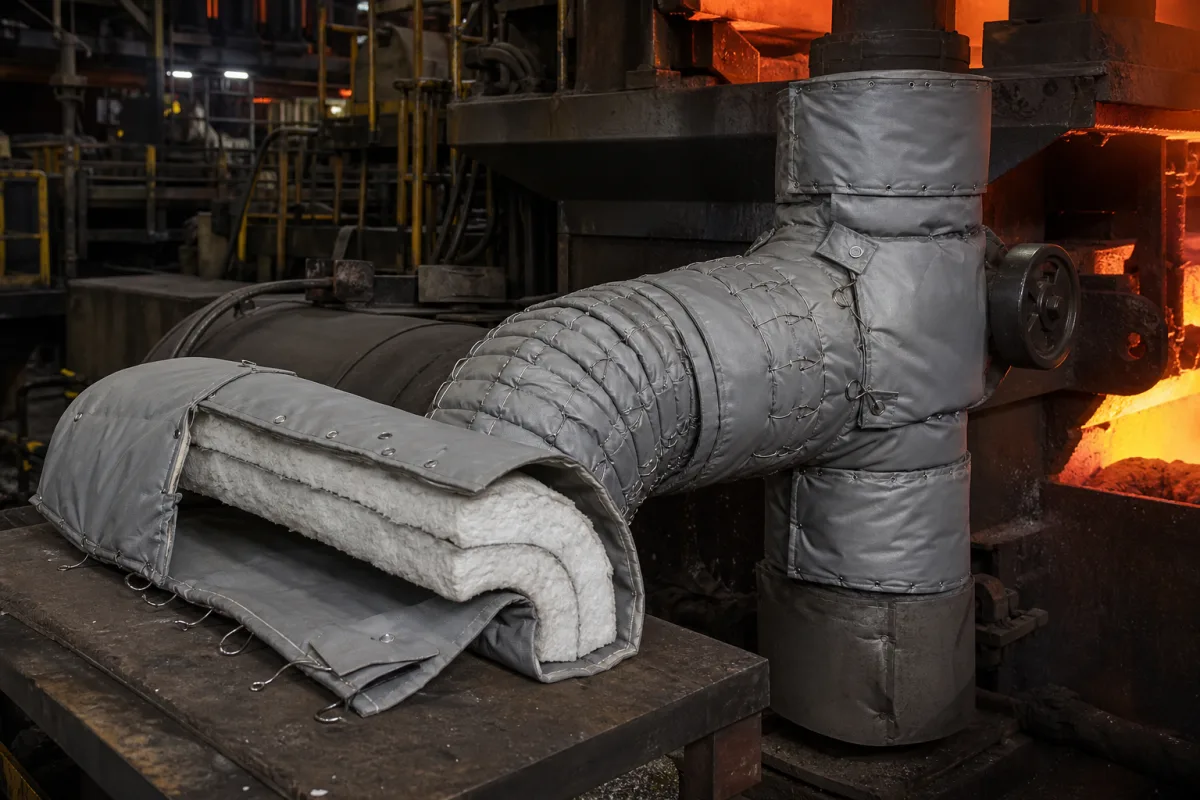
Removable, reusable insulation jackets for valves, flanges, pipes and equipment · ASTM C1695 service classes to 1,000 °F, inner and outer covers, insulating cores, lacing and strap closures, 1 in thickness, valve heat-loss savings, personnel protection above 120 °F and noise barriers
A thermal insulation jacket (removable insulation blanket or pad) is a sewn, fitted cover made of an inner cover, an insulating core and an outer cover that wraps a valve, flange, fitting, pump, turbine casing, heat exchanger or pipe and is held by lacing wire, straps or hook-and-loop closures, so the component stays insulated yet can be taken off for inspection and maintenance and refitted. Ask three things first: what component, surface temperature and environment the jacket must suit (indoor, outdoor, chemical exposure), what core material and thickness give the heat loss, surface temperature or noise reduction you need, and how it will be measured, fastened and removed.
Flexible removable and reusable insulation jackets, blankets and pads for hot surfaces on valves, flanges, fittings, steam traps, pumps, turbines, exhausts, heat exchangers and tanks. Fixed pipe insulation with metal cladding, insulated wall and roof panels (see insulated panels), refractory linings and personal protective clothing are outside this page except where compared.
CNFX editorial research · Sources checked October 12, 2026 · 5 sources
ASTM C1695-26 sets minimum materials and fabrication requirements for flexible removable and reusable blanket insulation for hot service from above ambient to 1,000 °F (538 °C), and treats industrial, outdoor commercial and indoor commercial applications separately: industrial and outdoor commercial blankets must be weather resistant and resistant to liquid chemicals, while indoor commercial blankets are limited to 500 °F (260 °C) and need neither. [1]
The US Department of Energy's Steam Tip Sheet #17 notes that during maintenance the insulation covering pipes, valves and fittings “is often damaged or removed and not replaced”, describes reusable pads with a noncombustible inside cover, insulation and a tear- and abrasion-resistant noncombustible outside cover that resist oil and water and are designed for up to 1,600 °F, and states as a general rule that surfaces hotter than 120 °F should be insulated to protect personnel. It lists flanges, valves, expansion joints, heat exchangers, pumps, turbines, tanks and other irregular surfaces as uses, and says pads can include acoustic barriers for noise control. [2]
Editorial calculation: 1,600 °F ≈ 871 °C and 120 °F ≈ 49 °C. [2]
Give the supplier the component types and sizes, surface (operating) temperature, indoor or outdoor location, exposure to oil, water or chemicals, vibration, any noise target, the required outer surface temperature or heat-loss limit, and how often the jacket will be removed.
02
Choose covers, insulating core, thickness and closures
Firwin describes its removable valve blankets as having inner and outer covers of PTFE- or silicone-reinforced fiberglass with polyester hook-and-loop fasteners and drawstrings for applications below 500 °F, and gives 1 in as the cover thickness unless the application needs another; its insulation jacket page lists fiberglass mats from ½ in to 4 in thick according to the heat reduction needed, aerogel, wool or layered fills, and closures of stainless steel lacing wire, straps, springs, snaps or Velcro, naming lacing wire hooked over capstan rivets its “most common fastening system”. [4][3]
Firwin's high-temperature materials page describes an aerogel insulation for equipment up to 1,100 °F, states that a 10 mm aerogel layer can match a standard 1 in fiberglass blanket where space is limited, and lists a vermiculite-coated plain-weave fiberglass fabric for higher temperatures. The DOE tip sheet describes pads held by wire laced through grommets or by straps with buckles, snap-on covers for inverted bucket steam traps, and insulating thermostatic and disk traps only as their makers specify so the traps keep working. [5][2]
Specify inner and outer cover fabrics, core material and thickness, maximum service temperature of each layer, stitching thread, closure type (lacing wire and rivets, straps and buckles, hook-and-loop), drain holes, name tags, and whether an acoustic barrier layer is included.
03
Estimate the heat saved on valves and fittings
The DOE tip sheet tabulates savings from a 1 in insulating pad on an ANSI Class 150 flanged valve at 65 °F ambient and no wind, calculated to ASTM C680: from 800 Btu/h on a 3 in valve at 200 °F to 29,300 Btu/h on a 12 in valve at 600 °F (for example 3,300 Btu/h for a 6 in valve at 300 °F and 13,000 Btu/h for an 8 in valve at 500 °F). Its worked example for a 6 in gate valve on 250 psig saturated steam (406 °F) uses 5,992 Btu/h, continuous operation, 80% boiler efficiency and $8.00/MMBtu natural gas to give 65.6 MMBtu and $525 a year. [2]
Editorial calculation: on the same assumptions (8,760 h/yr, 80% boiler efficiency), a 12 in valve at 600 °F saving 29,300 Btu/h avoids 29,300 × 8,760 ÷ 800,000 ≈ 321 MMBtu of fuel a year, about $2,570 at $8.00/MMBtu; substitute your hours, efficiency and fuel price. [2]
The tip sheet also advises checking existing insulation for asbestos under OSHA regulations before removing it, and notes that suppliers can measure on site for a good fit on irregular surfaces. [2]
Ask the supplier for a heat-loss and surface-temperature calculation for each jacket at your temperatures and ambient conditions, and for the method used.
04
Inner cover, core, outer cover, closures and acoustic layer of a removable pad
Service class, core thickness, closures and heat saving for each surveyed item
The temperature limits come from ASTM C1695 and the DOE tip sheet, the thicknesses and fabrics from Firwin; quantity and sizes can only come from a measured survey of your valves, flanges and traps.
Field
What it means and published values
Ask the supplier for
Service temperature
To 1,000 °F under ASTM C1695; pads designed to 1,600 °F in DOE's description. [1][2]
Rating of each layer.
Application class
Industrial, outdoor commercial or indoor commercial (≤500 °F). [1]
Class and resistance.
Core thickness
Firwin: 1 in valve covers unless the application needs another; 10 mm aerogel matches a “standard 1-inch fiberglass” layer. [4][5]
Explore company information and manufacturing capabilities, then discuss the scope of your project with a relevant supplier.
Share this page
Compiled and source-reviewed by the CNFX editorial team.
Each manufacturer above links to the page on that company's own website where the product is listed, with the date we checked it. How we source and review
· Page last updated 13 October 2026
Buyer questions
What temperature can removable insulation blankets handle?
ASTM C1695 covers hot service to 1,000 °F; DOE describes pad materials designed for up to 1,600 °F. [1][2]
How much energy does a removable valve jacket save?
DOE tabulates 800–29,300 Btu/h for a 1 in pad on 3–12 in valves at 200–600 °F. [2]
How are removable insulation jackets fastened?
With wire laced through grommets or over rivets, straps and buckles, springs, snaps or hook-and-loop. [2][3]
Can steam traps be insulated with jackets?
Inverted bucket traps can take snap-on covers; thermostatic and disk traps only as their makers specify. [2]
Sources and what still needs a direct check
Sources checked 2026-10-12. The ASTM page is a public scope summary; the DOE tip sheet is a US government guide; Firwin's pages describe one maker's products. Values for your jackets must come from the supplier offered.