Industry-Verified Manufacturing Data (2026)

Winder

Based on aggregated insights from multiple verified factory profiles within the CNFX directory, the standard Winder used in the Rubber and Plastic Product Manufacturing sector typically supports operational capacities ranging from standard industrial configurations to heavy-duty production requirements.

Technical Definition & Core Assembly

A canonical Winder is characterized by the integration of Winding Shaft and Tension Control System. In industrial production environments, manufacturers listed on CNFX commonly emphasize Carbon steel construction to support stable, high-cycle operation across diverse manufacturing scenarios.

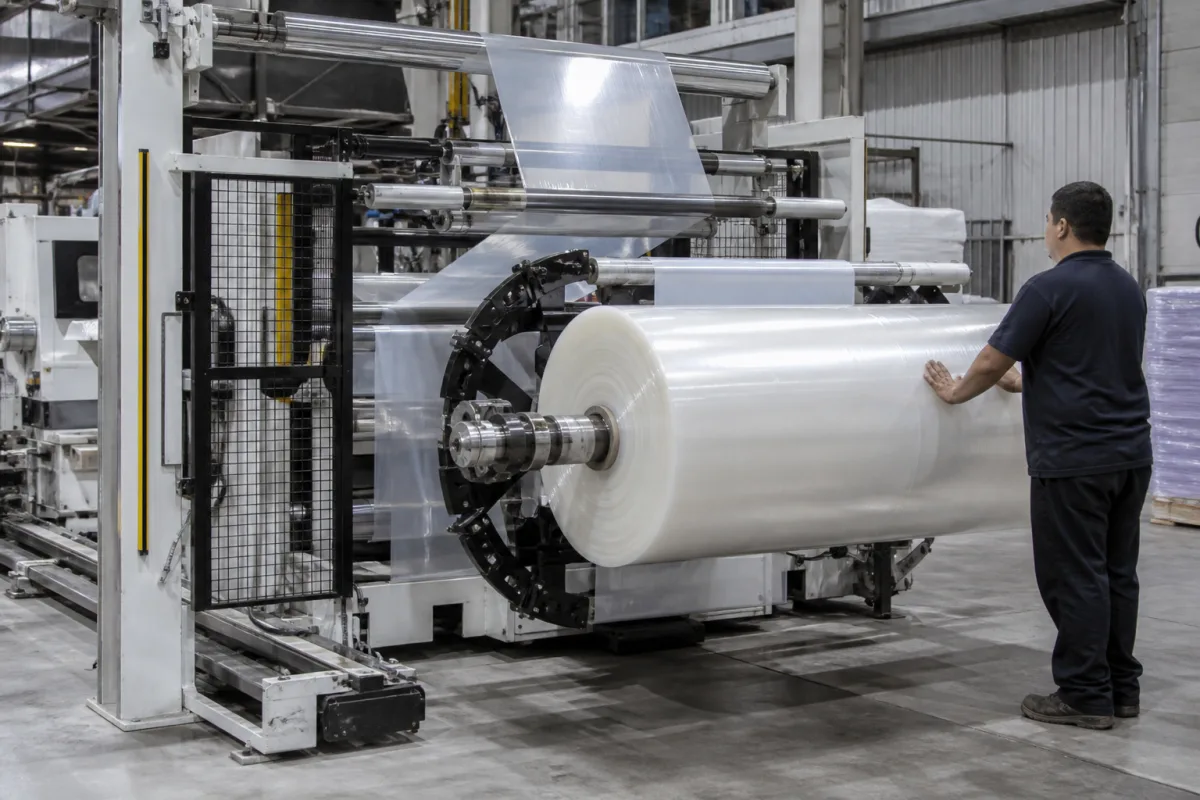
A mechanical component that winds the produced plastic film onto rolls in a controlled manner.
Product Specifications

Technical details and manufacturing context for Winder

Definition
The winder is a critical component of a plastic film blowing machine that collects and winds the continuous plastic film produced by the extrusion and blowing process onto cores or shafts to form finished rolls. It ensures proper tension control, alignment, and uniform winding for downstream handling and storage.
Working Principle
The winder operates by using motor-driven rollers or shafts to pull the plastic film from the collapsing frame and wind it onto a core. It typically incorporates tension control systems (pneumatic, magnetic, or electronic) to maintain consistent film tension, guiding systems to ensure edge alignment, and may include automatic cut-and-transfer mechanisms for continuous operation during roll changes.
Common Materials
Carbon steel, Stainless steel, Aluminum alloy
Technical Parameters
  • Maximum roll diameter capacity (mm) Standard Spec
Components / BOM
  • Winding Shaft
    Holds the core/tube and rotates to wind the film
    Material: Carbon steel
  • Tension Control System
    Maintains consistent film tension during winding to prevent wrinkles or stretching
    Material: Various (pneumatic, electronic components)
  • Guide System
    Ensures proper edge alignment of the film during winding
    Material: Aluminum alloy
  • Drive Motor
    Provides rotational power to the winding shaft
    Material: Steel, copper
  • Control Panel
    Allows operator to set parameters and monitor winding process
    Material: Plastic, electronic components
Engineering Reasoning
0.5-15 m/min linear winding speed, 10-200 N·m torque, 50-150 mm roll diameter
Exceeds 20 m/min linear speed causing film tearing, exceeds 250 N·m torque causing gear tooth shear at 350 MPa yield strength, exceeds 200 mm roll diameter causing shaft deflection >0.1 mm/m
Design Rationale: Film tensile failure at >25 MPa stress, gear tooth bending fatigue at >10^7 cycles with 200 MPa alternating stress, Euler buckling instability at slenderness ratio >100 for support shafts
Risk Mitigation (FMEA)
Trigger Bearing lubrication starvation below 0.1 mm oil film thickness
Mode: Roller bearing seizure at 120°C temperature
Strategy: Integrate hydrodynamic bearing design with 0.3 mm minimum oil film and temperature sensors at 100°C cutoff
Trigger Tension control PID loop oscillation at >5% overshoot
Mode: Film web breakage at 30 N tension differential
Strategy: Implement adaptive PID with 2% maximum overshoot and strain gauge feedback at 10 ms sampling

Industry Taxonomies & Aliases

Commonly used trade names and technical identifiers for Winder.

Industrial Ecosystem & Supply Chain DNA

Complementary Systems
Downstream Applications
Specialized Tooling

Application Fit & Sizing Matrix

Operational Limits
pressure: Atmospheric (non-pressurized)
other spec: Max Roll Diameter: 1500 mm, Max Roll Weight: 2000 kg, Line Speed: 5-200 m/min
temperature: Ambient to 60°C (140°F)
Media Compatibility
✓ Polyethylene (PE) film ✓ Polypropylene (PP) film ✓ Polyester (PET) film
Unsuitable: Abrasive or high-tack adhesive-coated films
Sizing Data Required
  • Film width (mm)
  • Maximum roll diameter (mm)
  • Line speed (m/min)

Reliability & Engineering Risk Analysis

Failure Mode & Root Cause
Bearing failure due to misalignment or contamination
Cause: Improper installation leading to shaft misalignment, ingress of dust or moisture into bearing housings, or inadequate lubrication causing overheating and premature wear.
Web tension control system malfunction
Cause: Sensor drift or calibration errors in tension measurement devices, wear in pneumatic/hydraulic actuators, or control software glitches leading to inconsistent material winding and potential web breaks.
Maintenance Indicators
  • Abnormal vibration or audible knocking from drive components during operation
  • Irregular or uneven winding patterns visible on the finished roll
Engineering Tips
  • Implement precision laser alignment during installation and periodic realignment checks to prevent bearing and gearbox failures.
  • Establish a routine calibration schedule for tension sensors and control systems, and maintain clean, dry air supply for pneumatic components.

Compliance & Manufacturing Standards

Reference Standards
ISO 9001:2015 (Quality Management Systems) ANSI B11.0 (Safety of Machinery) CE Marking (EU Machinery Directive 2006/42/EC)
Manufacturing Precision
  • Winding tension: +/- 5% of set value
  • Alignment of winding axis: +/- 0.05mm
Quality Inspection
  • Runout test for rotating components
  • Electrical safety test (insulation resistance, grounding)

Factories Producing Winder

Verified manufacturers with capability to produce this product in China

✓ 92% Supplier Capability Match Found

P Procurement Specialist from United States Feb 28, 2026
★★★★★
"The technical documentation for this Winder is very thorough, especially regarding technical reliability."
Technical Specifications Verified
T Technical Director from United Arab Emirates Feb 25, 2026
★★★★★
"Reliable performance in harsh Rubber and Plastic Product Manufacturing environments. No issues with the Winder so far."
Technical Specifications Verified
P Project Engineer from Australia Feb 22, 2026
★★★★★
"Testing the Winder now; the technical reliability results are within 1% of the laboratory datasheet."
Technical Specifications Verified
Verification Protocol

“Feedback is collected from verified sourcing managers during RFQ (Request for Quote) and factory evaluation processes on CNFX. These reports represent historical performance data and technical audit summaries from our B2B manufacturing network.”

12 sourcing managers are analyzing this specification now. Last inquiry for Winder from USA (19m ago).

Supply Chain Compatible Machinery & Devices

Industrial Conveyor Belt

A continuous loop of material used to transport goods in industrial settings.

Explore Specs →
Modular Injection Molded Plastic Pallet

Interlocking plastic pallet system for logistics and storage.

Explore Specs →
Multi-Layer Co-Extruded Barrier Film

Plastic film with multiple layers for superior barrier properties.

Explore Specs →
High-Precision Silicone Gasket

Custom-molded silicone seal for industrial equipment.

Explore Specs →

Frequently Asked Questions

What materials are used in the construction of this industrial winder?

Our winder is constructed from durable carbon steel, corrosion-resistant stainless steel, and lightweight aluminum alloy components for optimal performance in rubber and plastic manufacturing environments.

How does the tension control system improve plastic film winding?

The precision tension control system maintains consistent film tension throughout the winding process, preventing wrinkles, ensuring uniform roll density, and reducing material waste in plastic manufacturing operations.

What industries typically use this type of winding equipment?

This industrial winder is specifically designed for rubber and plastic product manufacturing, including applications in plastic film production, packaging materials, industrial sheeting, and rubber membrane manufacturing.

Can I contact factories directly on CNFX?

CNFX is an open directory, not a transaction platform. Each factory profile provides direct contact information and production details to help you initiate direct inquiries with Chinese suppliers.

Get Quote for Winder

Request technical pricing, lead times, or customized specifications for Winder directly from verified manufacturing units.

Your business information is encrypted and only shared with verified Winder suppliers.

Thank you! Your message has been sent. We'll respond within 1–3 business days.

Need to Manufacture Winder?

Connect with verified factories specializing in this product category

Add Your Factory Contact Us
Previous Product
Vibration Platform
Last Product