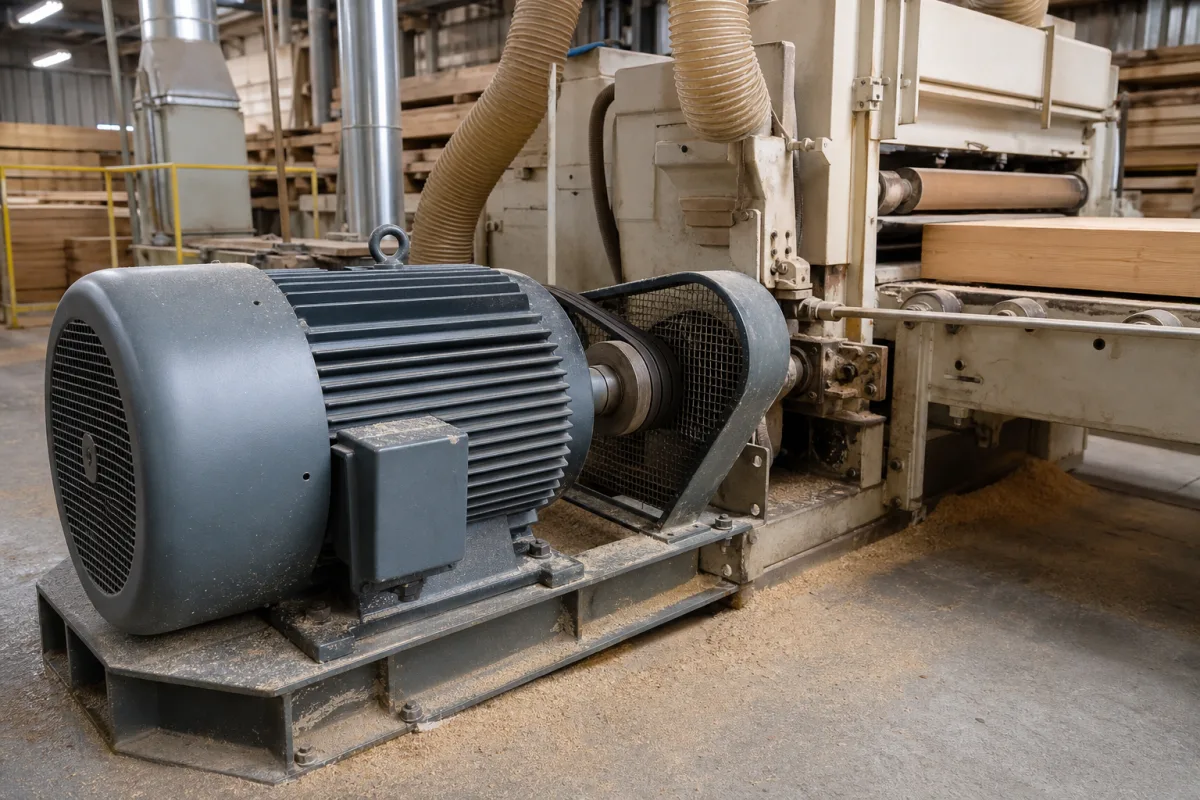
Main motor (main drive motor of a woodworking machine, chosen and wired so the cutter stops within the permitted run-down time)
Main drive motors for woodworking machines · the 10-second run-down rule, braked motors, DC injection braking, variable speed drives and mechanical brakes, E-stop wiring that lets the brake finish, larger machines allowed longer stops
A main motor here is the motor that drives the saw blade, cutter block or spindle of a woodworking machine, directly or through belts, and on these machines the motor and its braking have to be chosen together: the cutter must stop within the permitted run-down time once the stop is pressed. Ask three things first: whether the machine needs braking and to what stopping time, which braking method suits the motor and the machine's stored energy, and how the stop and isolator are wired so braking always completes.
Main drive motors of woodworking machines (saws, planers, thicknessers, spindle moulders, routers, tenoners, band saws) with their braking: braked motors, DC injection units, variable speed drives and mechanical brakes. Complete panel saws are covered on the Panel saw (sliding table saw) page; main motors of press brakes and electric hoists are outside this page.
CNFX editorial research · Sources checked October 12, 2026 · 3 sources
The 10-second run-down rule and the machines allowed longer
University of Nottingham safety guidance, summarising HSE requirements, states that new woodworking machinery "must be equipped with an automatic brake that stops the tool in a sufficiently short time (10 seconds or less) if there is a risk of contact with the tool while it runs down", and that for existing machines the same standard is applied through PUWER and its Approved Code of Practice after a risk assessment, with deadlines from 2003 for circular saw benches to 2008 for all other machines. It lists braking as unnecessary where the run-down is already 10 seconds or less, and notes that large band re-saws or log saws may be allowed 35 seconds because of the energy to be dissipated. [3]
HSE's information sheet WIS38 adds that bringing some machines to rest within ten seconds "might be positively harmful to the machine and dangerous to the operator", allowing "35 seconds for some larger machines (30 seconds for bandsaws)"; the bandsaw figure differs from the 35 seconds Nottingham gives for band re-saws, so check the figure that applies to your machine. Braking need not be fitted where interlocked guards with guard locking enclose the cutters until they stop, or where the blade returns automatically to a safe position. [1][3]
Give the motor or retrofit supplier the machine type and its existing motor (power, speed, frame, mounting inside or outside the frame, starter), the tool's inertia or measured run-down time, the target stopping time, the braking method wanted, the supply (single- or three-phase, reliability), E-stop and isolator arrangement, and the number of machines.
02
Braked motor, DC injection, variable speed drive or mechanical brake
WIS38 lists four ways to brake: replace the unbraked motor with a braked motor, fit a variable speed drive or a DC injection braking device to the existing motor, fit a power-operated mechanical brake, or fit a manual or foot-operated brake. Braked motors are "invariably longer" than unbraked ones, so space inside a machine frame and non-standard motor mountings can rule them out, and they are "not suitable for band re-saws" because of the stored energy. DC braking is not suitable for some motors, such as slip-ring motors; a VSD replaces the starter but a contactor may still be needed for emergency stopping, operated only after the motor has stopped, and high-inertia loads may need braking resistors. A mechanical brake should ideally be spring-applied and need power to release, and is "most efficient when applied to the low torque end of the drive unit". [1]
HSE's woodworking FAQ gives the cost of fitting DC braking as about £125 for parts plus £125 for electrical labour per motor, depending on motor size, and warns that switching off at the isolator cuts power to the braking unit before braking completes, which has caused run-down accidents; the E-stop should be used first, and the DC brake should be wired so that any local or remote E-stop applies it, with battery backup or an emergency supply considered where the mains is unreliable. [2]
Explore company information and manufacturing capabilities, then discuss the scope of your project with a relevant supplier.
Share this page
Compiled and source-reviewed by the CNFX editorial team.
Each manufacturer above links to the page on that company's own website where the product is listed, with the date we checked it. How we source and review
· Page last updated 13 October 2026
Buyer questions
How quickly must a woodworking machine stop?
HSE-based guidance requires new machines to stop the tool in 10 seconds or less where there is contact risk, with up to 35 seconds allowed for some larger machines. [3][1]
Why doesn't the brake work when I switch off at the isolator?
HSE says opening the isolator cuts power to the braking unit before braking completes; use the E-stop first. [2]
Can any motor take DC injection braking?
WIS38 says DC braking is not suitable for some motors, such as slip-ring motors. [1]
Why not just fit a braked motor?
WIS38 notes braked motors are longer, may not fit non-standard mountings, and are not suitable for band re-saws. [1]
Sources and what still needs a direct check
Sources checked 2026-10-12. HSE publishes its woodworking FAQ and information sheet WIS38 on retrofitting brakes; the University of Nottingham summarises the requirement for its workshops.