Industry-Verified Manufacturing Data (2026)

Sliding Carriage

Based on aggregated insights from multiple verified factory profiles within the CNFX directory, the standard Sliding Carriage used in the Wood Product Manufacturing sector typically supports operational capacities ranging from standard industrial configurations to heavy-duty production requirements.

Technical Definition & Core Assembly

A canonical Sliding Carriage is characterized by the integration of Carriage Frame and Linear Bearings. In industrial production environments, manufacturers listed on CNFX commonly emphasize Aluminum alloy construction to support stable, high-cycle operation across diverse manufacturing scenarios.

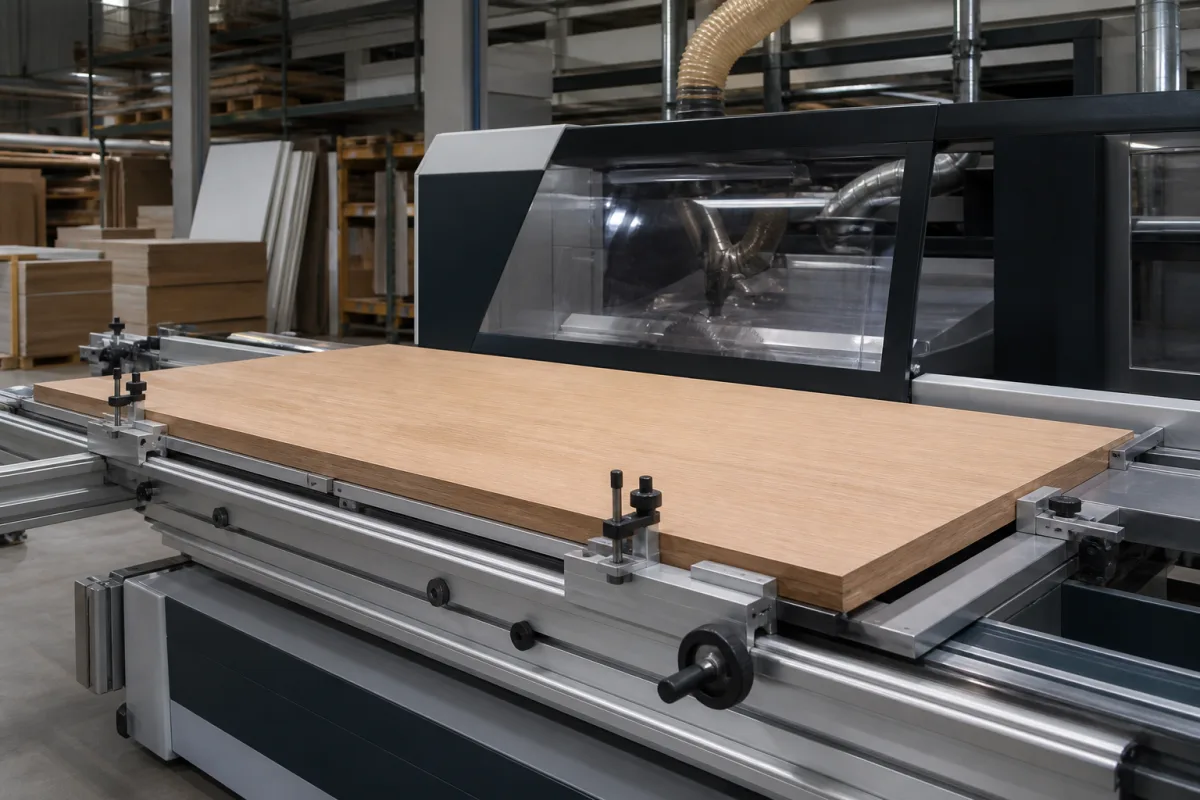
A movable support mechanism that holds and guides the workpiece during cutting operations on a panel saw.
Product Specifications

Technical details and manufacturing context for Sliding Carriage

Definition
The sliding carriage is a critical component of a panel saw that provides stable, precise movement of the workpiece along the cutting axis. It typically consists of a rigid frame mounted on linear bearings or rollers that slide along tracks, ensuring smooth and accurate positioning of panels during cutting operations. The carriage often includes clamping mechanisms to secure the workpiece and may feature integrated measuring systems for precise dimension control.
Working Principle
The sliding carriage operates by moving along precision tracks or rails using linear bearings, ball screws, or rack-and-pinion systems. It translates the motion from the drive mechanism (manual, pneumatic, or motorized) into controlled linear movement, allowing operators to position panels accurately for cutting. The carriage maintains alignment and stability throughout the cutting process to ensure straight, clean cuts.
Common Materials
Aluminum alloy, Steel
Technical Parameters
  • Maximum workpiece width capacity (mm) Customizable
Components / BOM
  • Carriage Frame
    Provides structural support and mounting points for other components
  • Linear Bearings
    Enable smooth, low-friction movement along the tracks
  • Clamping Mechanism
    Secures the workpiece to prevent movement during cutting
  • Positioning Scale
    Provides visual measurement reference for accurate panel positioning
Engineering Reasoning
0.5-2.5 m/s linear velocity, 50-200 N clamping force, -10°C to 60°C ambient temperature
Linear guide rail wear exceeding 0.1 mm clearance, ball bearing fatigue at 10⁷ cycles (ISO 281 L10 life), carriage deformation at 300 N clamping force
Design Rationale: Adhesive wear at Hertzian contact stresses exceeding 1.2 GPa between ball bearings and raceways, thermal expansion mismatch (Δα=12×10⁻⁶ K⁻¹) between aluminum carriage and steel rails causing binding
Risk Mitigation (FMEA)
Trigger Contaminated lubrication (ISO 4406 particle count >18/15/12)
Mode: Three-body abrasive wear in linear guideways increasing friction coefficient from 0.002 to 0.008
Strategy: IP67-rated sealing with double-lip wipers and automated grease injection at 100-hour intervals
Trigger Resonant vibration at 85 Hz matching carriage natural frequency
Mode: Fatigue cracking in carriage mounting points following Paris' law (da/dN=CΔK^m where m=3.2)
Strategy: Dynamic vibration absorbers tuned to 85 Hz with damping ratio ζ=0.25 and finite element modal analysis during design

Industry Taxonomies & Aliases

Commonly used trade names and technical identifiers for Sliding Carriage.

Applied To / Applications

This component is essential for the following industrial systems and equipment:

Industrial Ecosystem & Supply Chain DNA

Complementary Systems
Downstream Applications
Specialized Tooling

Application Fit & Sizing Matrix

Operational Limits
pressure: Max 5 bar
temperature: 0°C to 80°C
travel speed: 0.1 to 2 m/s
load capacity: Up to 500 kg
Media Compatibility
✓ Wood panels ✓ Composite boards ✓ Plastic sheets
Unsuitable: Abrasive slurry environments
Sizing Data Required
  • Workpiece maximum weight
  • Required travel distance
  • Panel saw cutting speed

Reliability & Engineering Risk Analysis

Failure Mode & Root Cause
Wear and scoring of sliding surfaces
Cause: Inadequate lubrication, contamination ingress (dust, debris), or misalignment causing metal-to-metal contact and abrasive damage.
Corrosion and pitting
Cause: Exposure to moisture, corrosive chemicals, or improper material selection for the operating environment, leading to surface degradation and loss of dimensional accuracy.
Maintenance Indicators
  • Audible grinding, scraping, or squeaking noises during operation indicating metal-on-metal contact or severe wear.
  • Visible scoring, discoloration, or excessive play/wobble in the carriage movement, suggesting surface damage or component loosening.
Engineering Tips
  • Implement a strict lubrication schedule using the correct grease/oil type and quantity, and install protective seals or wipers to prevent contamination.
  • Ensure precise alignment during installation and regularly check for wear using precision measurement tools, replacing worn components before catastrophic failure occurs.

Compliance & Manufacturing Standards

Reference Standards
ISO 286-2:2010 - Limits and fits ANSI B4.1-1967 - Preferred limits and fits for cylindrical parts DIN 7182-1:2001 - Tolerances for linear motion systems
Manufacturing Precision
  • Bore diameter tolerance: +/-0.01mm
  • Parallelism of guide surfaces: 0.05mm per 100mm
Quality Inspection
  • Surface roughness measurement (Ra ≤ 0.8μm)
  • Hardness testing (HRC 58-62 for bearing surfaces)

Factories Producing Sliding Carriage

Verified manufacturers with capability to produce this product in China

✓ 97% Supplier Capability Match Found

P Project Engineer from Canada Jan 21, 2026
★★★★★
"Reliable performance in harsh Wood Product Manufacturing environments. No issues with the Sliding Carriage so far."
Technical Specifications Verified
S Sourcing Manager from United States Jan 18, 2026
★★★★★
"Testing the Sliding Carriage now; the technical reliability results are within 1% of the laboratory datasheet."
Technical Specifications Verified
P Procurement Specialist from United Arab Emirates Jan 15, 2026
★★★★★
"Impressive build quality. Especially the technical reliability is very stable during long-term operation."
Technical Specifications Verified
Verification Protocol

“Feedback is collected from verified sourcing managers during RFQ (Request for Quote) and factory evaluation processes on CNFX. These reports represent historical performance data and technical audit summaries from our B2B manufacturing network.”

17 sourcing managers are analyzing this specification now. Last inquiry for Sliding Carriage from Thailand (11m ago).

Supply Chain Compatible Machinery & Devices

CNC Wood Router

Computer-controlled machine for cutting, carving, and shaping wood materials.

Explore Specs →
Smart CNC Wood Router with Auto-Tool-Changer

A computer-controlled wood router that automatically changes cutting tools during operation for continuous production.

Explore Specs →
Precision 5-Axis CNC Wood Carving Machine with Laser Alignment

A high-precision 5-axis CNC machine for complex wood carving with integrated laser alignment system.

Explore Specs →
Industrial-Grade 5-Axis CNC Wood Router with Vacuum Clamping System

A heavy-duty 5-axis CNC wood router featuring an integrated vacuum clamping system for high-volume production.

Explore Specs →

Frequently Asked Questions

What materials are used in this sliding carriage construction?

This sliding carriage is constructed from durable aluminum alloy for lightweight strength and steel components for structural integrity, ensuring long-lasting performance in wood manufacturing environments.

How does the clamping mechanism secure workpieces during cutting?

The integrated clamping mechanism provides adjustable pressure to securely hold wood panels in place during cutting operations, preventing movement and ensuring precise, consistent cuts on panel saws.

What maintenance do the linear bearings require?

The linear bearings require periodic cleaning to remove wood dust and debris, along with occasional lubrication to maintain smooth movement and extend the carriage's operational lifespan in wood product manufacturing.

Can I contact factories directly on CNFX?

CNFX is an open directory, not a transaction platform. Each factory profile provides direct contact information and production details to help you initiate direct inquiries with Chinese suppliers.

Get Quote for Sliding Carriage

Request technical pricing, lead times, or customized specifications for Sliding Carriage directly from verified manufacturing units.

Your business information is encrypted and only shared with verified Sliding Carriage suppliers.

Thank you! Your message has been sent. We'll respond within 1–3 business days.

Need to Manufacture Sliding Carriage?

Connect with verified factories specializing in this product category

Add Your Factory Contact Us
Previous Product
Precision 5-Axis CNC Wood Carving Machine with Laser Alignment
Next Product
Smart CNC Wood Router with Auto-Tool-Changer