Woodworking · From a sheet layout to finished parts
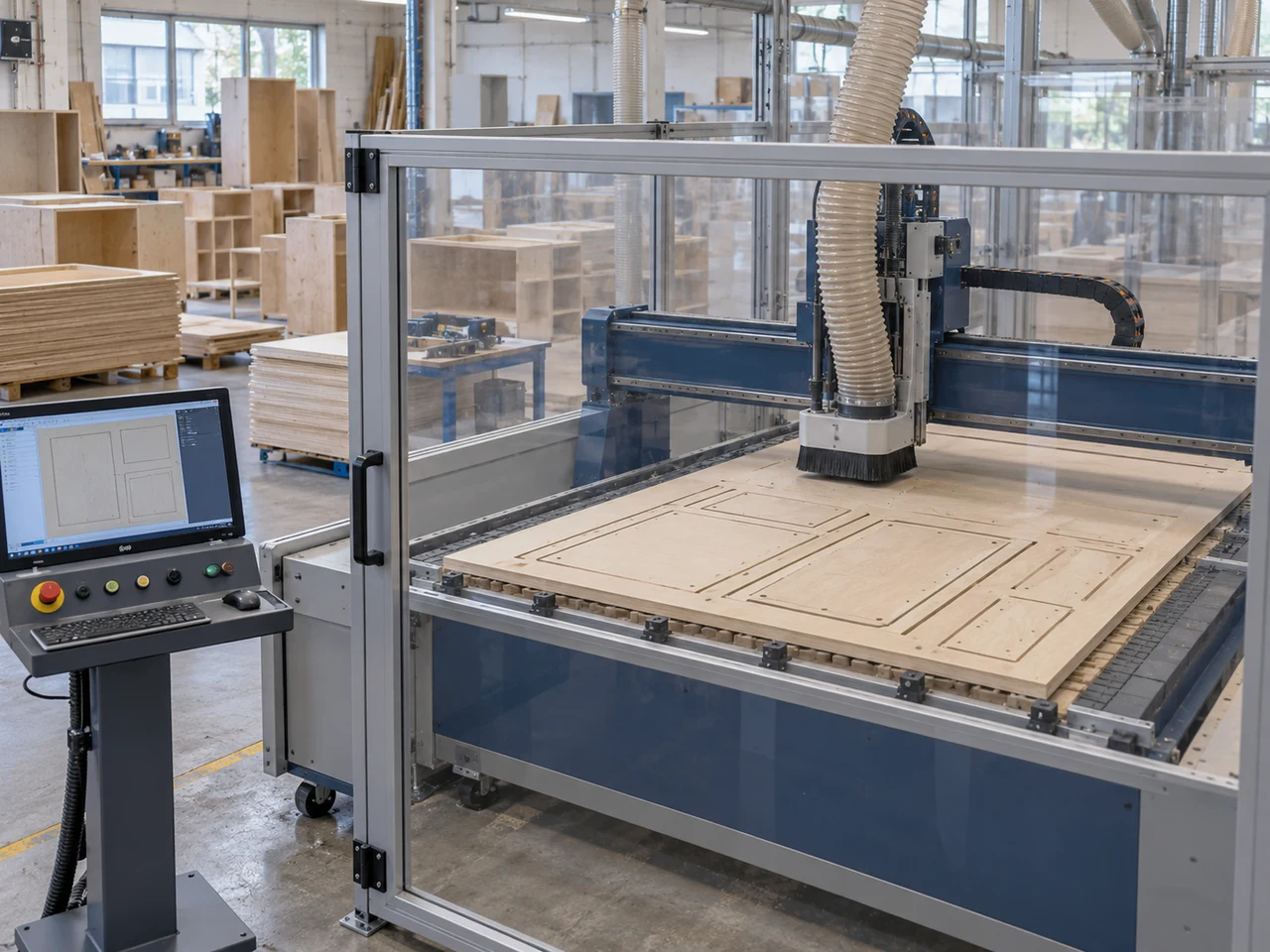
Start with your board and finished-part drawing. The useful question is whether the offered router can hold, cut and release those parts with the required edges, dimensions and cycle time.
Flat-bed wood and panel routing, including manual and automatic tool-change configurations. Rotary carving and five-axis machining require their own clearance and programming assessment.
CNFX editorial research · Sources checked October 10, 2026 · 12 sources
Choose a configuration around the operations on your drawing
A shared bed size does not make two routers equivalent. A single-tool profiling job, a panel requiring more than one cutter and a job with a drilling unit place different demands on the delivered machine. These examples are published offers, not machines tested by CNFX.
A model name can still cover conflicting descriptions. TechPro’s TPM1325 table lists a water-cooled 3.2 kW spindle; its other sections describe air-cooled 3.0 or 3.5 kW versions. Have the seller identify the actual spindle rather than choose a convenient value from the page. [12]
Named offer
What the manufacturer lists
Resolve before ordering
STYLECNC STM1325-R3
1300 × 2500 × 200 mm working area; 3 kW spindle; stepper drives and DSP control. Manual tool change; other configurations are separate offers. [1]
Which worktable, vacuum pump, dust equipment and rotary accessory are included?
BCAMCNC BCM-1325C
1300 × 2500 × 200 mm; 9 kW Hiteco spindle in the specification table; Syntec servos and an eight-position linear tool changer. [2]
Confirm spindle model, toolholder interface and the accuracy test: the page uses different positioning figures.
HUAHUA SKG-912M
2800 × 1300 mm working area; 9 kW spindle and twelve-tool linear magazine. [3]
The feature description shows a drilling head, while the table makes the drilling unit optional. Put its inclusion in the order.
Specify the operations: through profiles, pockets, grooves, drilling, relief carving or edge work. Have the supplier return a marked drawing showing the setup, fixture and tools for each operation. A tool changer does not by itself establish that horizontal drilling or five-axis movement is available.
02
Prove that the smallest finished part stays held through the last cut
Check the complete machining sequence, not just the initial grip on an uncut sheet. Bring the smallest part and the least favourable board surface to the proposed trial. Ask how each part remains restrained when the surrounding material has been removed.
Draw the fixture into the usable machining envelope
The working-area figure is only a starting point. Ask for a section drawing with the bed, spoilboard or vacuum blocks, workpiece, tool projection and dust shoe. State the reachable cutting depth and clearance with those items installed; do not treat quoted Z travel as a promised workpiece thickness.
Schmalz's VCBL-N is a useful example of why the table interface matters. It uses a nesting insert on MDF spoilboards or smooth tables; removing the insert changes its use to a grid-table arrangement. This is a clamping-product example, not evidence that the listed Chinese machines contain Schmalz equipment. [4]
Keep vacuum hold-down and dust extraction on separate service lists
HUAHUA publishes vacuum power and air volume separately from the router spindle rating. Those entries describe the named machine's vacuum service; they do not specify dust capture at the cutter. [3]
For the fixture, request the pump model, operating vacuum, flow information, zones, seals, spoilboard preparation and the response to loss of hold-down. For the dust system, request the extraction requirement at the machine connection and the installed duct arrangement. A pump motor rating or hose diameter alone does not answer both questions.
Investigate movement before continuing a cut
For its VCBL-N blocks, Schmalz directs users to inspect the suction plate and sealing frame, then the main-pump gauge and filter if those parts are sound. Its additional connection is intended for demanding applications. Use the instructions for the actual fixture and stop to resolve lost restraint; do not compensate by assuming that a larger motor guarantees a secure part. [4]
03
Set the cutting feed from the cutter and material
STYLECNC distinguishes maximum rapid travel of 33,000 mm/min from maximum working speed of 25,000 mm/min for the STM1325-R3. Neither is a recommended feed for every wood, cutter and depth. [1]
LMT Onsrud's hardwood sheet gives chip load by tool series and diameter, with cutting-depth conditions. Its relationship is feed rate = spindle rpm × number of cutting edges × chip load per tooth. The units must agree. [5]
As a calculation example only, an assumed 18,000 rpm, two cutting edges and 0.15 mm/tooth give 5,400 mm/min, or 5.4 m/min. These inputs are not a cutting recommendation. Replace them with the selected tool maker's data and the validated setup.
The Onsrud sheet also changes its recommendations with depth: the listed chip load applies at a depth equal to one cutter diameter; its notes reduce that load for deeper cuts. A feed copied without the tool series, diameter and depth has lost essential context. [5]
Request a tool list alongside the program: cutter identity, diameter, cutting edges, projection, holder, rpm, feed, depth and number of passes. Judge the actual edge and part in the trial. Quoted rapid travel is useful for non-cutting moves; total production time also includes loading, tool changes and unloading.
04
Trace the toolpath through the machine assembly
The controller turns the prepared program into axis movement while the spindle rotates the cutter. The frame, transmission and workholding establish the relationship between cutter and board. This is a functional assembly reference; quantities, material grades and replacement part numbers must come from the ordered build.
Assembly
Function and evidenced construction
Identify on the supplied machine
Machine frame
Supports the bed and motion system. BCAM describes a welded steel body. [2]
Fabricated structure, levelling points, installed mass and foundation requirements.
Gantry
Carries the spindle-side motion across the work. BCAM describes a reinforced gantry; no universal aluminium construction follows. [2]
Material and geometry, clearance, axis travel and service access.
Spindle assembly
Rotates and retains the cutter. DECI lists woodworking spindle variants with ISO30, BT30 and HSK63F interfaces. [6]
Exact spindle, duty rating, cooling, holder/collet interface and maintenance manual; do not interchange those interfaces.
Linear guides and transmission
Guide and drive each axis. The checked BCAM build uses rack drive on X/Y and a ball screw on Z. [2]
Axis-specific rail, rack, screw and lubrication requirements; not an all-axis ball-screw assumption.
CNC controller
Executes the prepared machine program and coordinates functions. BCAM identifies a Syntec controller. [2]
Hardware/software version, supported functions, postprocessor, licensed software and backup procedure.
Axis motors and drives
Provide controlled axis movement. Senke lists a stepper build; BCAM lists servos. [11][2]
Motor/drive models, feedback arrangement and delivered tuning/settings.
Worktable and fixture
Supports and restrains the board. T-slot, vacuum and combined tables are separately listed by Transon. [7]
Surface material, fixture drawing, zones, stops, spoilboard and clamp clearances.
Dust hood and extraction connection
Captures dust at the routing head when connected to a suitable extraction system. [8]
Hood geometry, connection, required flow and the installed extraction checks. A generic plastic/steel material label is insufficient.
Tool changer, if ordered
Selects and transfers tools in the programmed sequence. BCAM's named offer has a linear magazine. [2]
Supplies the table or fixtures used to restrain the work. HUAHUA identifies a separate vacuum pump. [3]
Pump, filter, piping, seals, gauge/monitoring, operating requirements and loss-of-vacuum response.
Obtain separate service instructions for the spindle, guides, rack/screw, tool changer, vacuum pump and dust system. Follow each component's manual for lubrication type and interval rather than a universal schedule.
05
Accept the finished part and the complete cycle
Use a representative cutting job agreed before the order. The following is a proposed buyer witness plan, not a quoted standard or a claim that CNFX tested these machines.
Freeze the job and delivered configuration
Record board material, actual thickness and surface, drawing revision, nesting layout, fixture, tools, program and controller/postprocessor versions. Identify any auxiliary pump, extractor or air supply used during the demonstration.
Cut the difficult features
Include the smallest released part, a relevant pocket or groove and the edge finish you will actually supply. Observe restraint during the final contour and the handling of released parts; a decorative sample alone cannot demonstrate your job.
Measure against the drawing
Record the chosen dimensions, hole locations, pocket depths and edge defects with agreed methods. Repeat parts at agreed positions on the bed. Keep the raw results separate from the machine's positioning or repeatability specification.
Time the production sequence
Start and end the clock at agreed boundaries. Record loading, alignment, cutting, tool changes, unloading and any manual finishing. Retain the program and settings that produced the accepted sample.
Include safe access and dust control in the installed proposal
HSE's router guidance discusses cutter and workpiece ejection, moving-machine trapping hazards and tool-changer access. It describes safeguarding selected for the machine configuration, with maintenance isolation to prevent unintended start-up. Ask the supplier to show the supplied protective arrangement and safe access for setup, tool changes and cleaning. This is UK guidance, not evidence that a listed machine is certified. [9]
HSE's WD5 covers CNC flat-bed routers but explicitly excludes woodworking machining centres. For its covered flat-bed arrangement, it calls for extraction at the enclosed router head and remote operation. It directs users to obtain the required extraction flow from the machine maker or ventilation engineer and to provide a way to check flow. Its cleaning guidance warns against using compressed air to disperse wood dust. Apply guidance for the actual machine and workplace. [8]
06
Specify the delivered machine and its site services
Use an order-specific schedule. State confirmed values for the offered build and attach the drawing, component data or test record that defines each one.
Field
What the quotation needs to establish
X working range
Reachable machining width, board width and allowance for fixtures or stops.
Y working range
Reachable machining length, loading direction and any restrictions from tool storage.
Z travel and clearance
Travel, tool projection, fixture height and usable workpiece envelope shown on a section drawing.
Spindle power
Selected spindle model, rated duty, speed/power information and cooling service.
Feed and rapid speed
Non-cutting traverse separately from the proposed tool/material cutting recipe and achieved cycle.
Positioning accuracy
Axis, travel length, test conditions, method and acceptance limit; retain the stated units.
Control system
Controller version, functions, postprocessor, included software/licences and file-transfer method.
Vacuum workholding
Included table/fixture and pump configuration, operating vacuum, flow, zones and monitoring. This is not a yes/no field measured in kW.
Dust connection
Hood and port geometry plus required extraction flow and system responsibility; diameter alone is incomplete.
Spindle speed
Permitted operating range for the selected spindle and tools, with cooling and duty conditions.
Repeatability
Axis and test procedure, distinct from finished-part tolerance and positioning accuracy.
Operating environment
Permitted temperature/humidity and controls/spindle cooling requirements for the installation.
Power supply
Voltage, phase, frequency, required current and connected auxiliaries on an electrical schedule.
Mass and installation
Net machine and auxiliary masses, footprint, handling/lifting plan, floor support and service access.
07
Send the board, drawing and tool sequence together
Paste it into your enquiry below or into an email to a maker, then replace every bracket.
Seven linked companies publish complete router offers; DECI publishes spindle components. The notes distinguish configurations and unresolved specification conflicts. These are source checks, not factory audits or comparative performance tests.
Jinan Style Machinery Co., Ltd. (STYLECNC)
Jinan — published contact address
STM1325-R3 is a complete stepper/DSP router offer. Its manual tool-change build and optional vacuum, dust and servo equipment need a line-item quotation; do not assume the features of other STM models.
BCM-1325C is a linear-ATC panel router offer. Confirm the spindle identity and positioning-test basis: the feature text and specification table use different precision figures.
SKG-912M lists a tool-changing spindle, vacuum pump and panel-routing functions. The drilling unit is optional in the table despite appearing in the feature description; confirm its inclusion.
Lists a 1325 linear-ATC machine, but its page mixes LNC, NC Studio and Syntec control descriptions and different spindle/servo combinations. Require a single configuration sheet with component identities.
SKW-1325 lists a stepper/DSP router with combined vacuum/T-slot workholding. The parameter table identifies an air-cooled spindle while a parts caption describes water cooling; settle the supplied option.
The 1325/1530 router page offers stepper and optional servo configurations. Its quick-details and later spindle sections give different speed/cooling descriptions; agree one build before using those values.
Location not reverified in this product-page check
TPM1325 lists RichAuto-A11 control and Leadshine stepper drives. Its table says a water-cooled 3.2 kW spindle, while other text says air-cooled 3.0 or 3.5 kW; speed figures also differ between sections.
Supplies woodworking spindle motors with ISO30, BT30 and HSK63F toolholder interfaces. Contact it for spindle replacement or upgrade; buy the complete router from a machine builder.
Explore company information and manufacturing capabilities, then discuss the scope of your project with a relevant supplier.
Share this page
Compiled and source-reviewed by the CNFX editorial team.
Confirm the legal seller, ordered configuration and applicable documentation. A public product page does not verify a certificate, machine acceptance result or factory location. How we source and review
· Page last updated 13 October 2026
Buyer questions
Is a vacuum table the same thing as a dust collector?
No. The workholding arrangement restrains the board; extraction captures dust at the routing head. HUAHUA lists a vacuum pump for its SKG-912M, while HSE's flat-bed router guidance separately calls for dust extraction at the head. Ask for both service requirements and which equipment is included. [3][8]
Does a 1325 designation fix the spindle and controller?
No. The checked iGolden 1325 page names LNC in its parameter table, NC Studio in its feature text and Syntec in another description; it also mixes spindle and servo options. Obtain one signed configuration rather than combining those paragraphs into a presumed machine. [10]
Can I use the highest published speed to estimate production output?
No single maximum establishes output. Onsrud relates cutting feed to spindle speed, cutting-edge count and chip load, with depth-specific guidance. Loading, tool changes and unloading also belong in the measured cycle. Use the accepted board-and-tool job as the basis for a production commitment. [5]
Sources and what still needs a direct check
Sources checked 2026-10-10. Manufacturer pages were read as configuration claims. Onsrud's image-based hardwood cutting sheet was visually inspected. HSE documents provide UK safe-work and extraction guidance; they do not establish certification or current legal compliance of these products.