Industry-Verified Manufacturing Data (2026)

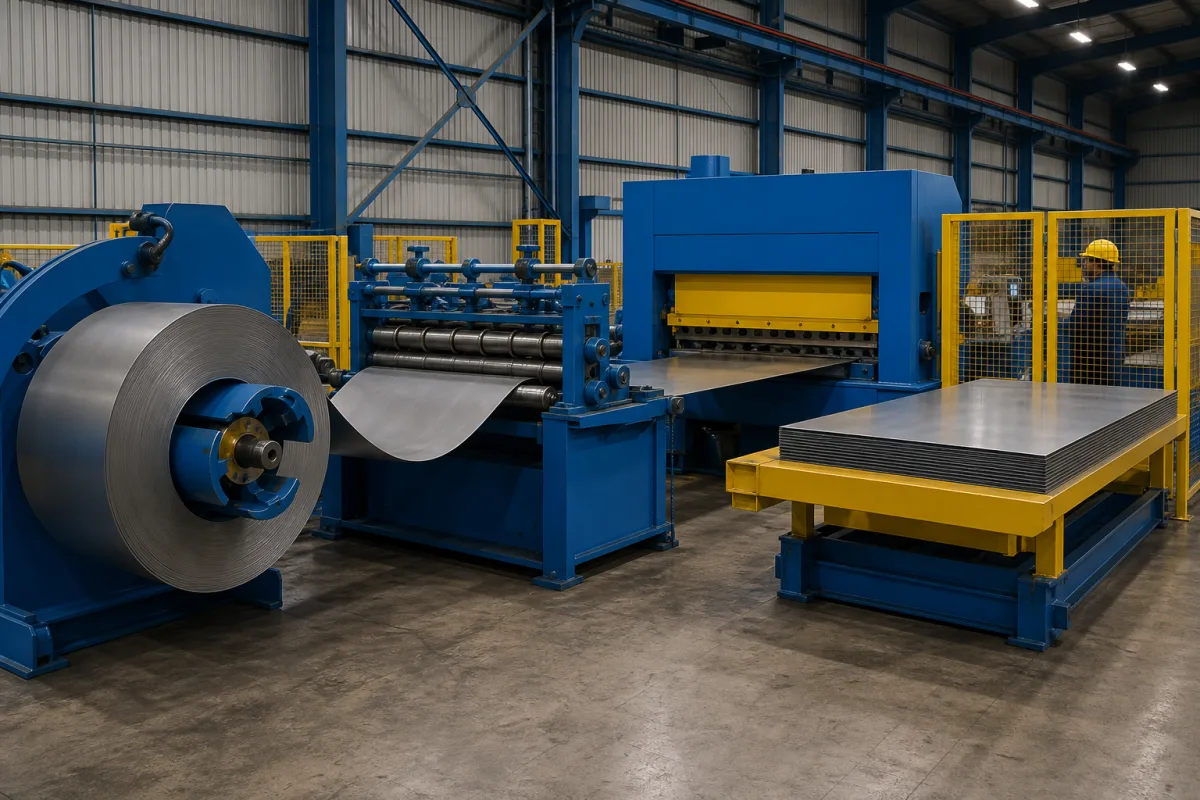
Automated Cut-to-Length Unit

Based on aggregated insights from multiple verified factory profiles within the CNFX directory, the standard Automated Cut-to-Length Unit used in the Basic Metal Manufacturing sector typically supports operational capacities ranging from standard industrial configurations to heavy-duty production requirements.

Technical Definition & Core Assembly

A canonical Automated Cut-to-Length Unit is characterized by the integration of Measurement Sensor Array and Hydraulic Cutting Mechanism. In industrial production environments, manufacturers listed on CNFX commonly emphasize High-strength alloy steel construction to support stable, high-cycle operation across diverse manufacturing scenarios.

A precision cutting system that automatically measures and cuts non-ferrous metal strips or sheets to specified lengths within a continuous casting and rolling line.
Product Specifications

Technical details and manufacturing context for Automated Cut-to-Length Unit

Definition
The Automated Cut-to-Length Unit is a critical component of the Non-Ferrous Metal Continuous Casting and Rolling System, responsible for precisely cutting continuously produced metal strips or sheets into predetermined lengths. It operates downstream from the rolling mill, ensuring dimensional accuracy and material optimization by eliminating manual measurement and cutting errors. This unit integrates measurement sensors, control systems, and cutting mechanisms to maintain production flow while achieving tight length tolerances.
Working Principle
The unit uses optical or laser measurement sensors to continuously monitor the length of the moving metal strip. When the measured length reaches the preset value, the control system triggers a high-speed cutting mechanism (typically hydraulic or pneumatic shears) to execute a clean, perpendicular cut. Advanced units incorporate feedback loops to compensate for material stretch and speed variations, ensuring consistent cut lengths regardless of production line fluctuations.
Common Materials
High-strength alloy steel, Tungsten carbide cutting blades, Industrial-grade hydraulic components
Technical Parameters
  • Cutting length range and tolerance (mm) Per Request
Components / BOM
  • Measurement Sensor Array
    Continuously measures the length of moving metal strip using optical or laser technology
    Material: Stainless steel housing with optical glass
  • Hydraulic Cutting Mechanism
    Executes precise cuts using hydraulic pressure to drive cutting blades through the metal
    Material: High-strength alloy steel
  • Programmable Logic Controller (PLC)
    Processes measurement data and controls the timing of cutting operations
    Material: Electronic components in industrial enclosure
  • Material Hold-Down System
    Secures the metal strip during cutting to prevent movement and ensure clean cuts
    Material: Hardened steel with rubberized contact surfaces
Engineering Reasoning
0.5-5.0 m/min feed rate, 0.1-3.0 mm material thickness, 100-600 mm cutting length
Shear blade wear exceeding 0.15 mm edge radius deviation, hydraulic pressure drop below 150 bar, servo positioning error exceeding ±0.05 mm
Design Rationale: Adhesive wear at blade-workpiece interface due to aluminum oxide abrasion (Mohs hardness 9.0), hydraulic fluid aeration causing pressure instability, thermal expansion mismatch between linear guideways (steel, α=11.5×10⁻⁶/K) and aluminum frame (α=23.1×10⁻⁶/K)
Risk Mitigation (FMEA)
Trigger Accumulated aluminum oxide particles (Al₂O₃) at blade interface
Mode: Progressive blade dulling causing burr formation exceeding 0.1 mm height
Strategy: Integrated ceramic particle filtration system with 5 μm absolute rating
Trigger Servo motor encoder signal interference from variable frequency drives
Mode: Positional overshoot of 0.2-0.5 mm during high-speed cuts
Strategy: Shielded twisted-pair cabling with ferrite cores and 1.5 mm separation from power lines

Industry Taxonomies & Aliases

Commonly used trade names and technical identifiers for Automated Cut-to-Length Unit.

Industrial Ecosystem & Supply Chain DNA

Complementary Systems
Downstream Applications
Specialized Tooling

Application Fit & Sizing Matrix

Operational Limits
pressure: Atmospheric operation only - no hydraulic/pneumatic cutting pressure
other spec: Material thickness: 0.2-6.0 mm, Cutting tolerance: ±0.5 mm, Line speed: 5-120 m/min
temperature: Ambient to 150°C (302°F) - typical for non-ferrous metal processing lines
Media Compatibility
✓ Aluminum strips/sheets ✓ Copper alloys ✓ Brass sheets
Unsuitable: Ferrous metals (steel, iron) due to different material properties and potential equipment damage
Sizing Data Required
  • Maximum material width (mm)
  • Required cutting length range (mm)
  • Production line speed (m/min)

Reliability & Engineering Risk Analysis

Failure Mode & Root Cause
Misalignment-induced bearing failure
Cause: Progressive misalignment from thermal expansion, vibration, or improper installation leading to excessive radial/axial loads on bearings, causing premature fatigue, overheating, and seizure.
Blade edge degradation and chipping
Cause: Material fatigue from cyclic loading, improper blade-to-material hardness mismatch, or contamination (e.g., abrasive particles in cut material) accelerating wear, micro-cracking, and edge failure.
Maintenance Indicators
  • Abnormal high-frequency vibration or audible knocking during operation, indicating potential bearing wear, imbalance, or mechanical looseness.
  • Inconsistent cut lengths or increased burr formation on cut edges, signaling blade wear, misalignment, or hydraulic/pneumatic system pressure loss.
Engineering Tips
  • Implement laser alignment checks and thermal growth compensation during installation, and use condition monitoring (vibration analysis, thermography) to detect early misalignment or bearing defects.
  • Establish a blade maintenance regimen including regular edge inspection, proper material-specific blade selection, and contamination control (e.g., material cleaning systems) to reduce abrasive wear and fatigue.

Compliance & Manufacturing Standards

Reference Standards
ISO 9001:2015 - Quality Management Systems CE Marking - Machinery Directive 2006/42/EC ANSI B11.19 - Performance Requirements for Safeguarding
Manufacturing Precision
  • Cut Length Accuracy: +/-0.5mm
  • Squareness of Cut: 0.2mm per 100mm
Quality Inspection
  • Laser Interferometer Calibration for Positioning Accuracy
  • Material Hardness Testing via Rockwell Scale

Factories Producing Automated Cut-to-Length Unit

Verified manufacturers with capability to produce this product in China

✓ 96% Supplier Capability Match Found

P Project Engineer from Australia Feb 18, 2026
★★★★★
"Standard OEM quality for Basic Metal Manufacturing applications. The Automated Cut-to-Length Unit arrived with full certification."
Technical Specifications Verified
S Sourcing Manager from Singapore Feb 15, 2026
★★★★★
"Great transparency on the Automated Cut-to-Length Unit components. Essential for our Basic Metal Manufacturing supply chain."
Technical Specifications Verified
P Procurement Specialist from Germany Feb 12, 2026
★★★★★
"The Automated Cut-to-Length Unit we sourced perfectly fits our Basic Metal Manufacturing production line requirements."
Technical Specifications Verified
Verification Protocol

“Feedback is collected from verified sourcing managers during RFQ (Request for Quote) and factory evaluation processes on CNFX. These reports represent historical performance data and technical audit summaries from our B2B manufacturing network.”

7 sourcing managers are analyzing this specification now. Last inquiry for Automated Cut-to-Length Unit from USA (16m ago).

Supply Chain Compatible Machinery & Devices

Vacuum Induction Melting Furnace

Industrial furnace for melting metals under vacuum using electromagnetic induction

Explore Specs →
Electroslag Remelting Furnace

Secondary refining furnace for high-quality metal ingots

Explore Specs →
Molten Metal Flow Control Valve

Precision valve for regulating molten metal flow in casting and pouring operations.

Explore Specs →
Molten Metal Temperature Measurement System

Automated system for continuous temperature monitoring of molten metals during processing.

Explore Specs →

Frequently Asked Questions

What types of materials can this automated cut-to-length unit process?

This unit is designed specifically for non-ferrous metal strips and sheets, including aluminum, copper, brass, and other alloys within continuous casting and rolling operations.

How does the measurement system ensure cutting precision?

The system uses a high-precision sensor array that continuously measures material length during production, feeding real-time data to the PLC which controls the hydraulic cutting mechanism for accurate cuts within ±0.5mm tolerance.

What maintenance is required for the tungsten carbide cutting blades?

Tungsten carbide blades typically require sharpening every 3-6 months depending on production volume, with complete replacement recommended annually. The hydraulic system should be inspected monthly for optimal performance.

Can I contact factories directly on CNFX?

CNFX is an open directory, not a transaction platform. Each factory profile provides direct contact information and production details to help you initiate direct inquiries with Chinese suppliers.

Get Quote for Automated Cut-to-Length Unit

Request technical pricing, lead times, or customized specifications for Automated Cut-to-Length Unit directly from verified manufacturing units.

Your business information is encrypted and only shared with verified Automated Cut-to-Length Unit suppliers.

Thank you! Your message has been sent. We'll respond within 1–3 business days.

Need to Manufacture Automated Cut-to-Length Unit?

Connect with verified factories specializing in this product category

Add Your Factory Contact Us
Previous Product
Anode Plate
Next Product
Automated Extraction Mechanism