Industry-Verified Manufacturing Data (2026)

Cold-Forged Steel Bar Stock

Based on aggregated insights from multiple verified factory profiles within the CNFX directory, the standard Cold-Forged Steel Bar Stock used in the Basic Metal Manufacturing sector typically supports operational capacities ranging from standard industrial configurations to heavy-duty production requirements.

Technical Definition & Core Assembly

A canonical Cold-Forged Steel Bar Stock is characterized by the integration of Steel Core and Surface Layer. In industrial production environments, manufacturers listed on CNFX commonly emphasize Carbon Steel construction to support stable, high-cycle operation across diverse manufacturing scenarios.

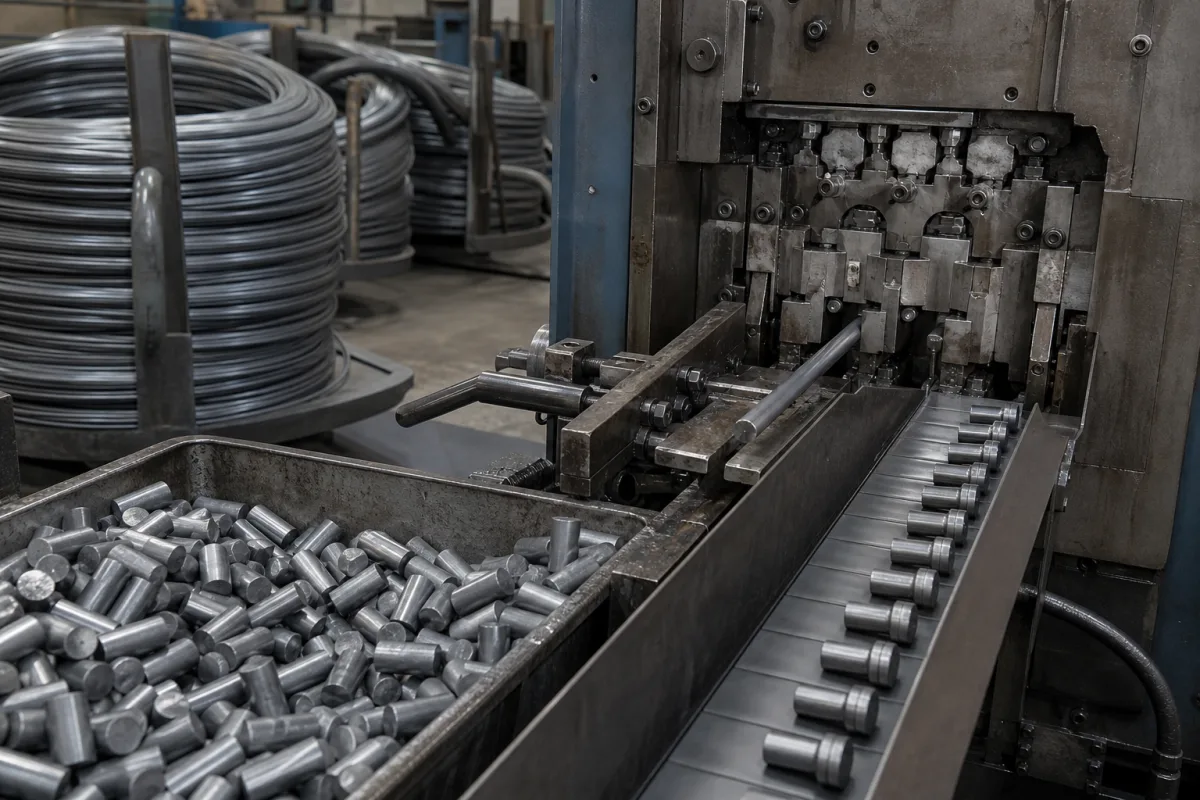
Semi-finished steel bar produced through cold forging for precision metalworking
Product Specifications

Technical details and manufacturing context for Cold-Forged Steel Bar Stock

Definition
Cold-forged steel bar stock is a semi-finished industrial material created by applying compressive forces to steel at room temperature, resulting in improved grain structure and mechanical properties. This material serves as the foundational input for subsequent machining, stamping, or forming operations in manufacturing. It offers superior dimensional accuracy and surface finish compared to hot-forged alternatives, making it ideal for high-precision components. The cold forging process enhances tensile strength and fatigue resistance while maintaining tight tolerances for industrial applications.
Working Principle
Steel is plastically deformed through compressive forces at ambient temperature, causing grain refinement and work hardening without melting
Common Materials
Carbon Steel, Alloy Steel
Technical Parameters
  • Standard diameter range for industrial applications (mm) Per Request
  • Minimum yield strength requirement (MPa) Per Request
Components / BOM
  • Steel Core
    Primary structural element providing mechanical strength
    Material: Carbon or alloy steel
  • Surface Layer
    Outer material zone with refined grain structure from forging
    Material: Work-hardened steel
Engineering Reasoning
Yield strength: 600-1200 MPa, Ultimate tensile strength: 700-1400 MPa, Hardness: 25-45 HRC, Diameter tolerance: ±0.05-0.15 mm
Microcrack initiation at 0.2% plastic strain, Brittle fracture at -40°C Charpy impact energy <27 J, Fatigue limit at 10^7 cycles: 350-550 MPa
Design Rationale: Cold work hardening-induced dislocation pileup at grain boundaries causing stress concentration exceeding Griffith's criterion (σ_critical = √(2Eγ/πa) where E=210 GPa, γ=1.5 J/m², a=50 μm)
Risk Mitigation (FMEA)
Trigger Residual stress gradient exceeding 300 MPa/mm from improper annealing
Mode: Dimensional instability with 0.3 mm warping during machining
Strategy: Controlled atmosphere annealing at 650°C for 2 hours with 15°C/hour cooling rate
Trigger Surface decarburization depth >0.1 mm from oxidation during processing
Mode: Reduced fatigue life by 60% at 400 MPa alternating stress
Strategy: Nitrogen-purged forging environment with O₂ <50 ppm and post-forge shot peening at 0.3 mmA Almen intensity

Industry Taxonomies & Aliases

Commonly used trade names and technical identifiers for Cold-Forged Steel Bar Stock.

Industrial Ecosystem & Supply Chain DNA

Complementary Systems
Downstream Applications
Specialized Tooling

Application Fit & Sizing Matrix

Operational Limits
pressure: Up to 1000 MPa static, 500 MPa cyclic fatigue limit
temperature: -40°C to 200°C (operational), -196°C to 400°C (short-term exposure)
surface finish: Ra 0.8-3.2 μm as-forged, Ra 0.1-0.4 μm after polishing
dimensional tolerance: ±0.05 mm for diameters ≤50 mm, ±0.1% for lengths
Media Compatibility
✓ Hydraulic fluid systems ✓ Precision bearing components ✓ Automotive transmission gears
Unsuitable: Chloride-rich marine environments (risk of stress corrosion cracking)
Sizing Data Required
  • Required tensile strength (MPa)
  • Final machined diameter tolerance (mm)
  • Required surface hardness (HRC)

Reliability & Engineering Risk Analysis

Failure Mode & Root Cause
Surface cracking
Cause: Residual stresses from cold forging process leading to stress corrosion cracking or fatigue under cyclic loading
Dimensional instability
Cause: Inadequate stress relief annealing after cold forging, causing gradual deformation under sustained load
Maintenance Indicators
  • Visible surface cracks or flaking along the bar length
  • Audible high-frequency pinging or cracking sounds during operation under load
Engineering Tips
  • Implement controlled stress relief annealing post-forging to reduce residual stresses below 30% of yield strength
  • Apply protective coatings or surface treatments (e.g., phosphating, zinc plating) to prevent environmental corrosion initiation

Compliance & Manufacturing Standards

Reference Standards
ISO 286-1:2010 (Geometrical product specifications - Limits and fits) ASTM A29/A29M-20 (Standard Specification for Steel Bars, Carbon and Alloy, Hot-Wrought and Cold-Finished) DIN 1013-1 (Cold-rolled steel strip and sheet - Technical delivery conditions)
Manufacturing Precision
  • Diameter tolerance: +/-0.05mm for diameters up to 25mm
  • Straightness tolerance: 0.3mm per 300mm length
Quality Inspection
  • Ultrasonic Testing for internal defects
  • Rockwell Hardness Test (HRC scale)

Factories Producing Cold-Forged Steel Bar Stock

Verified manufacturers with capability to produce this product in China

✓ 93% Supplier Capability Match Found

P Project Engineer from Germany Feb 18, 2026
★★★★★
"Standard OEM quality for Basic Metal Manufacturing applications. The Cold-Forged Steel Bar Stock arrived with full certification."
Technical Specifications Verified
S Sourcing Manager from Brazil Feb 15, 2026
★★★★★
"Great transparency on the Cold-Forged Steel Bar Stock components. Essential for our Basic Metal Manufacturing supply chain."
Technical Specifications Verified
P Procurement Specialist from Canada Feb 12, 2026
★★★★★
"The Cold-Forged Steel Bar Stock we sourced perfectly fits our Basic Metal Manufacturing production line requirements."
Technical Specifications Verified
Verification Protocol

“Feedback is collected from verified sourcing managers during RFQ (Request for Quote) and factory evaluation processes on CNFX. These reports represent historical performance data and technical audit summaries from our B2B manufacturing network.”

5 sourcing managers are analyzing this specification now. Last inquiry for Cold-Forged Steel Bar Stock from USA (10m ago).

Supply Chain Commonly Integrated Components

Purge Air System

A system that provides controlled airflow to clear optical paths and protect sensors in molten metal temperature measurement applications.

Explore Specs →
Degassing Chamber

A specialized vessel within a molten metal degassing system where dissolved gases are removed from molten metal through controlled processes.

Explore Specs →
Gas Control System

A system that regulates and controls the flow, pressure, and composition of gases used in molten metal degassing processes.

Explore Specs →
Burner Assembly

A combustion system component that generates controlled flame for heating applications in industrial preheating stations.

Explore Specs →

Frequently Asked Questions

What are the advantages of cold-forged steel bar stock over hot-forged alternatives?

Cold-forged steel bar stock offers superior dimensional accuracy, tighter diameter tolerances, improved surface finish with lower Ra values, and enhanced mechanical properties like higher yield strength due to work hardening during the cold forging process.

What carbon content ranges are available for cold-forged steel bar stock?

Our cold-forged steel bar stock is available in various carbon content percentages, typically ranging from low-carbon steels (0.05-0.25%) for formability to medium/high-carbon steels (0.30-0.60%) for strength, with alloy steel options offering additional properties through elements like chromium, nickel, or molybdenum.

What are the typical diameter tolerance and surface roughness specifications?

Cold-forged steel bar stock features tight diameter tolerances, typically within ±0.1mm to ±0.5mm depending on size, and excellent surface roughness with Ra values generally between 1.6-6.3μm, making it ideal for precision metalworking without extensive secondary machining.

Can I contact factories directly on CNFX?

CNFX is an open directory, not a transaction platform. Each factory profile provides direct contact information and production details to help you initiate direct inquiries with Chinese suppliers.

Get Quote for Cold-Forged Steel Bar Stock

Request technical pricing, lead times, or customized specifications for Cold-Forged Steel Bar Stock directly from verified manufacturing units.

Your business information is encrypted and only shared with verified Cold-Forged Steel Bar Stock suppliers.

Thank you! Your message has been sent. We'll respond within 1–3 business days.

Need to Manufacture Cold-Forged Steel Bar Stock?

Connect with verified factories specializing in this product category

Add Your Factory Contact Us
Previous Product
Coil Ejection System
Next Product
Collector Nozzle / Well Nozzle