Industry-Verified Manufacturing Data (2026)

Collector Nozzle / Well Nozzle

Based on aggregated insights from multiple verified factory profiles within the CNFX directory, the standard Collector Nozzle / Well Nozzle used in the Basic Metal Manufacturing sector typically supports operational capacities ranging from standard industrial configurations to heavy-duty production requirements.

Technical Definition & Core Assembly

A canonical Collector Nozzle / Well Nozzle is characterized by the integration of Nozzle Body and Seating Surface. In industrial production environments, manufacturers listed on CNFX commonly emphasize Alumina-Graphite refractory construction to support stable, high-cycle operation across diverse manufacturing scenarios.

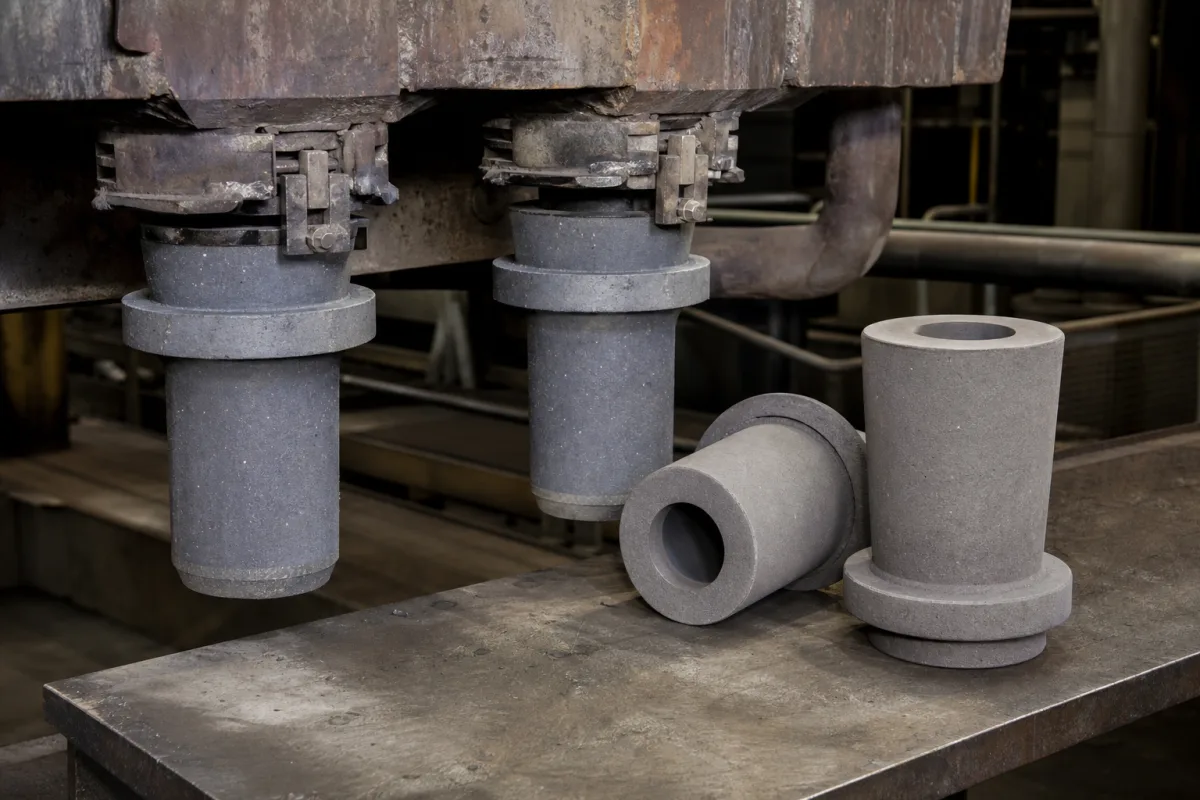
A precision nozzle component within a flow control device that collects and directs molten metal from a tundish into the mold during continuous casting.
Product Specifications

Technical details and manufacturing context for Collector Nozzle / Well Nozzle

Definition
The Collector Nozzle (also known as Well Nozzle) is a critical component of flow control devices like slide gates or stopper rods in continuous casting systems. It serves as the final interface between the tundish and the mold, precisely controlling the flow rate, stream shape, and distribution of molten steel or other metals into the mold cavity. Its design is crucial for preventing turbulence, minimizing oxidation, and ensuring uniform solidification.
Working Principle
The nozzle is positioned at the outlet of the tundish flow control mechanism. When the slide gate opens or the stopper rod is lifted, molten metal flows through the internal bore of the nozzle. Its tapered or shaped internal geometry transforms the flow into a coherent, controlled stream directed into the center of the mold's pouring well, minimizing splash and air entrapment.
Common Materials
Alumina-Graphite refractory, Zirconia-Graphite refractory, Fused Silica
Technical Parameters
  • Inner bore diameter, outer diameter, and overall length are critical for flow rate and fit within the flow control assembly. (mm) Standard Spec
Components / BOM
  • Nozzle Body
    Forms the main structure and internal flow channel (bore).
    Material: Refractory (e.g., Alumina-Graphite)
  • Seating Surface
    Precision-machined surface that seals against the slide gate plate or stopper rod head to prevent leakage.
    Material: Refractory
Engineering Reasoning
0.5-2.5 MPa (5-25 bar) at 1550-1600°C
Thermal stress exceeds 350 MPa yield strength of zirconia-based refractory at 1650°C
Design Rationale: Thermal fatigue from cyclic temperature gradients exceeding 200°C/mm during casting sequence transitions, combined with erosion from alumina inclusions at velocities >1.2 m/s
Risk Mitigation (FMEA)
Trigger Alumina inclusion accumulation exceeding 0.3% volume fraction in steel flow
Mode: Nozzle bore erosion rate exceeding 0.5 mm/hour, causing flow deviation >5° from vertical axis
Strategy: Implementation of argon bubbling through porous refractory insert at 2-4 L/min to prevent inclusion adhesion
Trigger Thermal shock from tundish temperature fluctuations exceeding 30°C/minute during ladle change
Mode: Radial cracking propagation through refractory thickness at >0.1 mm/second
Strategy: Preheating system maintaining nozzle temperature at 800-900°C during non-casting periods with controlled ramp rates <15°C/minute

Industry Taxonomies & Aliases

Commonly used trade names and technical identifiers for Collector Nozzle / Well Nozzle.

Applied To / Applications

This component is essential for the following industrial systems and equipment:

Industrial Ecosystem & Supply Chain DNA

Complementary Systems
Downstream Applications
Specialized Tooling

Application Fit & Sizing Matrix

Operational Limits
pressure: 0.1-0.5 MPa (tundish hydrostatic pressure range)
flow rate: 1-5 tons/min (typical casting rates)
temperature: 1500-1600°C (typical molten steel temperature)
slurry concentration: Not applicable - handles pure molten metal
Media Compatibility
✓ Molten steel ✓ Molten aluminum ✓ Molten copper alloys
Unsuitable: Corrosive chemical environments or abrasive slurries
Sizing Data Required
  • Required casting throughput (tons/hour)
  • Tundish nozzle bore diameter (mm)
  • Mold cross-sectional dimensions (mm)

Reliability & Engineering Risk Analysis

Failure Mode & Root Cause
Abrasive erosion
Cause: High-velocity particulate-laden fluid flow causing material degradation, often due to inadequate filtration or abrasive media in the process stream.
Cavitation
Cause: Rapid pressure changes causing vapor bubble formation and collapse, typically from improper nozzle design, excessive flow velocity, or pressure differentials.
Maintenance Indicators
  • Visible material thinning or localized pitting around the nozzle orifice
  • Abnormal flow patterns or audible hissing/popping sounds indicating cavitation
Engineering Tips
  • Implement real-time erosion monitoring with ultrasonic thickness testing and install upstream filtration systems to reduce particulate concentration
  • Optimize flow parameters using computational fluid dynamics (CFD) analysis to maintain pressure above vapor pressure and redesign nozzle geometry for smoother flow transitions

Compliance & Manufacturing Standards

Reference Standards
ISO 9001:2015 Quality Management Systems ASME B16.5 Pipe Flanges and Flanged Fittings API 6A Specification for Wellhead and Christmas Tree Equipment
Manufacturing Precision
  • Bore Diameter: +/-0.025mm
  • Surface Flatness: 0.05mm per 100mm
Quality Inspection
  • Dye Penetrant Testing for Surface Defects
  • Dimensional Verification with CMM

Factories Producing Collector Nozzle / Well Nozzle

Verified manufacturers with capability to produce this product in China

✓ 93% Supplier Capability Match Found

S Sourcing Manager from Germany Feb 13, 2026
★★★★★
"Impressive build quality. Especially the technical reliability is very stable during long-term operation."
Technical Specifications Verified
P Procurement Specialist from Brazil Feb 10, 2026
★★★★☆
"As a professional in the Basic Metal Manufacturing sector, I confirm this Collector Nozzle / Well Nozzle meets all ISO standards. (Delivery took slightly longer than expected, but technical support was excellent.)"
Technical Specifications Verified
T Technical Director from Canada Feb 07, 2026
★★★★★
"Standard OEM quality for Basic Metal Manufacturing applications. The Collector Nozzle / Well Nozzle arrived with full certification."
Technical Specifications Verified
Verification Protocol

“Feedback is collected from verified sourcing managers during RFQ (Request for Quote) and factory evaluation processes on CNFX. These reports represent historical performance data and technical audit summaries from our B2B manufacturing network.”

9 sourcing managers are analyzing this specification now. Last inquiry for Collector Nozzle / Well Nozzle from Vietnam (1h ago).

Supply Chain Compatible Machinery & Devices

Electromagnetic Induction Heater

Industrial heating device using electromagnetic induction for metal processing

Explore Specs →
Vacuum Induction Melting Furnace

Industrial furnace for melting metals under vacuum using electromagnetic induction

Explore Specs →
Electroslag Remelting Furnace

Secondary refining furnace for high-quality metal ingots

Explore Specs →
Molten Metal Flow Control Valve

Precision valve for regulating molten metal flow in casting and pouring operations.

Explore Specs →

Frequently Asked Questions

What materials are used in collector nozzles for continuous casting?

Collector nozzles are typically manufactured from high-performance refractory materials including alumina-graphite, zirconia-graphite, and fused silica to withstand extreme temperatures and corrosive molten metal environments.

How does a collector nozzle function in continuous casting?

The collector nozzle precisely directs molten metal from the tundish into the mold during continuous casting, ensuring controlled flow rates and preventing turbulence that could cause defects in the final metal product.

What are the key components of a collector nozzle assembly?

The main components include the nozzle body, which controls metal flow, and the seating surface, which ensures a secure, leak-proof connection between the tundish and the casting system.

Can I contact factories directly on CNFX?

CNFX is an open directory, not a transaction platform. Each factory profile provides direct contact information and production details to help you initiate direct inquiries with Chinese suppliers.

Get Quote for Collector Nozzle / Well Nozzle

Request technical pricing, lead times, or customized specifications for Collector Nozzle / Well Nozzle directly from verified manufacturing units.

Your business information is encrypted and only shared with verified Collector Nozzle / Well Nozzle suppliers.

Thank you! Your message has been sent. We'll respond within 1–3 business days.

Need to Manufacture Collector Nozzle / Well Nozzle?

Connect with verified factories specializing in this product category

Add Your Factory Contact Us
Previous Product
Cold-Forged Steel Bar Stock
Next Product
Column