Industry-Verified Manufacturing Data (2026)

Conveyor Belt/Trough

Based on aggregated insights from multiple verified factory profiles within the CNFX directory, the standard Conveyor Belt/Trough used in the Basic Metal Manufacturing sector typically supports operational capacities ranging from standard industrial configurations to heavy-duty production requirements.

Technical Definition & Core Assembly

A canonical Conveyor Belt/Trough is characterized by the integration of Trough Side Plates and Belt Surface. In industrial production environments, manufacturers listed on CNFX commonly emphasize Abrasion-resistant steel construction to support stable, high-cycle operation across diverse manufacturing scenarios.

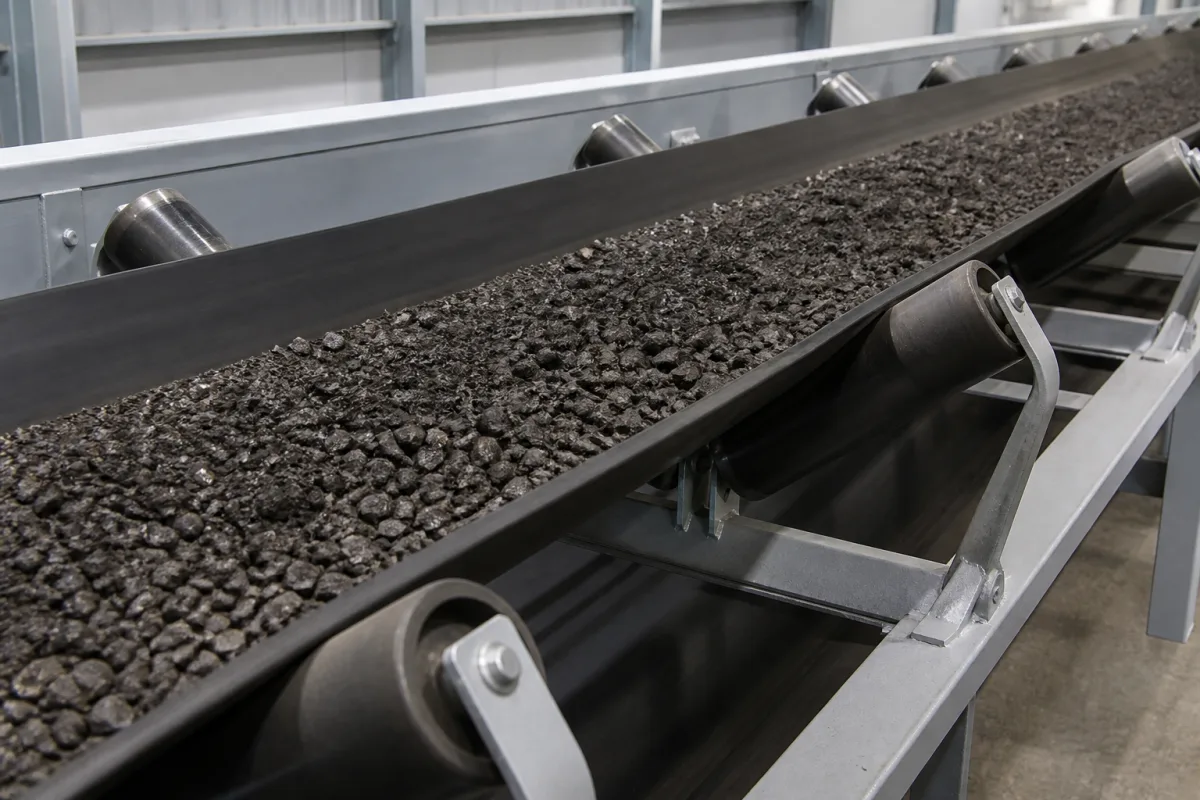
The load-bearing surface or channel that transports slag material along the conveyor system.
Product Specifications

Technical details and manufacturing context for Conveyor Belt/Trough

Definition
In a slag conveyor system, the conveyor belt/trough is the critical component that physically carries and transports hot or cooled slag material from one point to another. It serves as the primary interface between the conveyed material and the conveyor structure, designed to withstand abrasive, high-temperature slag while maintaining structural integrity and efficient material flow.
Working Principle
The belt or trough moves continuously along the conveyor frame, driven by pulleys or rollers. Slag material is loaded onto the belt/trough at the feed point and transported to the discharge point. The trough shape helps contain the material and prevent spillage, while the belt provides a continuous moving surface for material transport.
Common Materials
Abrasion-resistant steel, Heat-resistant rubber, Specialized composite materials
Technical Parameters
  • Width and depth dimensions of the belt or trough section (mm) Customizable
Components / BOM
  • Trough Side Plates
    Form the vertical sides of the trough to contain material and prevent spillage
    Material: Abrasion-resistant steel
  • Belt Surface
    Provides the moving surface for material transport and withstands direct contact with slag
    Material: Heat-resistant rubber or composite
  • Support Structure
    Provides structural support to maintain trough shape and belt alignment under load
    Material: Structural steel
  • Wear Liners
    Protect high-wear areas of the trough from abrasive slag material
    Material: Ceramic or hardened steel
Engineering Reasoning
0.5-2.5 MPa tensile stress, 0-150°C temperature, 0.1-3.0 m/s linear velocity
Tensile stress >3.0 MPa, temperature >180°C, abrasive wear depth >15 mm, belt misalignment >5° from centerline
Design Rationale: Polymer chain scission at >180°C causing rubber degradation, abrasive wear exceeding 15 mm reduces structural integrity by 70%, belt tracking failure at >5° misalignment causes edge damage
Risk Mitigation (FMEA)
Trigger Material fatigue from cyclic loading at 1.8 MPa stress amplitude
Mode: Longitudinal belt tear propagation at 2.5 mm/hour rate
Strategy: Reinforced carcass design with 2000 N/mm warp tensile strength
Trigger Thermal expansion differential of 0.012 mm/m·°C between belt layers
Mode: Delamination at splice joints under >120°C thermal cycling
Strategy: Vulcanized splice with 25 kN/m peel strength at 150°C

Industry Taxonomies & Aliases

Commonly used trade names and technical identifiers for Conveyor Belt/Trough.

Applied To / Applications

This component is essential for the following industrial systems and equipment:

Industrial Ecosystem & Supply Chain DNA

Complementary Systems
Downstream Applications
Specialized Tooling

Application Fit & Sizing Matrix

Operational Limits
pressure: Not applicable (belt/trough is not pressure-rated)
flow rate: 10-500 tons/hour depending on belt width and speed
temperature: -20°C to 120°C (standard), up to 200°C with specialized materials
slurry concentration: Up to 70% solids by weight for standard designs
Media Compatibility
✓ Steel slag ✓ Coal slag ✓ Foundry slag
Unsuitable: Highly acidic or corrosive chemical slurries (pH < 4)
Sizing Data Required
  • Material bulk density (kg/m³)
  • Required throughput capacity (tons/hour)
  • Maximum particle size (mm)

Reliability & Engineering Risk Analysis

Failure Mode & Root Cause
Belt misalignment and tracking failure
Cause: Improper installation, worn or damaged idlers/pulleys, material buildup on components, or incorrect belt tension leading to edge wear and potential belt damage or derailment.
Belt cover wear and material degradation
Cause: Abrasive materials causing surface erosion, chemical exposure degrading rubber compounds, excessive heat from friction or environment, or impact damage from sharp or heavy objects.
Maintenance Indicators
  • Audible squealing or grinding noises from drive components or belt interface
  • Visible material spillage along belt edges or at transfer points indicating tracking issues
Engineering Tips
  • Implement regular laser alignment checks and automated tracking systems to maintain proper belt positioning and reduce edge wear.
  • Establish a preventive maintenance schedule for idler rotation, pulley lagging inspection, and belt tension verification to distribute wear evenly and prevent sudden failures.

Compliance & Manufacturing Standards

Reference Standards
ISO 14890:2013 - Conveyor belts - Specification for rubber or plastics covered conveyor belts of textile construction for general use ANSI/CEMA 402-2003 - Belt Conveyors DIN 22101:2011 - Continuous conveyors - Belt conveyors for loose bulk materials - Basics for calculation and dimensioning
Manufacturing Precision
  • Belt thickness: +/-0.5mm
  • Pulley alignment: +/-0.1mm per meter of shaft length
Quality Inspection
  • Tensile strength test (ISO 283)
  • Non-destructive belt splice inspection (ultrasonic testing)

Factories Producing Conveyor Belt/Trough

Verified manufacturers with capability to produce this product in China

✓ 94% Supplier Capability Match Found

S Sourcing Manager from United Arab Emirates Feb 05, 2026
★★★★★
"The Conveyor Belt/Trough we sourced perfectly fits our Basic Metal Manufacturing production line requirements."
Technical Specifications Verified
P Procurement Specialist from Australia Feb 02, 2026
★★★★☆
"Found 24+ suppliers for Conveyor Belt/Trough on CNFX, but this spec remains the most cost-effective. (Delivery took slightly longer than expected, but technical support was excellent.)"
Technical Specifications Verified
T Technical Director from Singapore Jan 30, 2026
★★★★★
"The technical documentation for this Conveyor Belt/Trough is very thorough, especially regarding technical reliability."
Technical Specifications Verified
Verification Protocol

“Feedback is collected from verified sourcing managers during RFQ (Request for Quote) and factory evaluation processes on CNFX. These reports represent historical performance data and technical audit summaries from our B2B manufacturing network.”

5 sourcing managers are analyzing this specification now. Last inquiry for Conveyor Belt/Trough from India (14m ago).

Supply Chain Compatible Machinery & Devices

Continuous Casting Machine

Industrial machine for solidifying molten metal into continuous billets/blooms/slabs.

Explore Specs →
Electromagnetic Induction Heater

Industrial heating device using electromagnetic induction for metal processing

Explore Specs →
Vacuum Induction Melting Furnace

Industrial furnace for melting metals under vacuum using electromagnetic induction

Explore Specs →
Electroslag Remelting Furnace

Secondary refining furnace for high-quality metal ingots

Explore Specs →

Frequently Asked Questions

What materials are best for conveyor troughs handling hot slag?

Our troughs use abrasion-resistant steel, heat-resistant rubber, and specialized composite materials designed to withstand high temperatures and abrasive slag materials in basic metal manufacturing.

How do wear liners extend the life of slag conveyor systems?

Wear liners protect critical areas like trough side plates and support structures from abrasive slag particles, significantly reducing maintenance costs and downtime in metal production facilities.

What specifications should I consider for slag conveyor troughs?

Key specs include material thickness, temperature resistance ratings, load capacity, belt width compatibility, and wear liner attachment systems to ensure optimal performance in harsh metal manufacturing environments.

Can I contact factories directly on CNFX?

CNFX is an open directory, not a transaction platform. Each factory profile provides direct contact information and production details to help you initiate direct inquiries with Chinese suppliers.

Get Quote for Conveyor Belt/Trough

Request technical pricing, lead times, or customized specifications for Conveyor Belt/Trough directly from verified manufacturing units.

Your business information is encrypted and only shared with verified Conveyor Belt/Trough suppliers.

Thank you! Your message has been sent. We'll respond within 1–3 business days.

Need to Manufacture Conveyor Belt/Trough?

Connect with verified factories specializing in this product category

Add Your Factory Contact Us
Previous Product
Continuous Casting Mold Powder
Next Product
Coolant Reservoir/Pump