Industry-Verified Manufacturing Data (2026)

Coolant Reservoir/Pump

Based on aggregated insights from multiple verified factory profiles within the CNFX directory, the standard Coolant Reservoir/Pump used in the Basic Metal Manufacturing sector typically supports operational capacities ranging from standard industrial configurations to heavy-duty production requirements.

Technical Definition & Core Assembly

A canonical Coolant Reservoir/Pump is characterized by the integration of Impeller and Tank Baffles. In industrial production environments, manufacturers listed on CNFX commonly emphasize Stainless Steel construction to support stable, high-cycle operation across diverse manufacturing scenarios.

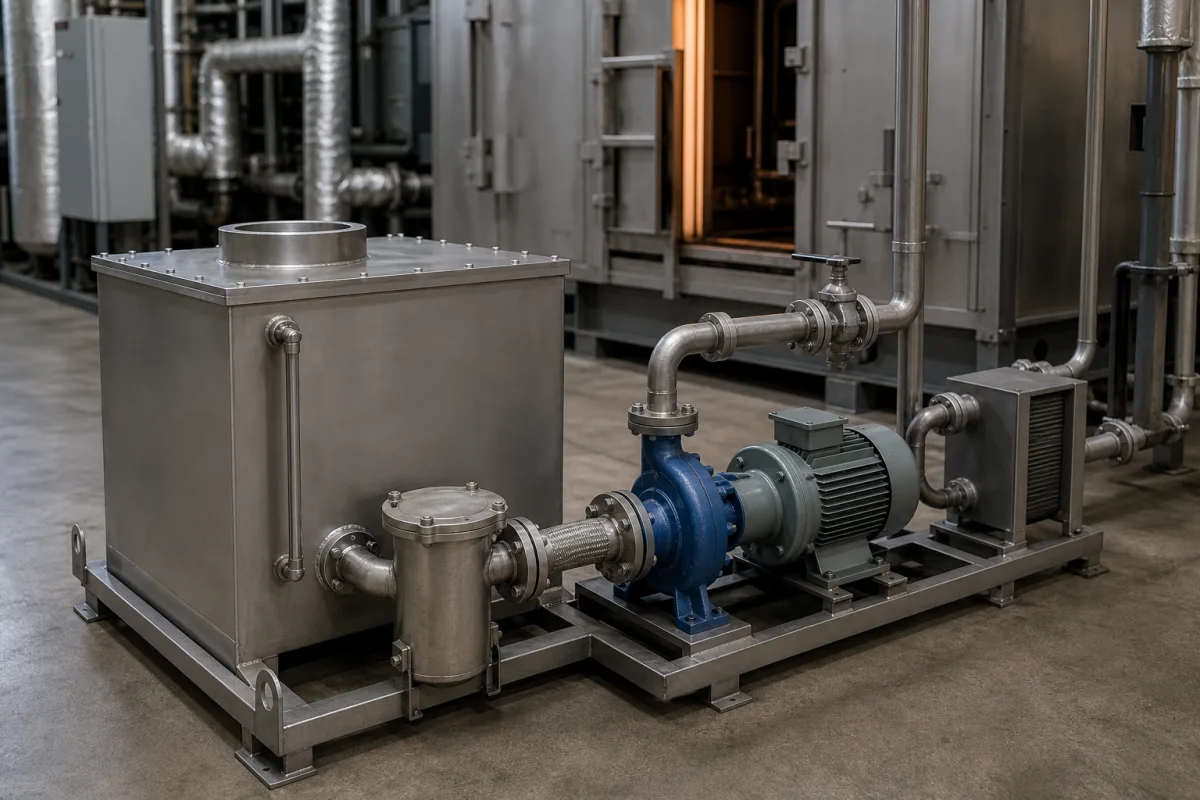
A combined unit that stores and circulates coolant fluid within a quenching system to control temperature during metal heat treatment processes.
Product Specifications

Technical details and manufacturing context for Coolant Reservoir/Pump

Definition
The Coolant Reservoir/Pump is an integrated component of industrial quenching systems, consisting of a storage tank for holding coolant fluid (typically water, oil, or polymer solutions) and a pumping mechanism that circulates this fluid through the system. Its primary function is to maintain consistent coolant flow and temperature during the quenching process, where heated metal parts are rapidly cooled to achieve desired material properties like hardness and strength. The reservoir provides volume capacity and temperature stabilization, while the pump ensures proper fluid circulation and pressure.
Working Principle
The reservoir stores coolant at a controlled temperature, often with cooling coils or heat exchangers. When quenching is initiated, the pump draws coolant from the reservoir and circulates it through spray nozzles or immersion baths to contact hot metal parts. The heated coolant returns to the reservoir where it's cooled before recirculation, creating a closed-loop system that maintains consistent quenching performance.
Common Materials
Stainless Steel, Cast Iron, Polypropylene
Technical Parameters
  • Flow rate capacity of the pump component (L/min) Customizable
Components / BOM
  • Impeller
    Rotating component that moves coolant through the pump
    Material: Stainless Steel
  • Tank Baffles
    Internal plates that control coolant flow and prevent vortex formation
    Material: Stainless Steel
  • Seal Assembly
    Prevents coolant leakage around the pump shaft
    Material: Carbon/Ceramic
Engineering Reasoning
0.5-3.0 bar (gauge pressure), 5-60°C coolant temperature, 10-100 L/min flow rate
Cavitation occurs at NPSHa < 3.0 m, seal failure at shaft speed > 3600 rpm, thermal stress cracking at ΔT > 80°C
Design Rationale: Cavitation due to vapor pressure drop below 0.023 bar at 20°C, bearing fatigue from Hertzian contact stress exceeding 1.2 GPa, polymer seal degradation at Arrhenius activation energy of 80 kJ/mol
Risk Mitigation (FMEA)
Trigger Coolant glycol concentration < 30% by volume
Mode: Freeze expansion cracking of reservoir at -15°C
Strategy: Integrated refractometer with automatic glycol injection maintaining 40-50% concentration
Trigger Impeller imbalance > 0.5 g·mm at 2900 rpm
Mode: Bearing resonance failure at 48 Hz natural frequency
Strategy: Dual-plane dynamic balancing to ISO 1940 G2.5 grade with laser alignment < 0.05 mm offset

Industry Taxonomies & Aliases

Commonly used trade names and technical identifiers for Coolant Reservoir/Pump.

Applied To / Applications

This component is essential for the following industrial systems and equipment:

Industrial Ecosystem & Supply Chain DNA

Complementary Systems
Downstream Applications
Specialized Tooling

Application Fit & Sizing Matrix

Operational Limits
pressure: 0-6 bar (operating), 10 bar (max burst)
flow rate: 5-500 L/min (typical range)
temperature: -20°C to 120°C (operating), -40°C to 150°C (material limits)
slurry concentration: ≤5% solids by weight (max for standard pump)
Media Compatibility
✓ Water-glycol mixtures ✓ Mineral oil-based coolants ✓ Synthetic quench oils
Unsuitable: Highly acidic or caustic solutions (pH <4 or >10)
Sizing Data Required
  • Required cooling capacity (kW)
  • System volume and required circulation rate (L/min)
  • Maximum operating temperature and ambient conditions

Reliability & Engineering Risk Analysis

Failure Mode & Root Cause
Cavitation
Cause: Insufficient net positive suction head (NPSH) due to low coolant level, clogged inlet filter, or excessive pump speed causing vapor bubble formation and implosion damage to impeller and housing.
Seal leakage
Cause: Mechanical seal failure from abrasive particles in coolant, improper alignment causing shaft deflection, or thermal cycling leading to seal face wear and coolant loss.
Maintenance Indicators
  • Unusual high-pitched whining or grinding noise from pump indicating cavitation or bearing failure
  • Visible coolant leakage around pump seals or reservoir connections with dripping or pooling fluid
Engineering Tips
  • Maintain proper coolant level and ensure inlet strainers are clean to prevent cavitation by maintaining adequate NPSH
  • Implement regular coolant filtration and analysis to remove abrasive particles and maintain proper chemical balance to protect seals and internal components

Compliance & Manufacturing Standards

Reference Standards
ISO 1219-1:2012 (Fluid power systems and components) ANSI/ASME B46.1-2019 (Surface Texture) DIN 7150-1:2007 (Tolerances for fits)
Manufacturing Precision
  • Bore diameter: +/-0.02mm
  • Flatness of mounting surface: 0.1mm
Quality Inspection
  • Pressure test: 1.5x operating pressure for 30 minutes
  • Material verification: Spectrographic analysis for alloy composition

Factories Producing Coolant Reservoir/Pump

Verified manufacturers with capability to produce this product in China

✓ 94% Supplier Capability Match Found

P Project Engineer from United Arab Emirates Feb 02, 2026
★★★★★
"Reliable performance in harsh Basic Metal Manufacturing environments. No issues with the Coolant Reservoir/Pump so far."
Technical Specifications Verified
S Sourcing Manager from Australia Jan 30, 2026
★★★★★
"Testing the Coolant Reservoir/Pump now; the technical reliability results are within 1% of the laboratory datasheet."
Technical Specifications Verified
P Procurement Specialist from Singapore Jan 27, 2026
★★★★★
"Impressive build quality. Especially the technical reliability is very stable during long-term operation."
Technical Specifications Verified
Verification Protocol

“Feedback is collected from verified sourcing managers during RFQ (Request for Quote) and factory evaluation processes on CNFX. These reports represent historical performance data and technical audit summaries from our B2B manufacturing network.”

5 sourcing managers are analyzing this specification now. Last inquiry for Coolant Reservoir/Pump from Turkey (1h ago).

Supply Chain Compatible Machinery & Devices

Continuous Casting Machine

Industrial machine for solidifying molten metal into continuous billets/blooms/slabs.

Explore Specs →
Electromagnetic Induction Heater

Industrial heating device using electromagnetic induction for metal processing

Explore Specs →
Vacuum Induction Melting Furnace

Industrial furnace for melting metals under vacuum using electromagnetic induction

Explore Specs →
Electroslag Remelting Furnace

Secondary refining furnace for high-quality metal ingots

Explore Specs →

Frequently Asked Questions

What materials are used in this coolant reservoir/pump construction?

This unit is constructed from durable materials including stainless steel for corrosion resistance, cast iron for structural integrity, and polypropylene for chemical compatibility with various coolant fluids.

How does this coolant reservoir/pump improve metal heat treatment processes?

The combined reservoir and pump system ensures consistent coolant circulation during quenching, maintaining precise temperature control for uniform metal properties and preventing thermal stress defects in treated metals.

What maintenance is required for the seal assembly in this coolant pump?

Regular inspection of the seal assembly is recommended to prevent coolant leaks. Maintenance intervals depend on operating hours and coolant type, typically requiring inspection every 500-1000 hours of operation.

Can I contact factories directly on CNFX?

CNFX is an open directory, not a transaction platform. Each factory profile provides direct contact information and production details to help you initiate direct inquiries with Chinese suppliers.

Get Quote for Coolant Reservoir/Pump

Request technical pricing, lead times, or customized specifications for Coolant Reservoir/Pump directly from verified manufacturing units.

Your business information is encrypted and only shared with verified Coolant Reservoir/Pump suppliers.

Thank you! Your message has been sent. We'll respond within 1–3 business days.

Need to Manufacture Coolant Reservoir/Pump?

Connect with verified factories specializing in this product category

Add Your Factory Contact Us
Previous Product
Conveyor Belt/Trough
Next Product
Cooling Headers (Water/Air)