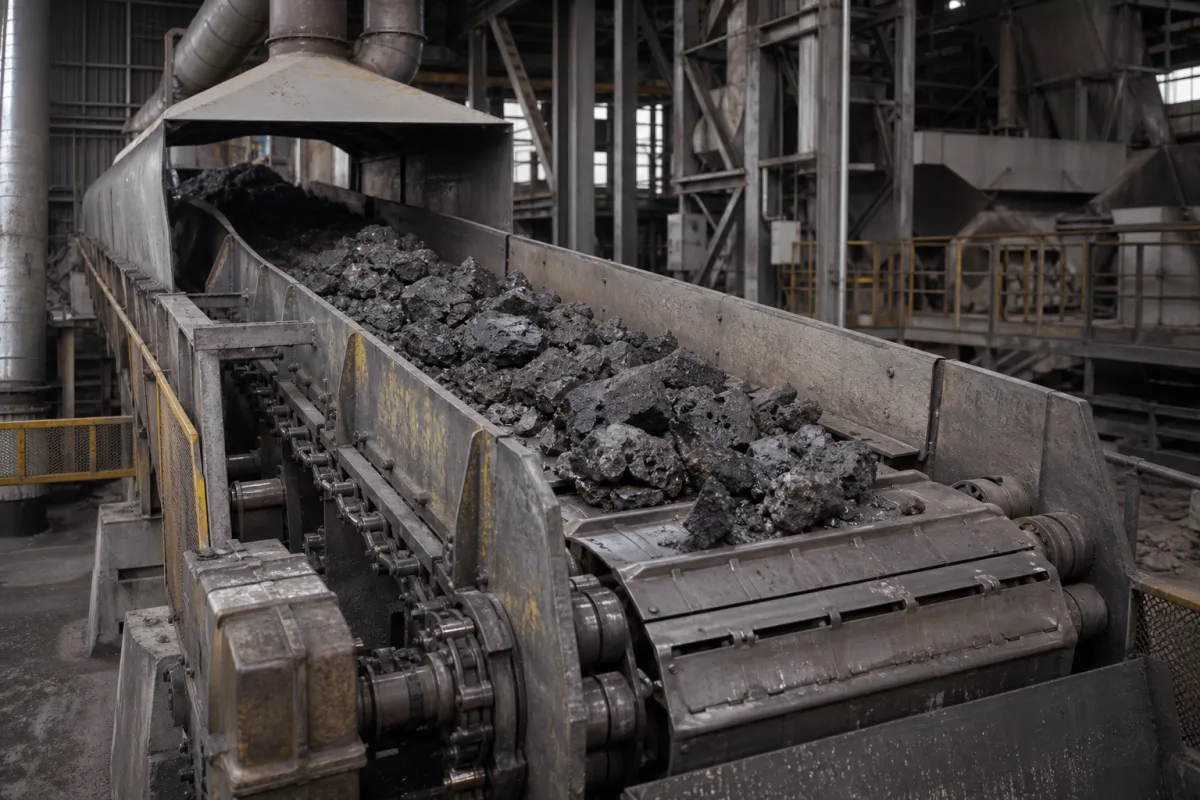
Slag conveyor (steel plate and apron conveyor for hot slag)
Steel plate and apron conveyors for hot slag from metallurgical furnaces · sticking of pasty slag, overlapping hinged plates, material temperature and plate width, molten slag versus solidified slag
A slag conveyor moves hot slag away from a metallurgical furnace: lumps or pasty slag tapped or skimmed from a melting, refining or recycling furnace, carried on steel plates or pans pulled by chains to a cooler, a quench, a pit or a storage silo. The plates must survive the heat, carry abrasive lumps without spillage and release slag that tends to stick. Settle three things first: the state and temperature of the slag when it reaches the conveyor (molten, pasty or solid), how the conveyor will shed slag that sticks to the plates, and the plate width, incline and capacity the route needs.
Steel plate (pan) and apron conveyors on chains that carry hot slag, pasty or solidified, from metallurgical furnaces to coolers, quenches, pits or silos; water-cooled troughs that solidify molten slag are compared. General belt, roller, chain, screw and modular conveyor systems are covered on the Conveyor systems page; modular conveyor sections and transfers on the Conveyor section page. Screw conveyors for brewery or winery pomace, chip conveyors for machine tools and slag ladles or pots are outside this page.
CNFX editorial research · Sources checked October 12, 2026 · 4 sources
Pasty salt slag at about 800 °C: hinged, overlapping plates that knock slag loose
Befesa Aluminio's European patent EP 3 192 754 B1 describes salt slag from the tilting rotary furnaces used to recover secondary aluminium: it leaves the furnace in a pasty state at about 800 °C and is collected in boxes of 1,500 to 2,000 kg. The patent states that no conveyor had evacuated it continuously to a cooler without the slag sticking to the metal plates or compacting, including attempts with horizontal vibrating conveyors. [1]
Before such a conveyor, the patent says the slag was either left to cool in the boxes, which takes more than a day and makes dust when the cold blocks are tipped and broken, or emptied red-hot and spread on the ground, which makes smoke and dust that are hard to control. [1]
The patented conveyor carries steel plates on two parallel chains joined by cross shafts. Each plate is hinged at its leading edge by a thick-walled pipe that turns freely on a shaft, and is slightly longer than twice the chain link length, so it overlaps the next plate. Past the head sprocket the plates separate; once the shaft passes the horizontal through the sprocket centre, each plate falls under its own weight onto a stop bar, breaking off stuck slag into a rotary cooler, and the impact can be adjusted by moving the bar closer to or further from the sprocket. On the first part of the return run the plates swing freely and strike each other. [1]
Tell the supplier the slag type and furnace, its state and temperature at the conveyor inlet, lump size, the batch mass and tapping interval, whether it sticks, and where it goes next (cooler, quench, pit, silo).
02
Material temperature, plate width, incline and capacity of hot-material pan and apron conveyors
The AUMUND and BEUMER figures are for clinker, sinter, DRI/HBI and similar hot bulk materials rather than for slag specifically; ask the supplier for references on the slag in question. AUMUND's hot-metal version adds an inert gas system against re-oxidation. [2][3]
Editorial calculation: at BEUMER's maximum 0.6 m/s, slag takes 250 ÷ 0.6 ≈ 420 s, about 7 minutes, to travel a 250 m conveyor, which is the time the plates spend loaded with hot slag on each pass. [3]
Molten slag at 2,400–2,800 °F: cooled troughs that solidify it before conveying
A Budd Company patent, US 4,522,377, describes molten metallurgical slag at about 2,400 to 2,800 °F poured onto a steel trough that is moved back and forth lengthwise. The trough is cooled from below by a water pan with serpentine baffles, so that no water touches the slag, and the slag solidifies and breaks into pieces as it travels. [4]
In its example the trough is about 14 ft long and 2 ft wide, the baffles are about 1-3/8 to 1-5/8 in apart and 1/2 in high, inlet water is kept as cold as possible (about 60 °F), and the solidified slag sheets are about 10 in across. [4] Editorial calculation: 2,400–2,800 °F is about 1,316–1,538 °C, well above the 800 °C pasty salt slag in the Befesa patent and the 1,100 °C top of AUMUND's hot DRI conveyors. [1][2]
Editorial note: a plate or apron conveyor of the kind above takes slag that is already solid or pasty; molten slag needs a quench, a cooling bed or a cooled trough first, and the transfer point between them must be specified.
04
Send the slag, its temperature and the route
Paste it into your enquiry below or into an email to a maker, then replace every bracket.
Slag: [type; source furnace; lump size; sticking tendency]
State at inlet: [molten, pasty or solid; temperature]
Quantity: [t/h or m³/h; batch mass; tapping interval]
Route: [length; incline; transfer points; destination]
Conveyor: [plate or cell width; plate overlap; chain type]
Release: [knock-off or stop bar; cleaning of return run]
Enclosure: [hood; dust and fume extraction; inert gas]
Explore company information and manufacturing capabilities, then discuss the scope of your project with a relevant supplier.
Share this page
Compiled and source-reviewed by the CNFX editorial team.
Each manufacturer above links to the page on that company's own website where the product is listed, with the date we checked it. How we source and review
· Page last updated 13 October 2026
Buyer questions
Why does hot slag stick to conveyor plates?
Befesa's patent describes salt slag leaving aluminium rotary furnaces pasty at about 800 °C and sticking to plates or compacting on vibrating conveyors; its conveyor drops hinged plates onto a stop bar to knock it free. [1]
How hot can apron and pan conveyors run?
BEUMER lists apron conveyors for up to 700 °C and higher; AUMUND lists hot DRI/HBI versions for material up to 1,100 °C. [3][2]
Can molten slag go straight onto a conveyor?
The Budd patent pours slag at about 2,400–2,800 °F onto a water-cooled reciprocating trough so it solidifies and breaks up before further handling. [4]
Sources and what still needs a direct check
Sources checked 2026-10-12. The Befesa and Budd documents are patents describing their applicants' designs; AUMUND and BEUMER describe their own hot-material conveyors. Capacities and temperatures are maker or patent statements for the stated materials.