Industry-Verified Manufacturing Data (2026)

Flying Shear or Saw

Based on aggregated insights from multiple verified factory profiles within the CNFX directory, the standard Flying Shear or Saw used in the Basic Metal Manufacturing sector typically supports operational capacities ranging from standard industrial configurations to heavy-duty production requirements.

Technical Definition & Core Assembly

A canonical Flying Shear or Saw is characterized by the integration of Cutting Blade / Saw Disc and Hydraulic/Servo Actuator. In industrial production environments, manufacturers listed on CNFX commonly emphasize High-Speed Tool Steel construction to support stable, high-cycle operation across diverse manufacturing scenarios.

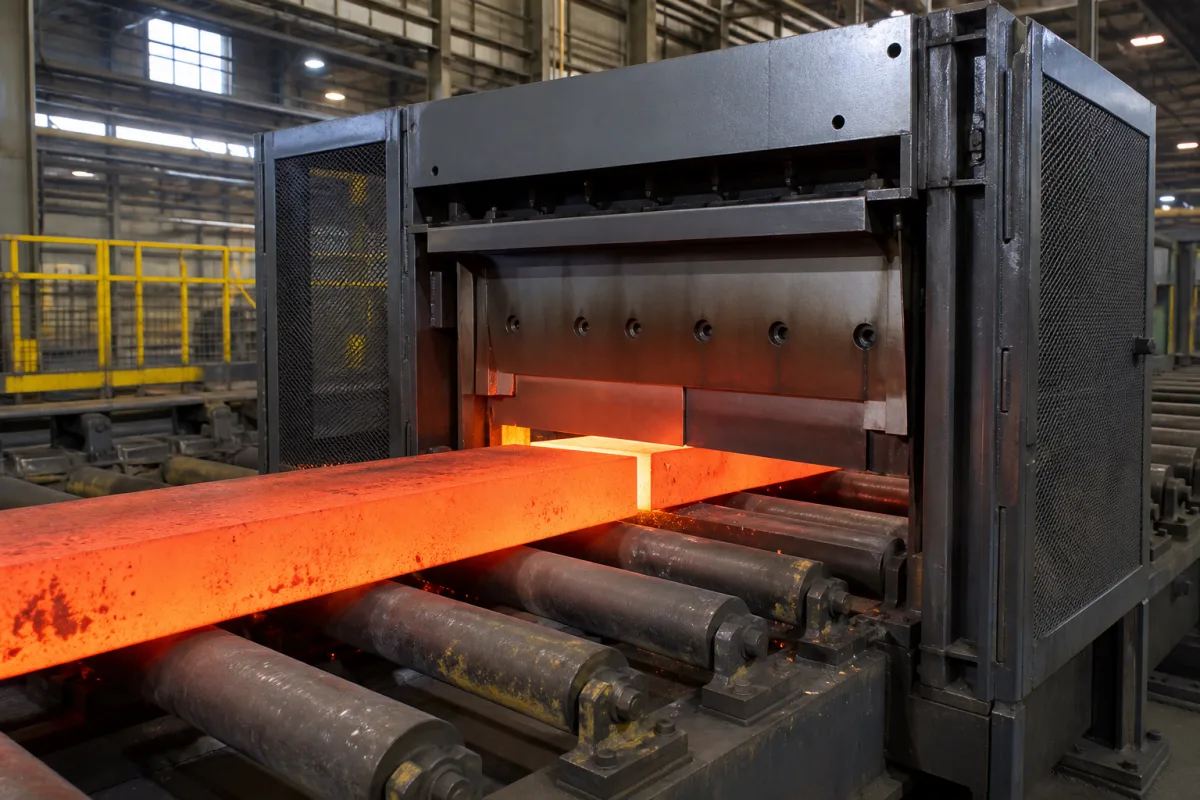
A high-speed cutting device that shears or saws continuously cast non-ferrous alloy billets or slabs while they are in motion.
Product Specifications

Technical details and manufacturing context for Flying Shear or Saw

Definition
In the Smart Continuous Casting System for Non-Ferrous Alloys, the Flying Shear or Saw is a critical component responsible for cutting the continuously cast strand into predetermined lengths without stopping the casting process. It operates in synchronization with the strand's movement, ensuring precise, clean cuts that maintain product quality and enable efficient downstream handling.
Working Principle
The device tracks the speed of the moving cast strand. When a predetermined length is reached, a high-speed hydraulic or servo-electric mechanism rapidly drives a shear blade or circular saw across the strand's path to perform the cut. It then retracts quickly to avoid interfering with the next section of the continuously moving product.
Common Materials
High-Speed Tool Steel, Tungsten Carbide
Technical Parameters
  • Maximum cross-sectional dimension (width/height/diameter) of the cast product it can cut. (mm) Per Request
Components / BOM
  • Cutting Blade / Saw Disc
    The primary tool that contacts and severs the cast metal strand.
    Material: High-Speed Tool Steel or Tungsten Carbide
  • Hydraulic/Servo Actuator
    Provides the high-speed, high-force linear motion to drive the cutting tool across the strand.
    Material: Steel Alloy
  • Guide Rails & Carriage
    Ensures precise, linear travel of the cutting head during the shear/saw stroke.
    Material: Hardened Steel
  • Control System Interface
    Receives signals from the casting line's master controller to initiate cuts at the correct time based on strand length and speed.
    Material: Electronic Components, Aluminum/Steel Enclosure
Engineering Reasoning
Cutting force: 15-80 kN, Blade speed: 1.5-4.0 m/s, Material feed rate: 0.8-2.5 m/s, Hydraulic pressure: 160-250 bar
Blade temperature exceeding 450°C (for carbide-tipped blades) or 650°C (for ceramic-coated blades), Cutting force exceeding 95 kN, Blade deflection exceeding 0.15 mm at cutting edge
Design Rationale: Thermal fatigue from cyclic heating during cutting and cooling during idle periods, combined with mechanical fatigue from impact loading at material contact initiation. The von Mises stress concentration at blade tooth roots exceeds material yield strength (typically 1200-1800 MPa for cutting alloys) when temperature-induced softening reduces material hardness below 45 HRC.
Risk Mitigation (FMEA)
Trigger Hydraulic fluid contamination exceeding ISO 4406 18/16/13 cleanliness level, causing servo valve stiction
Mode: Positional accuracy loss exceeding ±0.5 mm tolerance, resulting in incomplete cuts or material jamming
Strategy: Install dual 3-micron absolute filtration with differential pressure monitoring and automatic bypass at 1.5 bar ΔP
Trigger Resonance excitation at blade natural frequency (typically 85-120 Hz) due to material feed rate synchronization
Mode: Accelerated blade tooth wear exceeding 0.02 mm/hour, leading to cutting force increase beyond servo capacity
Strategy: Implement active damping with piezoelectric actuators tuned to blade's first bending mode, coupled with real-time FFT analysis of vibration spectra

Industry Taxonomies & Aliases

Commonly used trade names and technical identifiers for Flying Shear or Saw.

Industrial Ecosystem & Supply Chain DNA

Complementary Systems
Downstream Applications
Specialized Tooling

Application Fit & Sizing Matrix

Operational Limits
pressure: N/A (mechanical cutting device, not pressure-dependent)
other spec: Cutting speed: 0.5-5 m/s, Material thickness: 50-500 mm, Production line speed: 0.1-3 m/s, Blade life: 10,000-100,000 cuts depending on material hardness
temperature: Ambient to 200°C (392°F) for standard models, up to 400°C (752°F) with high-temperature blade materials and cooling systems
Media Compatibility
✓ Aluminum alloys (e.g., 6061, 7075) ✓ Copper alloys (e.g., brass, bronze) ✓ Lead-free solder alloys
Unsuitable: Ferrous materials (steel, iron) - requires specialized hardened blades and significantly reduces blade life
Sizing Data Required
  • Production line speed (m/s or fpm)
  • Billet/slab cross-sectional dimensions (width x thickness in mm)
  • Required cut length accuracy (± mm)

Reliability & Engineering Risk Analysis

Failure Mode & Root Cause
Blade wear and dulling
Cause: Abrasive contact with materials, improper blade selection for material hardness, or excessive feed rates causing accelerated wear.
Misalignment or tracking issues
Cause: Worn guide rollers or bearings, improper tensioning of the blade or shear mechanism, or structural fatigue in the frame leading to imprecise cutting.
Maintenance Indicators
  • Irregular or jagged cuts indicating blade wear or misalignment
  • Unusual vibrations, knocking sounds, or increased noise during operation signaling mechanical issues
Engineering Tips
  • Implement a strict blade inspection and rotation schedule, using hardness-matched blades for specific materials to reduce wear.
  • Regularly calibrate alignment and tension, and monitor guide components for wear to maintain cutting precision and prevent premature failure.

Compliance & Manufacturing Standards

Reference Standards
ISO 12100:2010 - Safety of machinery ANSI B11.19 - Performance criteria for safeguarding CE Marking - Machinery Directive 2006/42/EC
Manufacturing Precision
  • Cutting Edge Alignment: +/-0.05mm
  • Blade Runout: 0.1mm maximum
Quality Inspection
  • Non-Destructive Testing (NDT) - Magnetic Particle Inspection
  • Dimensional Verification - Coordinate Measuring Machine (CMM) Analysis

Factories Producing Flying Shear or Saw

Verified manufacturers with capability to produce this product in China

✓ 95% Supplier Capability Match Found

S Sourcing Manager from Brazil Jan 28, 2026
★★★★★
"Standard OEM quality for Basic Metal Manufacturing applications. The Flying Shear or Saw arrived with full certification."
Technical Specifications Verified
P Procurement Specialist from Canada Jan 25, 2026
★★★★☆
"Great transparency on the Flying Shear or Saw components. Essential for our Basic Metal Manufacturing supply chain. (Delivery took slightly longer than expected, but technical support was excellent.)"
Technical Specifications Verified
T Technical Director from United States Jan 22, 2026
★★★★★
"The Flying Shear or Saw we sourced perfectly fits our Basic Metal Manufacturing production line requirements."
Technical Specifications Verified
Verification Protocol

“Feedback is collected from verified sourcing managers during RFQ (Request for Quote) and factory evaluation processes on CNFX. These reports represent historical performance data and technical audit summaries from our B2B manufacturing network.”

10 sourcing managers are analyzing this specification now. Last inquiry for Flying Shear or Saw from Germany (1h ago).

Supply Chain Compatible Machinery & Devices

Vacuum Induction Melting Furnace

Industrial furnace for melting metals under vacuum using electromagnetic induction

Explore Specs →
Electroslag Remelting Furnace

Secondary refining furnace for high-quality metal ingots

Explore Specs →
Molten Metal Flow Control Valve

Precision valve for regulating molten metal flow in casting and pouring operations.

Explore Specs →
Molten Metal Temperature Measurement System

Automated system for continuous temperature monitoring of molten metals during processing.

Explore Specs →

Frequently Asked Questions

What materials can this flying shear cut effectively?

This flying shear is specifically designed for cutting continuously cast non-ferrous alloy billets and slabs, including aluminum, copper, and brass alloys, while maintaining high-speed operation without stopping production flow.

How does the servo control system improve cutting accuracy?

The servo actuator system provides precise speed synchronization with moving billets, enabling accurate length control and clean cuts at production line speeds, reducing material waste and improving product consistency.

What maintenance is required for tungsten carbide cutting blades?

Tungsten carbide blades offer extended service life with minimal maintenance. Regular inspection for wear, proper lubrication of guide systems, and periodic sharpening by qualified technicians will ensure optimal performance and longevity.

Can I contact factories directly on CNFX?

CNFX is an open directory, not a transaction platform. Each factory profile provides direct contact information and production details to help you initiate direct inquiries with Chinese suppliers.

Get Quote for Flying Shear or Saw

Request technical pricing, lead times, or customized specifications for Flying Shear or Saw directly from verified manufacturing units.

Your business information is encrypted and only shared with verified Flying Shear or Saw suppliers.

Thank you! Your message has been sent. We'll respond within 1–3 business days.

Need to Manufacture Flying Shear or Saw?

Connect with verified factories specializing in this product category

Add Your Factory Contact Us
Previous Product
Flow Control Mechanism
Next Product
Forged Steel Flange