Industry-Verified Manufacturing Data (2026)

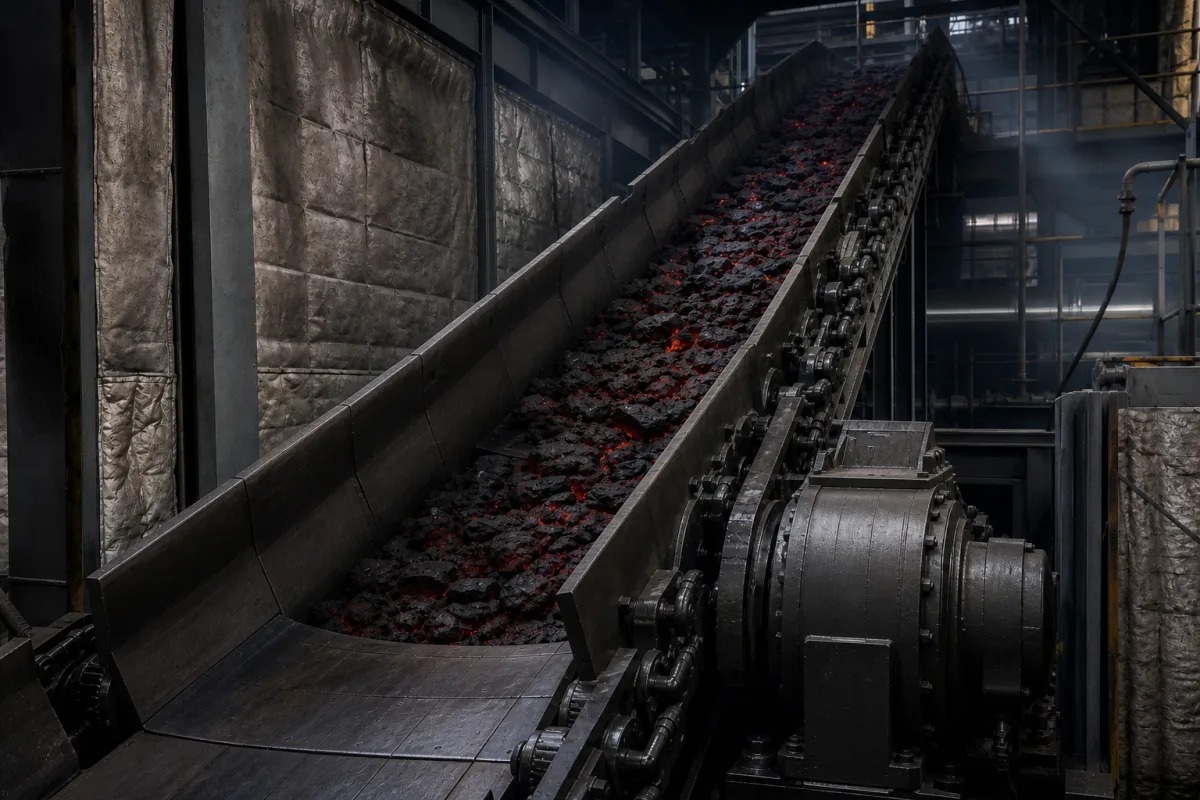
Heat-resistant Conveyor Belt

Based on aggregated insights from multiple verified factory profiles within the CNFX directory, the standard Heat-resistant Conveyor Belt used in the Basic Metal Manufacturing sector typically supports operational capacities ranging from standard industrial configurations to heavy-duty production requirements.

Technical Definition & Core Assembly

A canonical Heat-resistant Conveyor Belt is characterized by the integration of Top cover and Carcass. In industrial production environments, manufacturers listed on CNFX commonly emphasize Heat-resistant rubber compound construction to support stable, high-cycle operation across diverse manufacturing scenarios.

A specialized conveyor belt designed to withstand high temperatures while transporting hot materials.
Product Specifications

Technical details and manufacturing context for Heat-resistant Conveyor Belt

Definition
A critical component of the Slag Cooling Conveyor system, the heat-resistant conveyor belt is engineered to continuously transport hot slag from furnaces or processing units to cooling areas. It operates under extreme thermal conditions, preventing material degradation and maintaining structural integrity during the slag handling process.
Working Principle
The belt moves continuously on rollers, carrying hot slag along the conveyor path. Its heat-resistant properties prevent melting, deformation, or excessive wear when exposed to high-temperature materials, ensuring reliable transport through the cooling stages.
Common Materials
Heat-resistant rubber compound, Steel cord reinforcement, Fiberglass fabric
Technical Parameters
  • Belt thickness and width specifications (mm) Per Request
Components / BOM
  • Top cover
    Provides wear resistance and protects against heat and abrasion from hot slag
    Material: Heat-resistant rubber compound
  • Carcass
    Provides tensile strength and dimensional stability under load and heat
    Material: Steel cord or fabric reinforcement
  • Bottom cover
    Protects the carcass from friction with conveyor rollers and supports
    Material: Rubber compound
Engineering Reasoning
80-250°C continuous operation, 300°C peak for 15 minutes
Polymer decomposition at 320°C (onset of thermal degradation in chloroprene rubber), tensile strength reduction to 50% of original at 280°C sustained for 2 hours
Design Rationale: Chain scission in polymer backbone due to thermal energy exceeding bond dissociation energy (C-C bond ~347 kJ/mol), accelerated by oxidative degradation at high temperatures
Risk Mitigation (FMEA)
Trigger Material temperature exceeding 280°C for >120 minutes
Mode: Polymer embrittlement leading to longitudinal cracking along belt centerline
Strategy: Embedded fiberglass reinforcement with 3:1 warp-to-weft ratio and ceramic coating on underside
Trigger Thermal cycling between 80-250°C at >5 cycles/hour
Mode: Delamination of top cover from carcass at splice joints
Strategy: Vulcanized splice design with stepped ply construction and high-temperature adhesive (phenolic resin based)

Industry Taxonomies & Aliases

Commonly used trade names and technical identifiers for Heat-resistant Conveyor Belt.

Applied To / Applications

This component is essential for the following industrial systems and equipment:

Industrial Ecosystem & Supply Chain DNA

Complementary Systems
Downstream Applications
Specialized Tooling

Application Fit & Sizing Matrix

Operational Limits
pressure: Max 150 psi belt tension
other spec: Max belt speed: 2.5 m/s, Min pulley diameter: 400 mm
temperature: Up to 400°C continuous, 500°C intermittent
Media Compatibility
✓ Hot cement clinker ✓ Metal castings ✓ Ceramic kiln products
Unsuitable: Highly acidic chemical slurries
Sizing Data Required
  • Material temperature profile (°C)
  • Belt width requirement (mm)
  • Required throughput capacity (tons/hour)

Reliability & Engineering Risk Analysis

Failure Mode & Root Cause
Thermal degradation and delamination
Cause: Exposure to temperatures exceeding the belt's rated heat resistance, causing breakdown of rubber compounds and separation of plies or covers from the carcass.
Edge wear and longitudinal tearing
Cause: Misalignment, tracking issues, or material spillage leading to friction against conveyor structure, compounded by heat-induced material embrittlement.
Maintenance Indicators
  • Visible surface cracking, blistering, or glazing indicating thermal overexposure
  • Audible squealing or irregular noise during operation suggesting tracking problems or excessive friction
Engineering Tips
  • Implement infrared temperature monitoring at critical points to ensure operating temperatures remain within the belt's specified range, preventing thermal degradation.
  • Regularly inspect and adjust belt tracking systems and install effective scrapers/cleaners to prevent material buildup and edge wear.

Compliance & Manufacturing Standards

Reference Standards
ISO 14890:2013 - Conveyor belts - Specification for rubber- or plastics-covered conveyor belts of textile construction for general use ASTM D378 - Standard Test Methods for Rubber (Elastomeric) Conveyor Belting, Flat Type CE Marking - Compliance with EU Machinery Directive 2006/42/EC for safety requirements
Manufacturing Precision
  • Belt Thickness: +/- 0.5 mm
  • Edge Straightness: 5 mm per 10 m length
Quality Inspection
  • Tensile Strength Test - ASTM D378 Method A
  • Heat Resistance Test - ISO 4195:2010 for elevated temperature performance

Factories Producing Heat-resistant Conveyor Belt

Verified manufacturers with capability to produce this product in China

✓ 94% Supplier Capability Match Found

P Project Engineer from United Arab Emirates Jan 25, 2026
★★★★★
"Testing the Heat-resistant Conveyor Belt now; the technical reliability results are within 1% of the laboratory datasheet."
Technical Specifications Verified
S Sourcing Manager from Australia Jan 22, 2026
★★★★★
"Impressive build quality. Especially the technical reliability is very stable during long-term operation."
Technical Specifications Verified
P Procurement Specialist from Singapore Jan 19, 2026
★★★★★
"As a professional in the Basic Metal Manufacturing sector, I confirm this Heat-resistant Conveyor Belt meets all ISO standards."
Technical Specifications Verified
Verification Protocol

“Feedback is collected from verified sourcing managers during RFQ (Request for Quote) and factory evaluation processes on CNFX. These reports represent historical performance data and technical audit summaries from our B2B manufacturing network.”

16 sourcing managers are analyzing this specification now. Last inquiry for Heat-resistant Conveyor Belt from Brazil (1h ago).

Supply Chain Compatible Machinery & Devices

Vacuum Induction Melting Furnace

Industrial furnace for melting metals under vacuum using electromagnetic induction

Explore Specs →
Electroslag Remelting Furnace

Secondary refining furnace for high-quality metal ingots

Explore Specs →
Molten Metal Flow Control Valve

Precision valve for regulating molten metal flow in casting and pouring operations.

Explore Specs →
Molten Metal Temperature Measurement System

Automated system for continuous temperature monitoring of molten metals during processing.

Explore Specs →

Frequently Asked Questions

What maximum temperature can this heat-resistant conveyor belt withstand?

Our heat-resistant conveyor belts are engineered to withstand continuous operating temperatures up to 400°F (204°C), with peak resistance up to 500°F (260°C) for short durations, making them ideal for basic metal manufacturing applications.

How does the steel cord reinforcement improve belt performance?

The steel cord reinforcement provides exceptional tensile strength, dimensional stability, and impact resistance, ensuring reliable performance when transporting heavy, hot materials in metal manufacturing environments while maintaining flexibility and durability.

What maintenance is required for heat-resistant conveyor belts in metal plants?

Regular inspection for wear, proper tensioning, and cleaning to remove material buildup are essential. The heat-resistant rubber compound and fiberglass fabric construction minimize degradation, but following manufacturer guidelines for your specific metal processing application ensures optimal lifespan.

Can I contact factories directly on CNFX?

CNFX is an open directory, not a transaction platform. Each factory profile provides direct contact information and production details to help you initiate direct inquiries with Chinese suppliers.

Get Quote for Heat-resistant Conveyor Belt

Request technical pricing, lead times, or customized specifications for Heat-resistant Conveyor Belt directly from verified manufacturing units.

Your business information is encrypted and only shared with verified Heat-resistant Conveyor Belt suppliers.

Thank you! Your message has been sent. We'll respond within 1–3 business days.

Need to Manufacture Heat-resistant Conveyor Belt?

Connect with verified factories specializing in this product category

Add Your Factory Contact Us
Previous Product
Hearth Bottom
Next Product
Heating Element Bank