Industry-Verified Manufacturing Data (2026)

Heating Element Bank

Based on aggregated insights from multiple verified factory profiles within the CNFX directory, the standard Heating Element Bank used in the Basic Metal Manufacturing sector typically supports operational capacities ranging from standard industrial configurations to heavy-duty production requirements.

Technical Definition & Core Assembly

A canonical Heating Element Bank is characterized by the integration of Heating Element and Terminal Block / Connection Box. In industrial production environments, manufacturers listed on CNFX commonly emphasize Nickel-Chromium (NiCr) Alloy (e.g., Inconel) construction to support stable, high-cycle operation across diverse manufacturing scenarios.

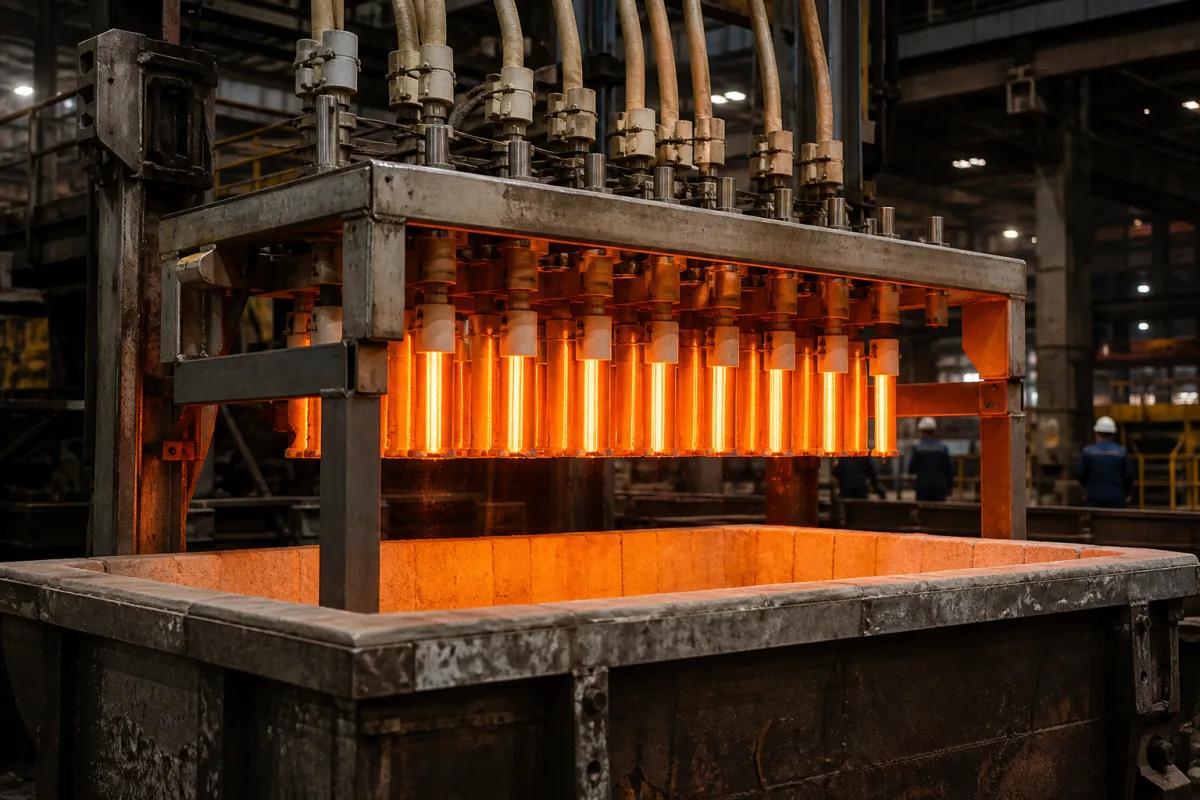
A modular assembly of multiple heating elements designed to provide controlled thermal energy to pre-heat the tundish.
Product Specifications

Technical details and manufacturing context for Heating Element Bank

Definition
The Heating Element Bank is a critical component within the Tundish with Pre-Heating system. It consists of an array of individual resistive heating elements arranged in a bank or cluster configuration. Its primary function is to uniformly raise and maintain the temperature of the tundish lining and internal surfaces to a specified setpoint before molten metal is introduced, preventing thermal shock, ensuring proper metal flow characteristics, and reducing energy consumption during the initial casting phase.
Working Principle
Electrical energy is converted into thermal energy (heat) through the principle of Joule heating (resistive heating). When an electric current passes through the high-resistance alloy wires or ribbons within each element, the electrical resistance generates heat. This bank of elements is controlled via a power regulation system (often SCR-based) to deliver precise, adjustable heat output to the tundish structure.
Common Materials
Nickel-Chromium (NiCr) Alloy (e.g., Inconel), Iron-Chromium-Aluminum (FeCrAl) Alloy (e.g., Kanthal), Ceramic Insulators (e.g., Alumina), Stainless Steel Mounting Hardware
Technical Parameters
  • Total rated power output of the entire bank. (kW) Customizable
Components / BOM
  • Heating Element
    The core resistive unit that converts electrical energy to heat. Typically a coiled alloy wire or ribbon embedded in ceramic or housed in a metal sheath.
    Material: NiCr or FeCrAl Alloy, Magnesium Oxide (MgO) insulation
  • Terminal Block / Connection Box
    Provides secure, insulated electrical connections for power supply cables to the element bank.
    Material: Stainless Steel, Ceramic
  • Mounting Frame / Bracket
    Structural support that holds the array of heating elements in the correct position relative to the tundish walls.
    Material: Heat-resistant Stainless Steel
  • Thermal Insulation / Reflector
    Minimizes heat loss to the environment and directs thermal radiation towards the tundish.
    Material: Ceramic Fiber, Aluminized Steel
Engineering Reasoning
800-1200°C surface temperature, 380-480V AC input, 15-25 kW thermal output
1350°C element surface temperature, 550V AC input voltage, 30 kW continuous thermal load
Design Rationale: Nickel-chromium alloy embrittlement at 0.8Tm (melting point), insulation breakdown at 600V dielectric strength, refractory spalling at 1400°C
Risk Mitigation (FMEA)
Trigger Phase imbalance exceeding 15% voltage differential
Mode: Differential thermal expansion causing element fracture at 0.3% strain mismatch
Strategy: Three-phase monitoring relay with 10% imbalance trip, balanced impedance wiring layout
Trigger Moisture ingress exceeding 85% relative humidity at 150°C
Mode: Ceramic insulator tracking failure at 0.5 mA leakage current
Strategy: IP65-rated enclosure with positive pressure nitrogen purge at 1.2 bar

Industry Taxonomies & Aliases

Commonly used trade names and technical identifiers for Heating Element Bank.

Applied To / Applications

This component is essential for the following industrial systems and equipment:

Industrial Ecosystem & Supply Chain DNA

Complementary Systems
Downstream Applications
Specialized Tooling

Application Fit & Sizing Matrix

Operational Limits
pressure: Atmospheric to 10 bar (gauge), depending on housing design
flow rate: 0.5 to 50 m³/h per module, scalable with bank configuration
temperature: Ambient to 1200°C (typical), up to 1500°C with special alloys
slurry concentration: Up to 60% solids by weight, particle size <2 mm
Media Compatibility
✓ Molten steel/slag (tundish pre-heating) ✓ Thermal oils (heat transfer fluids) ✓ High-temperature air/gas streams
Unsuitable: Chloride-rich or highly acidic environments (risk of corrosion/embrittlement)
Sizing Data Required
  • Required thermal power (kW) for target temperature rise
  • Tundish volume and material throughput (tons/hour)
  • Available electrical supply (voltage, phase, power capacity)

Reliability & Engineering Risk Analysis

Failure Mode & Root Cause
Thermal fatigue cracking
Cause: Repeated heating/cooling cycles causing expansion/contraction stress, exacerbated by rapid temperature changes or poor element support
Insulation breakdown
Cause: Moisture ingress, contamination buildup, or overheating degrading electrical insulation between elements and housing
Maintenance Indicators
  • Visible hot spots or discoloration patterns on element surfaces indicating uneven heating
  • Audible arcing/crackling sounds or intermittent operation suggesting electrical faults
Engineering Tips
  • Implement controlled ramp-up/cooldown procedures to minimize thermal shock stress
  • Establish regular infrared thermography inspections to detect early-stage hot spots and insulation degradation

Compliance & Manufacturing Standards

Reference Standards
ISO 9001:2015 - Quality Management Systems IEC 60335-2-30 - Safety for household and similar electrical appliances ASTM B863 - Standard Specification for Titanium and Titanium Alloy Wire
Manufacturing Precision
  • Resistance: +/- 5% of nominal value
  • Element straightness: 0.5mm per 300mm length
Quality Inspection
  • Insulation Resistance Test (minimum 100 MΩ at 500V DC)
  • Leakage Current Test (maximum 0.75mA at rated voltage)

Factories Producing Heating Element Bank

Verified manufacturers with capability to produce this product in China

✓ 92% Supplier Capability Match Found

P Procurement Specialist from United States Feb 20, 2026
★★★★★
"As a professional in the Basic Metal Manufacturing sector, I confirm this Heating Element Bank meets all ISO standards."
Technical Specifications Verified
T Technical Director from United Arab Emirates Feb 17, 2026
★★★★★
"Standard OEM quality for Basic Metal Manufacturing applications. The Heating Element Bank arrived with full certification."
Technical Specifications Verified
P Project Engineer from Australia Feb 14, 2026
★★★★★
"Great transparency on the Heating Element Bank components. Essential for our Basic Metal Manufacturing supply chain."
Technical Specifications Verified
Verification Protocol

“Feedback is collected from verified sourcing managers during RFQ (Request for Quote) and factory evaluation processes on CNFX. These reports represent historical performance data and technical audit summaries from our B2B manufacturing network.”

17 sourcing managers are analyzing this specification now. Last inquiry for Heating Element Bank from Thailand (1h ago).

Supply Chain Compatible Machinery & Devices

Continuous Casting Machine

Industrial machine for solidifying molten metal into continuous billets/blooms/slabs.

Explore Specs →
Electromagnetic Induction Heater

Industrial heating device using electromagnetic induction for metal processing

Explore Specs →
Vacuum Induction Melting Furnace

Industrial furnace for melting metals under vacuum using electromagnetic induction

Explore Specs →
Electroslag Remelting Furnace

Secondary refining furnace for high-quality metal ingots

Explore Specs →

Frequently Asked Questions

What are the main advantages of using a modular heating element bank for tundish pre-heating?

Modular heating element banks provide precise temperature control, easy maintenance through individual element replacement, uniform heat distribution across the tundish, and scalability to match different production requirements in basic metal manufacturing.

How do nickel-chromium and iron-chromium-aluminum alloys compare in heating element performance?

Nickel-chromium (NiCr) alloys like Inconel offer excellent oxidation resistance and stability at high temperatures (up to 1200°C), while iron-chromium-aluminum (FeCrAl) alloys like Kanthal provide higher maximum operating temperatures (up to 1400°C) and better resistance to sulfur atmospheres, making material selection dependent on specific process conditions.

What maintenance considerations are important for heating element banks in metal manufacturing environments?

Regular inspection for oxidation/corrosion, checking electrical connections for tightness, monitoring insulation integrity, cleaning to prevent buildup of metal dust or oxides, and scheduled replacement of individual elements to maintain optimal thermal efficiency and prevent unexpected downtime.

Can I contact factories directly on CNFX?

CNFX is an open directory, not a transaction platform. Each factory profile provides direct contact information and production details to help you initiate direct inquiries with Chinese suppliers.

Get Quote for Heating Element Bank

Request technical pricing, lead times, or customized specifications for Heating Element Bank directly from verified manufacturing units.

Your business information is encrypted and only shared with verified Heating Element Bank suppliers.

Thank you! Your message has been sent. We'll respond within 1–3 business days.

Need to Manufacture Heating Element Bank?

Connect with verified factories specializing in this product category

Add Your Factory Contact Us
Previous Product
Heat-resistant Conveyor Belt
Next Product
Heating/Insulation System