Industry-Verified Manufacturing Data (2026)

Idlers/Rollers

Based on aggregated insights from multiple verified factory profiles within the CNFX directory, the standard Idlers/Rollers used in the Basic Metal Manufacturing sector typically supports operational capacities ranging from standard industrial configurations to heavy-duty production requirements.

Technical Definition & Core Assembly

A canonical Idlers/Rollers is characterized by the integration of Roller Barrel and Shaft. In industrial production environments, manufacturers listed on CNFX commonly emphasize Carbon Steel construction to support stable, high-cycle operation across diverse manufacturing scenarios.

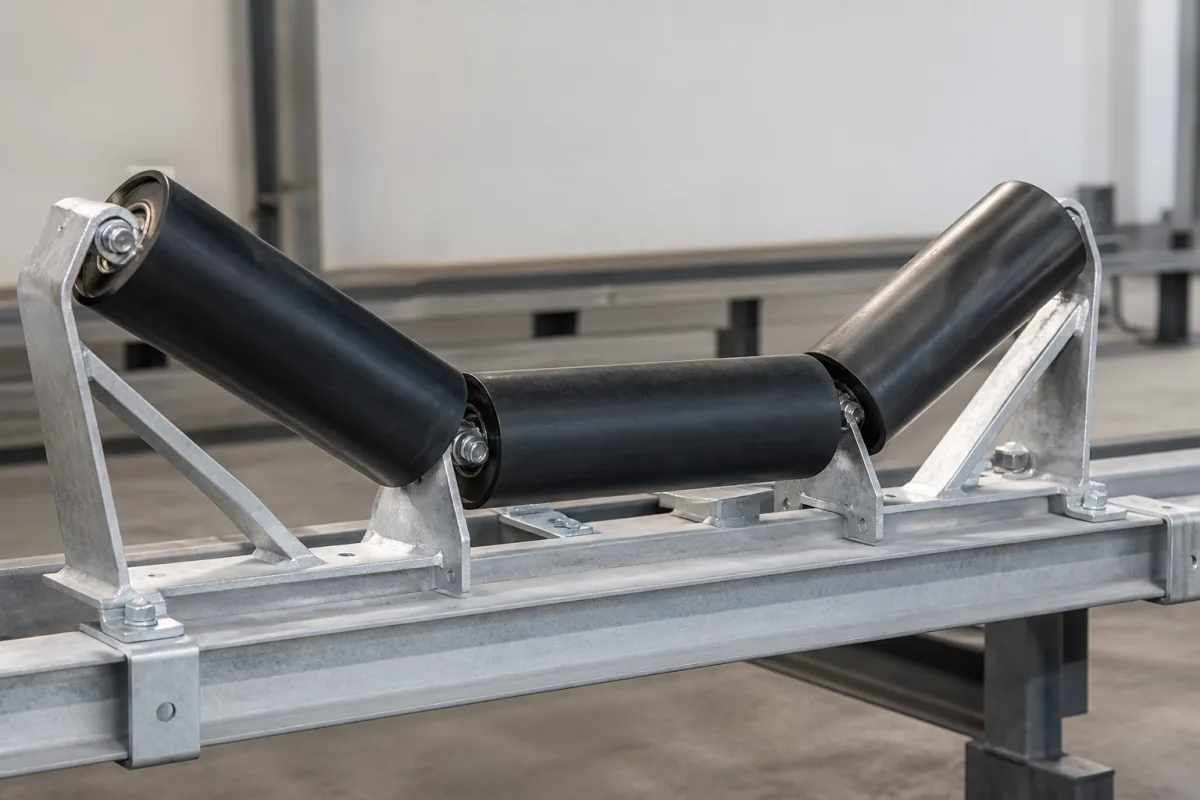
Supporting rollers that carry and guide conveyor belts in slag handling systems.
Product Specifications

Technical details and manufacturing context for Idlers/Rollers

Definition
Idlers/Rollers are cylindrical rotating components installed along the length of a slag conveyor system. They provide continuous support to the conveyor belt, reducing friction and wear while maintaining proper belt alignment and tension. In slag conveyor applications, these components must withstand high temperatures, abrasive slag materials, and heavy loads while ensuring smooth material transport from furnaces or processing units to disposal or recycling areas.
Working Principle
Idlers/Rollers rotate on bearings as the conveyor belt moves over them, converting sliding friction into rolling friction. This reduces energy consumption and belt wear. They maintain the belt's trough shape for efficient material containment and provide consistent support along the conveyor's length, preventing belt sag and ensuring stable slag transport.
Common Materials
Carbon Steel, Alloy Steel, Heat-resistant Steel
Technical Parameters
  • Diameter and length of the roller barrel (mm) Standard Spec
Components / BOM
  • Roller Barrel
    Main cylindrical body that contacts and supports the conveyor belt
    Material: Steel
  • Shaft
    Central axle that transfers rotational force and supports the barrel
    Material: Alloy Steel
  • Bearings
    Reduce friction between shaft and barrel, enabling smooth rotation
    Material: Steel with lubricant
  • Seals
    Protect bearings from slag dust, moisture, and contaminants
    Material: Rubber or Polymer
  • End Caps
    Secure bearings and provide mounting points for brackets
    Material: Steel
Engineering Reasoning
0.5-3.0 m/s belt speed, 50-1500 kg/m belt load, -20°C to 80°C ambient temperature
Bearing L10 life < 10,000 hours at 500 rpm, seal failure at >0.1 mm shaft deflection, roller shell deformation >2 mm radial runout
Design Rationale: Hertzian contact stress exceeding 1500 MPa in bearing races causes subsurface fatigue spalling; abrasive wear coefficient >5×10⁻⁶ mm³/N·m from slag particles exceeding Mohs 7 hardness
Risk Mitigation (FMEA)
Trigger Misalignment-induced moment loading >50 N·m at bearing housing
Mode: Bearing cage fracture with fragment ejection
Strategy: Integrated spherical roller bearings with ±2° self-alignment capability and laser-aligned mounting brackets
Trigger Slag particle embedment >0.5 mm depth in rubber lagging
Mode: Belt tracking deviation exceeding ±25 mm from centerline
Strategy: Ceramic-impregnated polyurethane lagging with 90 Shore A hardness and continuous scraper system with 10 N/cm contact pressure

Industry Taxonomies & Aliases

Commonly used trade names and technical identifiers for Idlers/Rollers.

Applied To / Applications

This component is essential for the following industrial systems and equipment:

Industrial Ecosystem & Supply Chain DNA

Complementary Systems
Downstream Applications
Specialized Tooling

Application Fit & Sizing Matrix

Operational Limits
pressure: Max 2 bar (29 psi) radial load
other spec: Slurry concentration up to 60% solids by weight, belt speed up to 5 m/s
temperature: -20°C to 120°C
Media Compatibility
✓ Hot slag slurry ✓ Abrasive mineral ores ✓ Wet bulk materials
Unsuitable: Highly corrosive chemical environments (e.g., acidic/alkaline solutions)
Sizing Data Required
  • Belt width and tension
  • Material bulk density and flow rate
  • Roller spacing and shaft diameter

Reliability & Engineering Risk Analysis

Failure Mode & Root Cause
Bearing seizure
Cause: Inadequate lubrication leading to metal-on-metal contact, overheating, and eventual lockup
Roller shell wear/erosion
Cause: Material abrasion from conveyed product buildup, misalignment causing uneven loading, or chemical corrosion
Maintenance Indicators
  • Abnormal grinding or squealing noise during operation
  • Visible wobble or uneven rotation indicating bearing wear or shaft damage
Engineering Tips
  • Implement precision laser alignment during installation and periodic checks to ensure even load distribution
  • Establish a proactive lubrication schedule using the correct grease type/quantity and monitor bearing temperatures

Compliance & Manufacturing Standards

Reference Standards
ISO 1537:2018 - Idler rollers for belt conveyors ANSI/CEMA 502-2005 - Bulk material belt conveyor troughing and return idlers DIN 22112-1:2011 - Belt conveyors for bulk materials - Idlers - Part 1: Idlers for belt widths from 500 to 1600 mm
Manufacturing Precision
  • Bore diameter: +/-0.02 mm
  • Radial runout: 0.1 mm maximum
Quality Inspection
  • Dimensional accuracy verification using CMM
  • Non-destructive testing (NDT) for weld integrity

Factories Producing Idlers/Rollers

Verified manufacturers with capability to produce this product in China

✓ 95% Supplier Capability Match Found

P Procurement Specialist from Brazil Feb 04, 2026
★★★★★
"Impressive build quality. Especially the technical reliability is very stable during long-term operation."
Technical Specifications Verified
T Technical Director from Canada Feb 01, 2026
★★★★★
"As a professional in the Basic Metal Manufacturing sector, I confirm this Idlers/Rollers meets all ISO standards."
Technical Specifications Verified
P Project Engineer from United States Jan 29, 2026
★★★★★
"Standard OEM quality for Basic Metal Manufacturing applications. The Idlers/Rollers arrived with full certification."
Technical Specifications Verified
Verification Protocol

“Feedback is collected from verified sourcing managers during RFQ (Request for Quote) and factory evaluation processes on CNFX. These reports represent historical performance data and technical audit summaries from our B2B manufacturing network.”

6 sourcing managers are analyzing this specification now. Last inquiry for Idlers/Rollers from Brazil (11m ago).

Supply Chain Compatible Machinery & Devices

Electromagnetic Induction Heater

Industrial heating device using electromagnetic induction for metal processing

Explore Specs →
Vacuum Induction Melting Furnace

Industrial furnace for melting metals under vacuum using electromagnetic induction

Explore Specs →
Electroslag Remelting Furnace

Secondary refining furnace for high-quality metal ingots

Explore Specs →
Molten Metal Flow Control Valve

Precision valve for regulating molten metal flow in casting and pouring operations.

Explore Specs →

Frequently Asked Questions

What materials are best for idlers in high-temperature slag handling?

Heat-resistant steel is ideal for high-temperature slag handling, offering durability and resistance to thermal stress, while carbon and alloy steel suit moderate conditions.

How do these idlers support conveyor belts in slag systems?

These idlers carry and guide conveyor belts, reducing friction and wear, with components like bearings and seals ensuring smooth operation in abrasive slag environments.

What maintenance do slag handling rollers require?

Regular inspection of bearings, seals, and barrel surfaces is recommended to prevent downtime, with lubrication and cleaning to handle slag debris and heat exposure.

Can I contact factories directly on CNFX?

CNFX is an open directory, not a transaction platform. Each factory profile provides direct contact information and production details to help you initiate direct inquiries with Chinese suppliers.

Get Quote for Idlers/Rollers

Request technical pricing, lead times, or customized specifications for Idlers/Rollers directly from verified manufacturing units.

Your business information is encrypted and only shared with verified Idlers/Rollers suppliers.

Thank you! Your message has been sent. We'll respond within 1–3 business days.

Need to Manufacture Idlers/Rollers?

Connect with verified factories specializing in this product category

Add Your Factory Contact Us
Previous Product
Hydraulic Gap Control
Next Product
Inclusion Absorbers