Industry-Verified Manufacturing Data (2026)

Hydraulic Gap Control

Based on aggregated insights from multiple verified factory profiles within the CNFX directory, the standard Hydraulic Gap Control used in the Basic Metal Manufacturing sector typically supports operational capacities ranging from standard industrial configurations to heavy-duty production requirements.

Technical Definition & Core Assembly

A canonical Hydraulic Gap Control is characterized by the integration of Hydraulic Cylinder and Servo Valve. In industrial production environments, manufacturers listed on CNFX commonly emphasize High-strength alloy steel construction to support stable, high-cycle operation across diverse manufacturing scenarios.

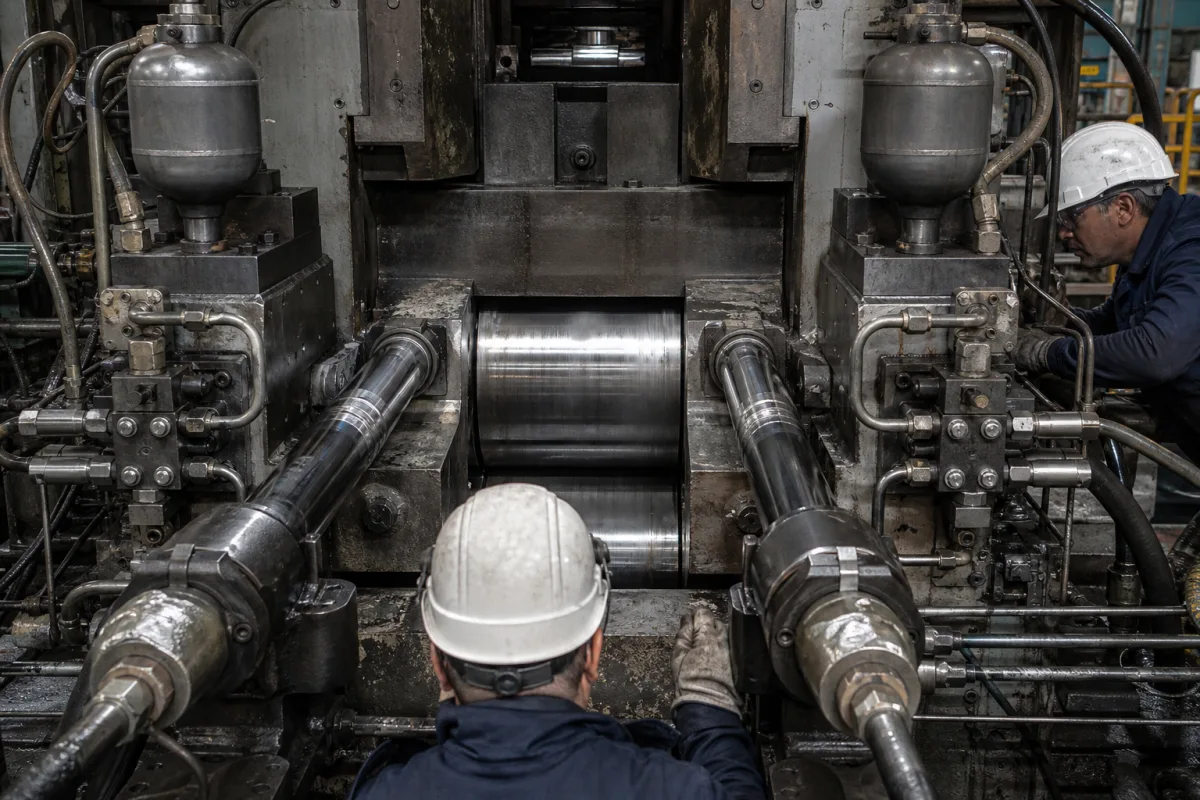
A hydraulic system that precisely controls the gap between work rolls in a rolling mill to achieve desired material thickness and quality.
Product Specifications

Technical details and manufacturing context for Hydraulic Gap Control

Definition
Hydraulic Gap Control is a critical subsystem within an Industrial Metal Rolling Mill that uses hydraulic pressure to dynamically adjust and maintain the precise distance between the work rolls during the metal rolling process. This system ensures consistent material thickness, improves product quality, reduces material waste, and enables rapid adjustments for different material grades and thickness specifications.
Working Principle
The system uses hydraulic cylinders connected to the roll chocks or mill housing to apply controlled force. A closed-loop control system monitors roll gap measurements (via position sensors or load cells) and compares them to setpoints. The hydraulic servo valves adjust oil flow to the cylinders, creating precise positioning forces that maintain the desired gap despite variations in material hardness, temperature, or mill deflection.
Common Materials
High-strength alloy steel, Hydraulic seals, Servo valves
Technical Parameters
  • Roll gap adjustment range and precision (mm) Standard Spec
Components / BOM
  • Hydraulic Cylinder
    Applies precise force to adjust roll position
    Material: High-strength alloy steel
  • Servo Valve
    Controls hydraulic oil flow for precise positioning
    Material: Stainless steel with precision components
  • Position Sensor
    Measures actual roll gap for feedback control
    Material: Stainless steel with electronic components
  • Control Unit
    Processes sensor data and controls hydraulic system
    Material: Electronic components in protective housing
Engineering Reasoning
15-300 bar hydraulic pressure, 0.01-0.5 mm gap control accuracy, 20-80°C operating temperature
Hydraulic pressure exceeds 350 bar causing seal rupture, gap deviation exceeds ±0.75 mm causing material quality failure, temperature exceeds 90°C causing fluid degradation
Design Rationale: Seal failure occurs at 350 bar due to elastomer tensile strength limit (35 MPa for HNBR), gap control failure at ±0.75 mm deviation due to material yield strength exceedance, thermal failure at 90°C due to hydraulic fluid viscosity dropping below 10 cSt causing loss of laminar flow
Risk Mitigation (FMEA)
Trigger Hydraulic fluid contamination exceeding ISO 4406 18/16/13 cleanliness level
Mode: Servo valve spool sticking causing 0.3-0.8 mm gap oscillation
Strategy: Install dual 3 μm absolute filtration with pressure differential monitoring and automatic bypass
Trigger Position transducer thermal drift exceeding 0.05% FS/°C specification
Mode: Gap control error accumulating to 0.4 mm over 8-hour production run
Strategy: Implement dual-redundant LVDT position feedback with temperature compensation algorithm using PT100 sensors

Industry Taxonomies & Aliases

Commonly used trade names and technical identifiers for Hydraulic Gap Control.

Applied To / Applications

This component is essential for the following industrial systems and equipment:

Industrial Ecosystem & Supply Chain DNA

Complementary Systems
Downstream Applications
Specialized Tooling

Application Fit & Sizing Matrix

Operational Limits
pressure: Up to 350 bar (max working pressure), 500 bar (peak transient)
flow rate: 10-500 L/min (typical), depends on cylinder size and response time
temperature: 0°C to 80°C (operating), -20°C to 100°C (storage)
response time: 20-100 ms (for gap adjustment)
positioning accuracy: ±0.001 mm (with feedback systems)
Media Compatibility
✓ Hydraulic oil (ISO VG 32-68) ✓ Water-glycol fluids (for fire resistance) ✓ Synthetic esters (high-temperature applications)
Unsuitable: High-concentration abrasive slurry environments without filtration
Sizing Data Required
  • Maximum rolling force (kN)
  • Required gap adjustment range (mm)
  • Mill speed and response time requirements (mm/s and ms)

Reliability & Engineering Risk Analysis

Failure Mode & Root Cause
Seal degradation and leakage
Cause: Contamination ingress (particles, water) causing abrasive wear, chemical incompatibility with hydraulic fluid, or excessive temperature leading to hardening/cracking of elastomers.
Valve spool sticking or sluggish response
Cause: Accumulation of fine particulate contamination (silting) in critical clearances, varnish formation from fluid breakdown/oxidation, or internal corrosion from moisture ingress.
Maintenance Indicators
  • Audible high-frequency whine or chatter from the servo valve, indicating cavitation, aeration, or sticking components.
  • Visible external hydraulic fluid leakage around seals, fittings, or valve body, especially if accompanied by a drop in system pressure or inconsistent gap control.
Engineering Tips
  • Implement strict fluid cleanliness control: use high-efficiency filtration (ISO 4406 class 16/14/11 or better), conduct regular fluid analysis for particle count, moisture, and oxidation, and ensure proper reservoir breathers.
  • Maintain stable fluid temperature: ensure cooling systems are functional, avoid prolonged operation near maximum temperature limits, and use fluids with appropriate viscosity index and thermal stability for the operating environment.

Compliance & Manufacturing Standards

Reference Standards
ISO 4401: Hydraulic fluid power - Four-port directional control valves - Mounting surfaces ANSI/B93.5M: Hydraulic Fluid Power - Cylinders - Bore and Rod Area DIN 24342: Hydraulic fluid power - Cylinders - Nominal pressures
Manufacturing Precision
  • Cylinder bore diameter: +/-0.02mm
  • Sealing surface flatness: 0.05mm
Quality Inspection
  • Pressure testing for leaks at 1.5x operating pressure
  • Dimensional verification with coordinate measuring machine (CMM)

Factories Producing Hydraulic Gap Control

Verified manufacturers with capability to produce this product in China

✓ 94% Supplier Capability Match Found

T Technical Director from United Arab Emirates Feb 19, 2026
★★★★★
"Impressive build quality. Especially the technical reliability is very stable during long-term operation."
Technical Specifications Verified
P Project Engineer from Australia Feb 16, 2026
★★★★☆
"As a professional in the Basic Metal Manufacturing sector, I confirm this Hydraulic Gap Control meets all ISO standards. (Delivery took slightly longer than expected, but technical support was excellent.)"
Technical Specifications Verified
S Sourcing Manager from Singapore Feb 13, 2026
★★★★★
"Standard OEM quality for Basic Metal Manufacturing applications. The Hydraulic Gap Control arrived with full certification."
Technical Specifications Verified
Verification Protocol

“Feedback is collected from verified sourcing managers during RFQ (Request for Quote) and factory evaluation processes on CNFX. These reports represent historical performance data and technical audit summaries from our B2B manufacturing network.”

18 sourcing managers are analyzing this specification now. Last inquiry for Hydraulic Gap Control from Poland (1h ago).

Supply Chain Compatible Machinery & Devices

Electromagnetic Induction Heater

Industrial heating device using electromagnetic induction for metal processing

Explore Specs →
Vacuum Induction Melting Furnace

Industrial furnace for melting metals under vacuum using electromagnetic induction

Explore Specs →
Electroslag Remelting Furnace

Secondary refining furnace for high-quality metal ingots

Explore Specs →
Molten Metal Flow Control Valve

Precision valve for regulating molten metal flow in casting and pouring operations.

Explore Specs →

Frequently Asked Questions

How does hydraulic gap control improve material quality in rolling mills?

Hydraulic gap control maintains precise, consistent spacing between work rolls through servo valves and position sensors, ensuring uniform material thickness, reducing defects, and improving surface finish in metal products.

What maintenance is required for hydraulic gap control systems?

Regular maintenance includes monitoring hydraulic seals for leaks, calibrating position sensors, checking servo valve performance, and inspecting high-strength alloy steel components for wear to ensure continuous precision operation.

Can hydraulic gap control systems be retrofitted to existing rolling mills?

Yes, hydraulic gap control systems can be integrated with existing rolling mills by installing hydraulic cylinders, servo valves, position sensors, and a control unit, often improving thickness accuracy without complete mill replacement.

Can I contact factories directly on CNFX?

CNFX is an open directory, not a transaction platform. Each factory profile provides direct contact information and production details to help you initiate direct inquiries with Chinese suppliers.

Get Quote for Hydraulic Gap Control

Request technical pricing, lead times, or customized specifications for Hydraulic Gap Control directly from verified manufacturing units.

Your business information is encrypted and only shared with verified Hydraulic Gap Control suppliers.

Thank you! Your message has been sent. We'll respond within 1–3 business days.

Need to Manufacture Hydraulic Gap Control?

Connect with verified factories specializing in this product category

Add Your Factory Contact Us
Previous Product
Hydraulic Forging Press
Next Product
Idlers/Rollers